
CNC High-Speed Processing: How It Works and When to Use It
High-speed processing is not simply a machine running faster. It is a change in how the cut removes material: small chip loads, high spindle rpm, and feed rates matched to the tool. This page explains the mechanism, the limits, and the part shapes where it pays off.
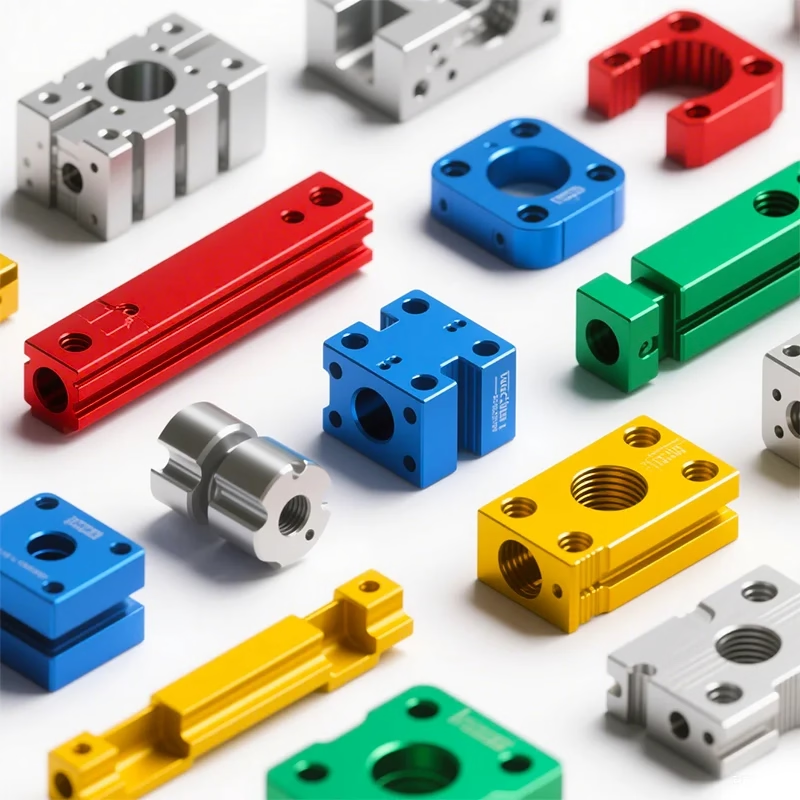
What Actually Changes in CNC High-Speed Processing
A high-speed setup keeps the cutting edge moving fast while taking a light load. A typical setup runs a Ø6 mm three-flute end mill at 24,000 rpm with a 0.05 mm chip per tooth. At that rate the tool advances over 3,600 mm/min, but each tooth only bites a sliver of material. The spindle does more work per minute; the cutting edge does less work per pass.
Heat leaves with the chip. That is the core of the idea. In conventional milling, most of the heat generated at the shear zone goes into the workpiece, the tool, and the fixture. When the chip is thin and the speed is high, the chip carries away a larger share before heat can soak into the part. The result is less thermal growth in the workpiece and a longer tool life.
Cutting forces drop as speed rises in many aluminum alloys. The specific cutting pressure falls once the chip thins below a certain point, so the tool pushes the part less even though the table moves faster. Fixture design gets easier. Thin ribs, tall walls, and small features no longer deflect the way they would under a heavy conventional cut.
The trade-off is stiffness on the machine side. A high-speed spindle needs a rigid frame, balanced toolholders, and a control that can look ahead hundreds of blocks. If the machine cannot accelerate to the programmed feed, the actual chip load rises and the tool rubs instead of cutting. That is the most common reason high-speed processing underperforms on paper.
- 1Small chip, high speedChip load typically 0.02–0.10 mm per tooth on aluminum.
- 2Heat to the chipLess thermal distortion in thin-wall and long parts.
- 3Lower cutting forceEasier workholding for ribs, fins, and small features.
- 4Look-ahead requiredControls must keep up, or chip load climbs and tools wear.
Spindle Speed, Tool Geometry, and Balance
The spindle sets the ceiling. Above roughly 20,000 rpm you are in high-speed territory for most job-shop work. Our 16 simultaneous 5-axis machining centers and mill-turn centers run tooling up to Ø400 mm rotary table capacity, with spindle speeds that support light-load strategies on aluminum, copper, and plastics. Steel and titanium run at lower rpm but still benefit from the same chip-thinning logic.
Tool geometry drives the result more than raw rpm. A high-speed end mill usually has three or four flutes, a variable helix, and a polished flute face to evacuate chips. The core diameter is thicker than a conventional cutter of the same size, which raises rigidity. A tool that is not balanced for the speed will vibrate, and vibration shows up as chatter marks on the finished surface.
Balance grade matters once you pass 15,000 rpm. An unbalanced holder at 24,000 rpm generates a centrifugal force that grows with the square of the speed. The symptom is a finish that looks fine on one side of the part and rough on the other. Shrink-fit and hydraulic holders hold concentricity better than a standard collet at these speeds.
Coolant strategy changes too. Through-spindle air blast clears chips on aluminum without the thermal shock of flood coolant. Some shops use minimum quantity lubrication for steel and titanium, where a fine oil mist reaches the cutting edge and the chip leaves before heat builds. Flood coolant still works, but it is not the default for every high-speed job.
- 1Variable helixBreaks up chatter harmonics at high rpm.
- 2Thicker coreMore rigidity than a general-purpose cutter.
- 3Shrink-fit holdersBetter concentricity above 15,000 rpm.
- 4Air or MQLClears chips with less thermal shock than flood.
Which Materials Suit This Approach
Aluminum is the natural fit. Grades 6061, 7075, 2024, and 6082 machine at high surface speed with low cutting pressure. A 7075 bracket with thin webs and a deep pocket is the shape that benefits most, because the light chipload keeps the web from springing. Finish can reach Ra 0.2–0.8 μm on a well-tuned setup, often without a separate polishing step.
Copper and brass behave similarly. C101 and C110 conduct heat away from the cut quickly, so tool life is long. Beryllium copper and C36000 need more care with dust and chip control, but the same small-chip strategy applies. Plastics such as POM, PEEK, and ABS cut cleanly at high rpm, though heat buildup can smear the surface if the feed is too low.
Stainless and steel are a different story. Grades 304, 316, and 17-4PH work-harden if the tool rubs. High-speed processing helps here only when the feed is high enough to stay under the hardened layer on every pass. A 0.05 mm chip per tooth at 12,000 rpm on 17-4PH is workable; a 0.01 mm chip at the same speed is not, because the edge dwells and the surface hardens.
Titanium and Inconel push back hardest. TC4 (Ti-6Al-4V) and Inconel generate high cutting temperatures and low thermal conductivity. High-speed strategies still apply, but at lower surface speeds and with more attention to coolant delivery. The payoff is less tool deflection on thin walls, not a dramatic cycle-time cut.
- 1Best fitAluminum 6061, 7075, 2024, 6082; copper C101, C110.
- 2Workable with careStainless 304, 316, 17-4PH; steel 4140, 4340.
- 3Lower surface speedTitanium TC4 and Inconel need cooler, slower passes.
- 4PlasticsPOM, PEEK, ABS cut cleanly with high feed and air blast.
Limits, Failure Modes, and When Not to Use It
High-speed processing is not the right answer for every part. If the job is a 200 mm steel block with simple pockets and a generous tolerance, a conventional three-axis machine removes the stock faster and cheaper. The light chipload that protects thin walls also means more passes over the same area, and on a thick part that is wasted cycle time.
Chatter is the most common failure. It starts when the tool or the workpiece has a natural frequency that matches the tooth-passing frequency. The fix is not always more speed. Sometimes a different flute count, a shorter gauge length, or a change in radial engagement breaks the resonance. Ignoring it burns tools and leaves a finish that fails inspection.
Tool wear shows up differently at high rpm. Instead of a worn flank, you often see chipping at the cutting edge from thermal cycling. The edge heats and cools with every entry into the cut. A coating such as AlTiN or a polished uncoated carbide helps on aluminum, but the real control is keeping the chip load steady so the edge does not rub.
Machine condition sets the practical ceiling. A spindle with 5 μm of runout will not hold ±0.005 mm no matter how good the program is. Thermal growth in the ball screws, worn linear guides, and an unbalanced tool all add error. High-speed work rewards machines that are tight, and it exposes machines that are not.
- 1Skip it forThick steel stock with simple geometry and loose tolerance.
- 2Watch for chatterMatch flute count and gauge length to the part.
- 3Edge chippingThermal cycling, not flank wear, is the usual failure.
- 4Machine runoutAbove 5 μm, tight tolerances are not reachable.
How We Set Up and Verify the Cut
We start with a DFM review inside 12 hours of receiving a model. The review checks wall thickness, corner radii, tool reach, and whether the part has features that would be better cut on a 5-axis machine in one setup. Fewer setups mean fewer datum shifts and tighter positional accuracy.
Programming uses smooth, arc-filtered toolpaths with a constant chip load. We avoid sharp direction changes that force the machine to decelerate, because a dip in feed turns into a rise in chip load. The control look-ahead is set high enough that the programmed feed is the actual feed through corners.
First-article inspection confirms the setup before the run continues. We check raw material, in-process dimensions, and final geometry. Tolerances hold to ±0.005 mm (±0.0002 in) on parts that need it, and finish is verified against the drawing. Reports are available on request.
We machine from one prototype to 10,000+ part runs with no minimum order quantity. Materials on hand include 6061-T6, 7075, 304, 316L, 17-4PH, TC4, and PEEK, plus finishes such as anodizing, electroless nickel, bead blasting, and laser marking. Every upload stays confidential, and an NDA is available on request.
- 1DFM in 12 hoursWall thickness, radii, and tool reach checked up front.
- 2Constant chip loadArc-filtered toolpaths keep feed steady through corners.
- 3100% inspectionRaw material, in-process, and final checks before shipment.
- 4No minimum orderOne prototype or a 10,000-part run, same process control.
High-Speed vs Conventional Milling: When Each Wins
Use this table to judge whether a part belongs on a high-speed spindle or a conventional one.
| Factor | High-speed processing | Conventional milling |
|---|---|---|
| Spindle speed | 20,000–40,000 rpm typical | 4,000–12,000 rpm typical |
| Chip load | 0.02–0.10 mm per tooth | 0.10–0.30 mm per tooth |
| Cutting force | Low; thin walls stay stable | Higher; needs stout fixtures |
| Heat path | Most heat leaves with the chip | More heat into part and tool |
| Best part shapes | Thin ribs, deep pockets, small features | Heavy stock removal, simple geometry |
| Tooling cost | Higher; balanced holders required | Lower; standard holders work |
| Programming | Needs look-ahead and smooth toolpaths | Forgiving of simple toolpaths |
| Finish as cut | Ra 0.2–1.6 μm on aluminum | Ra 1.6–3.2 μm typical |
The Verdict
If the part has thin walls, deep pockets, or features under 2 mm, high-speed processing on a 5-axis machine will hold tolerance and finish better than a conventional cut. If the part is thick, simple, and loose on tolerance, run it conventionally and save the cycle time.
Questions Engineers Ask
What spindle speed counts as high-speed processing?
There is no fixed threshold, but most shops treat 20,000 rpm and above as high-speed territory for aluminum and plastics. Steel and titanium run lower, often 8,000–15,000 rpm, because the cutting temperature climbs fast.
The number that matters more is chip load. If the chip per tooth is small and the surface speed is high, the cut behaves like high-speed processing even at a moderate rpm.
Can high-speed processing hold ±0.005 mm?
Yes, on a machine that is tight and with the right tooling. We hold ±0.005 mm (±0.0002 in) on parts that require it, with 100% inspection before shipment.
The limit is usually the machine, not the strategy. Spindle runout above 5 μm, worn guides, or thermal growth in the ball screws will eat the tolerance before the cutting parameters do.
Does it work on stainless steel and titanium?
It works, but at lower surface speeds and with a feed high enough to stay under the work-hardened layer on every pass. A very light chip on 304 or 17-4PH rubs the edge and hardens the surface.
On TC4 and Inconel, the benefit is less tool deflection on thin features rather than a large cycle-time reduction.
Why do tools chip instead of wearing evenly?
Thermal cycling. The cutting edge heats on entry and cools on exit thousands of times per minute. At high rpm that cycle is fast enough to fatigue the edge and cause micro-chipping.
Keeping the chip load steady, using a suitable coating, and avoiding dwell in the cut all extend edge life.
What file formats do you need for a quote?
STEP and IGES are preferred for 3D geometry. 2D PDF drawings help when the part has tolerances, datums, or callouts that the model does not carry.
Uploads are secure and confidential. We return a quotation and DFM analysis within 12 hours, and production can start within 24 hours of approval.
Is there a minimum order quantity?
No. We run from one prototype to 10,000+ part runs on the same process controls.
Typical delivery is 3–5 days after production starts, and our historical late-delivery probability is below 2%.
Send Us the Part and We Will Tell You If It Fits
Upload a STEP file and we will return a quotation and DFM analysis within 12 hours, with a clear answer on whether high-speed processing is the right route for your geometry.
12-hour quote100% inspectionNo minimum order
More Machining Notes
We publish setup notes, tooling trials and inspection data from the factory floor.











