
High-speed CNC Machining OC: How It Actually Cuts Metal
A working explanation of high-speed CNC machining for engineers who need to judge whether a part suits it. We cover spindle speed ranges, chip thinning, heat paths, and the geometry that makes or breaks the process.
In this article
- 1
- 2
- 3
- 4
- 5
- 6
- 7
What high-speed CNC machining OC really means
High-speed CNC machining OC is not a single machine setting. It is a cutting strategy where a small-diameter tool runs at high rpm and high feed per tooth, taking shallow radial cuts at deep axial depth. The goal is to remove material with a controlled chip load instead of forcing a large tool through the part.
The rpm range depends on material and tool diameter. Aluminum on a 12 mm end mill may run 18,000–24,000 rpm. Titanium and Inconel run slower, often 3,000–8,000 rpm, because the tool edge cannot survive the same surface speed. In every case the feed per tooth stays in a narrow window, usually 0.02–0.10 mm for finishing passes.
The payoff is lower cutting force, not just faster cycle time. When the chip is thin and the heat leaves with it, the part stays cooler, the wall does not spring back, and the finish holds. That is why high-speed machining often improves accuracy even before it improves speed.
- 1Spindle speed10,000–50,000 rpm depending on tool and material
- 2Radial engagement5–10% of tool diameter on finishing passes
- 3Feed per tooth0.02–0.10 mm, adjusted by chip thinning
- 4Heat pathMost heat leaves in the chip, not the workpiece
Chip thinning and cutting force in high-speed milling
When the radial depth of cut drops below half the tool diameter, the chip becomes thinner than the feed per tooth suggests. This is chip thinning. If you keep the same feed per tooth, the actual chip load falls and the tool rubs instead of cutting. Rubbing generates heat, work-hardens stainless and titanium, and shortens tool life.
The fix is to raise the feed per tooth so the chip thickness stays in the target range. A 10 mm carbide end mill at 6% radial engagement may need 0.08 mm per tooth instead of 0.04 mm. The machine must be able to accelerate fast enough to hold that feed through corners, or the chip load collapses again on entry.
This is where machine dynamics matter more than raw rpm. A high-speed spindle on a light frame will chatter at 20,000 rpm. A heavier 5-axis center with a Ø400 mm rotary table can hold the same rpm with less vibration. The operator reads the sound and the chip color, then trims the feed override.
- 1Thin chipBelow 50% radial engagement, raise feed per tooth
- 2RubbingToo-thin chips cause heat and work hardening
- 3AccelerationCorners drop feed and chip load without look-ahead
Tool path strategy: trochoidal, ramp, and constant engagement
High-speed tool paths keep the cutter engaged at a constant angle. Trochoidal milling uses a circular loop that limits the radial bite and lets the tool cool between passes. Ramping enters the material at a shallow angle instead of plunging straight down. Both reduce shock load on the edge and keep the chip load steady.
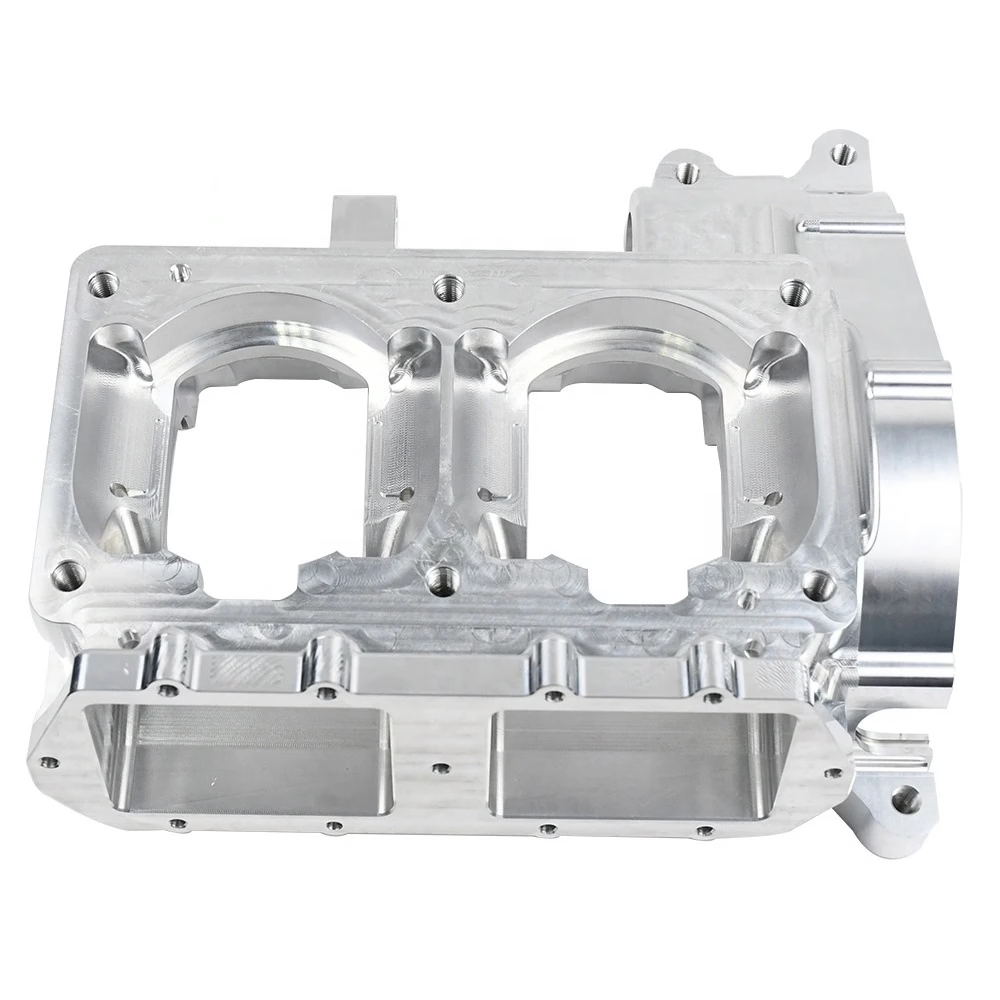
On a 5-axis machine, the tool axis can tilt so the cutter engages the part with the side of the flute rather than the tip. This spreads wear and gives better access to deep pockets and undercut features. A part with a 150 mm deep cavity and a 5 mm corner radius is a good candidate; a flat plate with through holes is not.
Look-ahead control is not optional. The controller must slow the feed before a corner, not after. Without it, the tool overshoots the target chip load, and you see chipping on the entry edge. Programs with 2,000–5,000 blocks per minute of cut are common in high-speed work.
- 1TrochoidalConstant radial bite, good for deep slots
- 2Ramp entry2–5° entry angle, avoids plunge shock
- 3Tilted tool axisUses flute side, spreads wear on 5-axis
Thermal control and surface finish in high-speed CNC
Heat in high-speed machining goes two places: the chip and the tool. The chip carries most of it away when the speed and feed are right. If the chip turns blue or purple on steel, the surface speed is too high or the feed is too low. If the chip is silver and curls tight, the cut is running in the right window.
The workpiece absorbs heat when the tool rubs. That heat expands the part and the machine, and the error shows up after cooling. For a ±0.005 mm tolerance on a 300 mm aluminum frame, we run roughing passes, let the part rest, then finish with coolant through the spindle. This is not a speed trick; it is thermal management.
Surface finish tracks the same variables. A light finishing pass at 0.02 mm per tooth with a sharp corner radius can reach Ra 0.2–0.8 μm on aluminum. The same parameters on titanium may only reach Ra 0.8–1.6 μm because the material tears instead of shearing. Finish is a material property as much as a machining one.
- 1Chip colorSilver and curled means the cut is running cool
- 2CoolantThrough-spindle coolant controls thermal drift
- 3Rest between passesLets the part and machine stabilize before finishing
Which materials suit high-speed machining, and which do not
Aluminum alloys are the natural fit. 6061-T6, 7075, and 6082 cut cleanly at 18,000–24,000 rpm with uncoated or DLC-coated carbide. They carry heat away fast, so the tool lasts. Thin walls down to 0.5 mm are practical when the tool path keeps the load steady.
Stainless 17-4PH and 316L run at lower surface speed, often 6,000–10,000 rpm. The material work-hardens if the tool rubs, so chip thinning control matters more than rpm. Titanium Ti-6Al-4V and Inconel run slower still, 3,000–8,000 rpm, with high-pressure coolant and sharp edges. These are not high-speed in the rpm sense; they are high-speed in the constant-engagement sense.
Plastics like POM and PEEK cut at high rpm but need sharp tools and strong chip evacuation. The risk is melting, not tool wear. Copper and brass run fast and leave a good finish, but they are gummy and need a positive rake geometry. There is no single speed chart that covers all of them.
- 1Aluminum18,000–24,000 rpm, best all-round fit
- 2Stainless and titaniumLower rpm, constant engagement, high-pressure coolant
- 3PlasticsHigh rpm, sharp edges, avoid melting
When high-speed CNC machining is the wrong choice
High-speed machining does not help a part with a few large holes and flat faces. A 50 mm face mill on a 3-axis machine removes that material faster and cheaper. High-speed strategies shine on thin walls, deep pockets, small corner radii, and complex 3D contours where tool load and heat are the limiting factors.
It also does not fix a bad setup. If the fixture lets the part vibrate, higher rpm makes the chatter worse. A rigid tombstone or a properly supported 5-axis fixture is a precondition, not an upgrade. We have turned down high-speed jobs where the geometry was too flimsy to hold.
Finally, high-speed tool paths generate long programs. A single complex surface may need 500,000 blocks. This is fine on a modern controller with look-ahead, but it is slow to prove out. For one-off parts with simple geometry, the programming time can exceed the cycle time saved.
- 1Simple flat partsA large face mill on 3-axis is faster
- 2Flexible setupsChatter grows with rpm, not shrinks
- 3Long programsProving time can eat the cycle-time gain
High-speed vs conventional machining: when to pick which
Use this table to match the part geometry to the process, not to a machine spec sheet.
| Part feature | High-speed CNC | Conventional CNC | Why |
|---|---|---|---|
| Thin wall under 1 mm | Suitable | Risky | Low radial load keeps the wall from springing |
| Deep pocket, small corner | Suitable | Slow | Long reach tools need light load and high rpm |
| Flat plate, large holes | Overkill | Suitable | Face mill removes material faster |
| Complex 3D contour | Suitable | Difficult | 5-axis tilt and constant engagement |
| One-off simple bracket | Overkill | Suitable | Programming time exceeds cycle saving |
| Hardened tool steel | Conditional | Conditional | Depends on hardness and cutter grade |
| Large weldment | Not ideal | Suitable | Vibration and residual stress dominate |
The bottom line
Choose high-speed CNC machining when the part has thin walls, deep pockets, or tight 3D contours and the setup is rigid. Choose conventional 3-axis milling when the geometry is simple and flat. The material and the fixture decide more than the spindle spec.
Questions engineers ask about high-speed CNC
Does high-speed machining always mean higher rpm?
No. For aluminum, rpm often runs 18,000–24,000. For titanium and Inconel, the same strategy runs at 3,000–8,000 rpm because the tool edge cannot take higher surface speed.
High-speed refers to the constant-engagement tool path and controlled chip load, not a single rpm number.
Can high-speed CNC hold ±0.005 mm on a thin part?
Yes, when the radial load is low and the part is supported. Aluminum frames with 0.5 mm walls are common in our 5-axis work at that tolerance.
The risk is thermal drift, not cutting force. We rough, rest, then finish with through-spindle coolant and inspect before shipment.
What tool coatings work best for high-speed aluminum?
Uncoated polished carbide and DLC coatings work well. They resist built-up edge and keep the chip flowing.
Avoid thick TiAlN on aluminum; it can drag and smear the surface.
How long do high-speed tool paths take to program?
A complex 3D surface can need 500,000 blocks. CAM time may run several hours, and proving the first part adds more.
For simple geometry, conventional programming is faster. We quote the programming time honestly rather than hide it in the cycle time.
Does high-speed machining cost more per part?
The machine rate is higher, but cycle time and setup time drop. On complex parts the cost per part usually falls.
On simple flat parts, the higher rate is not recovered. We tell you which case your part is in before you commit.
Can you run high-speed machining on a 3-axis machine?
Yes, for parts with open access. Trochoidal and ramp strategies work on 3-axis machines.
The limitation is undercut features and deep cavities, where a tilted 5-axis tool axis is the only way to reach the surface with the side of the cutter.
Send the part, get a process judgment
Upload a STEP file and we will tell you whether high-speed CNC is the right process, what material and tool path we would use, and where the risk sits.
12-hour quote and DFMNo minimum order quantityNDA on request
More process notes
We publish setup notes, tooling trials and inspection data from the factory floor.











