
CNC Machine Service Engineer Jobs: How to Vet Service Coverage
This guide is for engineers and sourcing teams comparing CNC machine service engineer jobs, whether you hire in-house or contract a supplier. Read it to judge service scope, machine access, and uptime support before you commit.
In this article
- 1
- 2
- 3
- 4
- 5
- 6
- 7
- 8
Key takeaways
In-house engineer vs contracted service team
Use this table to decide which coverage model fits your shop.
| Factor | In-house engineer | Contracted service team |
|---|---|---|
| Coverage | One or two machines, fixed shift | Many machines, scheduled visits |
| Best for | High-utilization cells, one brand | Mixed fleets, several control brands |
| Response | Immediate, on payroll | Depends on contract window |
| Spindle work | Needs in-house tooling and training | Usually brings alignment tooling |
| Cost shape | , }}Fixed salary plus training | Call-out rate plus parts |
| Process support | Can tune programs daily | Limited to service visits |
| Knowledge risk | Leaves with the person | Stays with the vendor |
What the CNC machine service engineer job actually covers
The title covers a wide range. In some shops, CNC machine service engineer jobs mean preventive maintenance on a fixed schedule. In others, the same title means breakdown repair at 2 a.m. and process troubleshooting during the day. Before you compare candidates or vendors, split the work into three buckets: scheduled maintenance, unplanned repair, and process support. A person strong in one bucket is often weak in another.
Scheduled maintenance includes backlash checks on each axis, way lubrication, spindle taper cleaning, coolant system flush, and level checks. It also includes verifying tool-change repeatability and checking the ATC arm position. These tasks need a documented interval and a sign-off sheet, not a verbal promise.
Unplanned repair covers spindle replacement, servo drive faults, ball screw replacement, and control alarms that stop production. This work depends on spare parts and on how fast the engineer can read the alarm history. Response time matters more than hourly rate here.
Process support is different again. It means helping with fixture setup, first-article inspection, and cutting parameters when a new part runs out of tolerance. A service engineer who can read a CMM report and adjust a program is more valuable than one who only swaps parts.
- 1MaintenancePlanned intervals, documented sign-off, wear trends
- 2RepairAlarm diagnosis, spindle and axis work, parts logistics
- 3Process supportFixture setup, parameter tuning, first-article checks
Match the engineer to your machine types
A service engineer who spends all day on 3-axis vertical mills will struggle with a 5-axis trunnion machine. The kinematics, the rotary table alignment, and the post-processor behavior are different skill sets. When you review CNC machine service engineer jobs, list your machine mix first: how many 3-axis, 4-axis, 5-axis, and mill-turn centers you run.
For 5-axis work, ask about rotary table alignment and how they verify center of rotation. A common method uses a test sphere and a probe cycle, then checks the result against the machine model. If the candidate cannot describe a center-of-rotation check, that is a gap.
For mill-turn centers, ask about turret alignment, subspindle synchronization, and bar feeder setup. These are the failure points that stop a lights-out run. An engineer who has never synchronized a subspindle will need training time you may not have budgeted.
Size also matters. Large gantry work with travels around 4,000 mm needs different handling than a compact 500 mm machine. Thermal growth over a long bed is a real variable, and the engineer should know how to compensate for it during a long cut.
- 15-axisCenter-of-rotation check, trunnion alignment, post-processor
- 2Mill-turnTurret alignment, subspindle sync, bar feeder
- 3Large gantryThermal growth, long-bed leveling, rail parallelism
Five checks before you sign a service contract
First, ask for the machine list they have actually serviced in the past year, grouped by control brand. A vendor who lists Fanuc, Siemens, and Mitsubishi controls is more useful to a mixed shop than one who only knows a single brand.
Second, ask what measurement tools they bring. A service engineer who arrives without a dial indicator, granite square, or ballbar cannot verify geometry after a repair. Tooling tells you more than a resume.
Third, ask how they handle spare parts. Spindle cartridges, servo drives, and ball screws are long-lead items. A service team with a parts agreement or local stock will cut downtime more than a lower hourly rate will.
Fourth, ask for the escalation path when a fault returns. A repair that fails after two weeks should come back under the same call, not as a new charge. Get that in writing.
Fifth, ask about documentation. Every visit should end with a report showing what was measured, what was replaced, and what the next interval should be. Without that record, you cannot spot a machine that is drifting.
- 1Control coverageAsk for the serviced machine list by brand
- 2ToolingDial indicator, granite square, ballbar
- 3Parts chainLocal stock or a stated lead time
- 4DocumentationMeasurements, replacements, next interval
What to look for in a machining supplier's service team
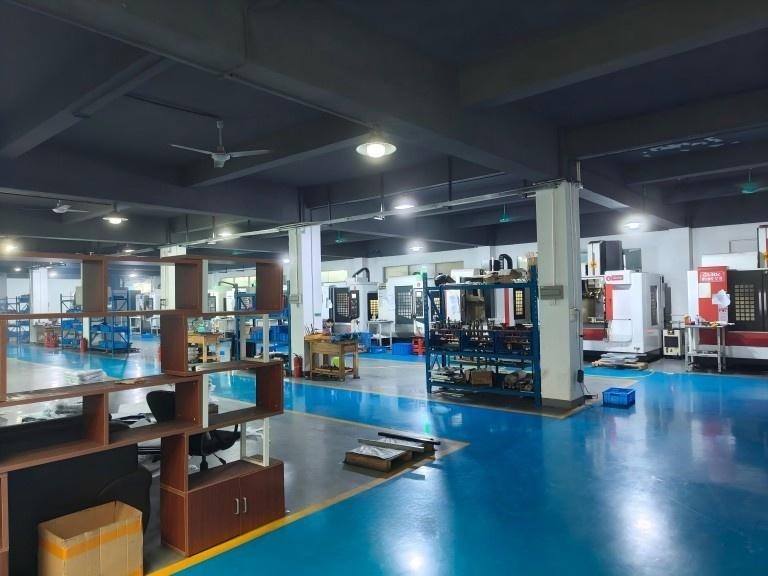
If you outsource parts and also rely on the supplier for process support, check the service side of that supplier. A shop running 16 simultaneous 5-axis centers and 16 mill-turn centers has to keep its own engineers on staff. That capability usually shows up in how fast they answer a tolerance question.
Ask how the supplier handles a drift problem on your part. A good answer names the measurement step: raw material check, in-process monitoring, and final inspection reports on request. A weak answer promises to try harder.
Certifications are a useful filter here. ISO 9001:2015, IATF 16949:2016, ISO 13485:2016, and ISO 27001:2022 tell you the shop has documented processes and controlled records. That is the same discipline a service engineer needs to keep maintenance logs useful.
Also check machine capability against your part. If your part needs ±0.005 mm and a fine finish of Ra 0.2–0.8 μm, the service team must be able to hold geometry on the machines that cut it. Capability and maintenance are the same conversation.
- 1Own engineersA shop with 16 five-axis centers keeps service in-house
- 2Measurement stepsRaw material, in-process, final inspection
- 3CertificationsISO 9001, IATF 16949, ISO 13485, ISO 27001
Common traps when comparing service offers
The first trap is comparing hourly rates only. Two vendors may quote the same rate, but one bills travel time and the other does not. One brings parts and the other waits on yours. Rate alone tells you little.
The second trap is a vague response window. 'Same day' can mean a phone call at 8 a.m. and a visit at 6 p.m. Write the window as hours to on-site arrival, and separate remote diagnosis from physical repair.
The third trap is missing machine records. If the vendor has no history of your machine model, the first visit becomes a learning visit. That is acceptable for a low-utilization machine and expensive for a bottleneck cell.
The fourth trap is ignoring the parts chain. A spindle that takes weeks to arrive makes the fastest engineer irrelevant. Ask for stated lead times on the three parts most likely to fail on your machines.
The fifth trap is no handover document. If the shift supervisor cannot see what changed, the next fault starts from zero. A one-page report per visit fixes this.
- 1Rate-only comparisonTravel time and parts change the real cost
- 2Vague response windowWrite hours to on-site arrival
- 3No machine historyFirst visit becomes a learning visit
- 4Weak parts chainAsk lead times on the top three failure parts
How to run a service coverage review in six steps
Follow this sequence before renewing or signing a service agreement.
- 1List your machines by type and controlCount 3-axis, 4-axis, 5-axis, and mill-turn units, then note the control brand on each. This list defines the skill set you are buying.
- 2Separate the three service bucketsWrite maintenance, repair, and process support as separate line items with separate expectations. Do not let one price cover all three.
- 3Set a response window in hoursState hours to remote diagnosis and hours to on-site arrival. For a bottleneck machine, keep the on-site window tight.
- 4Request the parts list and lead timesAsk for stated lead times on spindle cartridges, servo drives, and ball screws for your models. Compare those numbers, not just rates.
- 5Require a one-page visit reportThe report should show measurements taken, parts replaced, and the next planned interval. Keep the reports in one folder.
- 6Review the data every quarterTrack repeat faults and mean time between failures per machine. A machine with three repeat faults in a quarter needs a root-cause review, not another call-out.
Frequently asked questions
What qualifications should a CNC machine service engineer have?
Look for hands-on experience with the control brands you run, plus documented training on spindle and axis alignment. Certifications in CNC programming or machining help, but the machine list they have actually serviced matters more.
Ask how they verify geometry after a repair. A dial indicator, granite square, or ballbar check is a practical sign of a real alignment process.
How many machines can one service engineer cover?
It depends on the failure rate and the travel distance, not on a fixed number. A shop with stable machines and a documented maintenance schedule can cover more units per engineer than a shop fighting repeat faults.
Set the ratio after one quarter of data. Track visits per machine per month and adjust from there.
Should we hire in-house or contract the service work?
In-house works when you run a small number of high-utilization machines of one brand. Contracted coverage works better for mixed fleets and several control brands, because the vendor spreads training across many machines.
Many shops use both: in-house engineers for daily process support and a contracted team for spindle and control work.
What does a service visit report need to include?
Measurements taken before and after the work, parts replaced with part numbers, and the next planned interval. Alarm history is useful too, because repeat codes point to a root cause.
Keep the reports together so you can compare a machine against its own history instead of guessing.
How do we judge process support separately from repair?
Repair restores the machine to its previous state. Process support changes the setup or program so the part meets tolerance. Judge process support by whether first-article inspection passes after the change.
Ask the engineer to explain what parameter or fixture change caused the improvement. If they cannot explain it, the fix may not hold.
Does a machining supplier's own service team help with outsourced parts?
Yes, when you hit a tolerance problem on a supplied part. A supplier running its own 5-axis and mill-turn capacity can check the setup and the inspection data instead of only reworking the part.
Ask for inspection reports on request and confirm the shop holds ISO 9001:2015 and, where relevant, IATF 16949:2016 or ISO 13485:2016.
Get a quote and a DFM review within 12 hours
Send your drawings and machine requirements. Our engineers review feasibility and tolerances, and you get a quotation with free DFM analysis within 12 hours.
12-hour quote100% inspectionNo MOQNDA on request
More from GreatLight
We publish setup notes, tooling trials and inspection data from the factory floor.











