
CNC Machine Service Houston: 7 Proven Checks Before You Send an RFQ
This guide is for engineers and sourcing managers in the Houston area comparing a cnc machine service houston suppliers list. It covers the seven checks that actually change part quality, lead time, and total cost, so you can shortlist a shop in one pass instead of three rounds of emails.
In this article
- 1
- 2
- 3
- 4
- 5
- 6
- 7
Key takeaways
Seven checks for a cnc machine service houston supplier
Use the target column to score each shop you contact.
| Check | What to ask | Target for Houston work |
|---|---|---|
| Tolerance | Held across a full run, not one part | ±0.005 mm, report on request |
| Quote turnaround | Time to quote plus DFM feedback | Quotation and DFM within 12 hours |
| Production start | Days from PO to chips cutting | Production start within 24 hours |
| Delivery | Typical ship window for machined parts | Parts ship in 3–5 days |
| MOQ | Smallest order the shop will take | No minimum, one part upward |
| Certifications | Which standards the QMS is audited to | ISO 9001, IATF 16949, ISO 13485, ISO 27001 |
| Inspection | What is checked and what you receive | 100% inspection, reports on request |
The shortlist test
If a shop cannot state its tolerance, quote in a day, and sign an NDA, it is not ready for Houston aerospace, medical, or energy work. Score every supplier against the seven checks and drop any that misses two.
Tolerance and machine mix on a cnc machine service houston floor
A cnc machine service houston buyer should start with tolerance, because it drives everything downstream: tooling, fixturing, inspection time, and price. Ask the shop what it holds across a full run of your part, not what one machine can do on a single good cycle. A shop that says ±0.005 mm and can show inspection records is giving you a number you can design around. A shop that quotes ±0.05 mm without asking about your drawing is guessing.
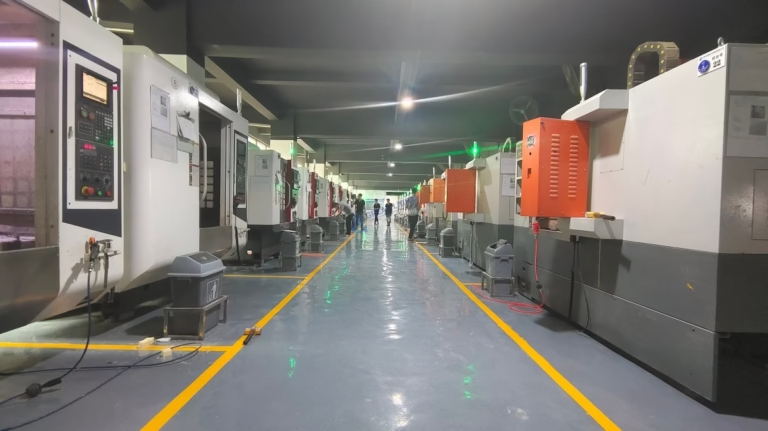
Machine mix matters as much as the tolerance claim. A shop with 127 high-precision CNC machines can route your part to the right spindle instead of forcing it onto whatever is free. For Houston work, the useful split is 16 simultaneous 5-axis machining centers, 12 four-axis mills, 27 three-axis machines, and 16 mill-turn centers. Five-axis handles contoured aerospace brackets and impellers. Mill-turn handles shaft-type parts that would otherwise need two setups.
Size limits decide whether a shop can even quote. GreatLight machines up to 4,000 mm, with travels of 4,000 × 400 × 150 mm and 750 × 1,150 × 550 mm on the larger frames. Compact work runs on 500 × 500 × 450 mm and 500 × 310 × 200 mm machines. A Ø400 mm rotary table covers round parts. If your part is 1,800 mm long, a shop with only 600 mm travels will either decline or farm it out.
- 1Ask for the tolerance on a specific featureA bore diameter and a flatness callout are different capabilities.
- 2Check the largest travel before you send a modelOversized parts are the most common reason an RFQ stalls.
- 3Confirm five-axis is simultaneous, not indexedIndexed 3+2 cannot cut a true contoured surface in one pass.
Lead time, MOQ, and what the quote actually covers
Lead time is where quotes quietly differ. A fast quote that hides a four-week queue costs more than a slower quote from a shop that starts cutting in 24 hours. Ask two separate questions: how long to quote, and how long to first chips. A shop that returns a quotation and DFM analysis within 12 hours is usually set up to release work quickly. Delivery of machined parts in 3–5 days is a normal window for a well-loaded floor.
MOQ is a signal about how the shop is organized. No minimum order quantity means the shop runs one prototype and a 10,000-part run on the same floor without a separate setup charge. That matters for Houston teams doing a pilot build before a full release. If a shop insists on a 500-piece minimum, prototyping will be slow and expensive, and design changes will cost you tooling each time.
Read the quote line by line. Does it include material certification, first-article inspection, and finishing, or are those added later? Surface finish is the usual gap: as-machined at Ra 1.6–3.2 μm, high finish at Ra 0.8–1.6 μm, and fine finish at Ra 0.2–0.8 μm. If your drawing calls for a sealing surface at Ra 0.4 μm, that is a separate operation and should appear as a line item, not a surprise.
- 1Separate quote time from production timeThey are different processes with different bottlenecks.
- 2Ask what a 10-piece and a 5,000-piece order costThe gap shows how much setup dominates the price.
- 3Pin the finish callout in the quoteRa values change cycle time and tool wear.
Certifications that matter for Houston industries
Houston is an aerospace, oil and gas, medical, and automotive town, and each sector audits suppliers differently. ISO 9001:2015 is the baseline quality management system. IATF 16949:2016 is what automotive and EV programs expect, and it covers traceability and change control. ISO 13485:2016 applies to medical devices and is needed if your part touches a patient or a diagnostic instrument. ISO 27001:2022 covers information security, which matters when you upload proprietary CAD files.
Certification is not the same as capability. A shop can hold ISO 9001 and still have no experience with Inconel or 17-4PH. Ask which materials the shop runs regularly: aluminum 6061, 7075, and ADC12; stainless 303, 316L, and 17-4PH; steel 4130, 4140, and 4340; titanium TC4 and Inconel; and plastics from POM to PEEK and carbon fiber. The material list tells you more about fit than the certificate wall.
For medical and aerospace work, ask how inspection is documented. GreatLight inspects 100% of parts before shipment, with raw material checks, in-process monitoring, and a final inspection, and can supply reports on request. A qualification rate of 99.99% is only useful if you can see the inspection method behind it. Ask whether CMM reports, material certs, and first-article reports are included or billed separately.
- 1Match the certificate to your sectorIATF for auto, ISO 13485 for medical, ISO 27001 for IP handling.
- 2Ask for the material list, not the brochureRegularly run alloys matter more than a long catalog.
- 3Request a sample inspection reportIt shows the format and the level of detail you will get.
Finishing, secondary work, and confidentiality
Most Houston parts are not finished when they come off the machine. Anodizing, plating, powder coating, and laser marking are common secondary steps, and coordinating them across three vendors adds days and creates finger-pointing when a finish fails. A shop that runs surface finishing in-house or under one roof keeps the schedule in one place. Anodizing in clear, color, hardcoat, and conductive versions covers most aluminum work. Electroless nickel, zinc, silver, and gold plating cover the rest.
Laser marking has a practical limit worth knowing before you design a serial number scheme. Minimum character height is 1.5 mm. Anything smaller will not mark cleanly, and a shop that accepts a 0.5 mm text callout is setting up a reject. Bead blasting, tumbling, brushing, and polishing are cosmetic options that also change the surface finish reading, so if your drawing already specifies Ra 0.8 μm, confirm the two requirements do not conflict.
Confidentiality is the last check and often the one that stalls a project. Uploads should be secure and confidential, and an NDA should be available on request for defense, medical, and energy work. If a shop cannot sign an NDA before you send models, move on. That is a process signal, not a legal formality.
- 1Keep secondary operations with one vendorFewer handoffs means fewer schedule breaks and clearer accountability.
- 2Respect the 1.5 mm minimum for laser marksSmaller text will not mark cleanly.
- 3Get the NDA signed before you uploadSecure uploads and a signed NDA are the baseline for proprietary CAD.
Step by step: evaluating a cnc machine service houston supplier
Run these seven steps in order. Each one filters out a different failure mode.
- 1Pull the drawing tolerances firstList your tightest feature and its callout. If the shop quotes ±0.005 mm, ask which feature that applies to and how it is verified.
- 2Send one RFQ and time the responseTrack hours to quotation and whether DFM notes come back. Under 12 hours with real DFM feedback is a strong signal.
- 3Ask for first-chip and ship windows separatelyProduction start within 24 hours and parts shipped in 3–5 days are normal for a well-loaded shop. If the answer is vague, ask for a recent schedule.
- 4Test the minimum order policyRequest pricing for 1, 50, and 5,000 pieces. A shop with no minimum order quantity will quote all three without a setup penalty.
- 5Match certifications to your sectorConfirm ISO 9001 plus the one your industry audits against. Ask when the last audit was and what the findings were.
- 6Confirm finishing and marking in-houseName your finish and Ra callout, then ask whether it is done on site. Check the 1.5 mm minimum for laser marks.
- 7Sign the NDA before uploading CADDo this before sending native files. Secure uploads and an NDA on request are the baseline.
Frequently asked questions
What tolerance should I expect from a cnc machine service houston supplier?
A capable shop holds ±0.005 mm (±0.0002 in) on critical features and states that number before you ask. The number only means something when it comes with an inspection method: CMM, gauge, or optical, and a report format you can read.
If a shop quotes looser than your drawing, ask which feature drives the limit. Sometimes the answer is fixturing, sometimes it is tool access on a deep pocket. Either way, you want the reason, not just the number.
How fast can a shop start and ship machined parts?
For a well-loaded floor, quotation and DFM analysis come back within 12 hours, production can start within 24 hours, and parts ship in 3–5 days. Those windows assume material is in stock and the drawing has no open questions.
Delays usually come from material lead time or a finish that has to go out to a third party. Confirming both upfront is the easiest way to protect the schedule.
Is there a minimum order quantity?
It depends on the shop. Some set a floor in the hundreds of pieces; others have no minimum order quantity and run from one prototype to 10,000+ part runs. For a pilot build or a design iteration, a no-minimum shop saves both money and time.
Ask how a one-piece order is priced versus a 5,000-piece order. The ratio shows how much setup dominates the cost, which tells you whether the shop is tooled for your volume.
Which certifications should a Houston supplier hold?
ISO 9001:2015 is the baseline. Add IATF 16949:2016 for automotive and EV, ISO 13485:2016 for medical devices, and ISO 27001:2022 if you are uploading proprietary CAD. Houston's energy and aerospace work often adds its own supplier requirements on top.
Certificates are a starting filter. The follow-up question is which materials and part families the shop runs every week, because that is what actually predicts quality on your job.
How do I protect my design when sending files overseas?
Sign an NDA before uploading anything, and confirm the shop treats uploads as secure and confidential. Ask who inside the shop can open the files and whether the CAD system is access-controlled.
ISO 27001:2022 is a useful signal here because it covers information security management, not just part quality. If a shop resists an NDA, treat that as a process gap.
What drives the price of a machined part?
Setup time, material, feature complexity, tolerance, and finishing. A part with one tight bore costs far less than the same part with six tight bores, because each one adds inspection and scrap risk.
Ask for a cost breakdown on the first quote: material, machining, finishing, and inspection. Once you see the split, you can decide whether to loosen a tolerance or change a finish to cut cost.
Send your drawing to a shop that answers the seven checks
Upload your CAD and get a quotation plus free DFM analysis within 12 hours. No minimum order quantity, 100% inspection before shipment, and an NDA available on request.
12-hour quoteNo MOQ100% inspectionNDA on request
More from the shop floor
We publish setup notes, tooling trials and inspection data from the factory floor.











