
How to Choose a CNC Machine Service Manufacturer
This guide is for engineers and sourcing managers comparing cnc machine service manufacturer quotes. It covers the numbers that actually predict success: achievable tolerance, lead time, MOQ, certifications, and how suppliers quote. Read it before you send the same RFQ to five shops.
In this article
- 1
- 2
- 3
- 4
- 5
- 6
- 7
- 8
Key takeaways
What to check in a cnc machine service manufacturer
Use this table to score suppliers before you award a job.
| Criterion | Weak signal | Strong signal | How to verify |
|---|---|---|---|
| Tolerance claim | ±0.01 mm on everything | ±0.005 mm with stated part size range | Ask for the size at which the tolerance holds |
| Quote turnaround | 3-5 business days | Quote and DFM feedback in 12 hours | Send a test RFQ with a real drawing |
| MOQ | 500 pieces minimum | No minimum order quantity | Ask for a one-piece prototype price |
| Certifications | ISO 9001 listed only | ISO 9001, IATF 16949, ISO 13485, ISO 27001 | Request current certificate copies and scope |
| Inspection | Final check on request | 100% inspection before shipment | Ask which reports ship with the parts |
| Lead time | Vague 'fast turnaround' | Parts ship in 3-5 days | Ask what happens when one operation slips |
| Finishing | Outsourced to a third party | In-house anodizing, plating, powder coating | Ask who owns the finish schedule |
Match the tolerance to the part, not the brochure
Every supplier page says tight tolerance. The useful question is where that number stops being true. A 5-axis machining center can hold ±0.005 mm on a compact aluminum part in one setup. Move to a 600 mm stainless housing and thermal growth, tool deflection, and fixture stiffness start to move the result. Ask the shop to state the part size range attached to its tolerance claim.
Geometry decides how many setups a part needs. A part with features on five faces needs either a 5-axis machine or three to four re-fixturing steps on a 3-axis mill. Every extra setup adds a datuming error and a queue wait. For complex housings, brackets, and impellers, 5-axis machining usually wins on total cost even at a higher hourly rate.
Surface finish follows the same logic. Ra 0.8–1.6 μm is a normal machined finish on aluminum and steel. Ra 0.2–0.8 μm needs a finishing pass, sharp tooling, and often a different insert grade. If your drawing calls for Ra 0.2 μm on a deep pocket wall, expect the shop to quote extra time and possibly a secondary operation.
Send the drawing with GD&T, not just a 3D model. Datum callouts tell the shop which surfaces to hold and which to let move. A model alone leaves the machinist guessing.
- 1State part size with the tolerance±0.005 mm means different things at 50 mm and 600 mm.
- 2Count the setupsMore than two setups is a signal to ask about 5-axis.
- 3Check finish on real surfacesDeep pockets and thin walls are harder to finish than flat plates.
Machine capacity tells you what a shop can actually take
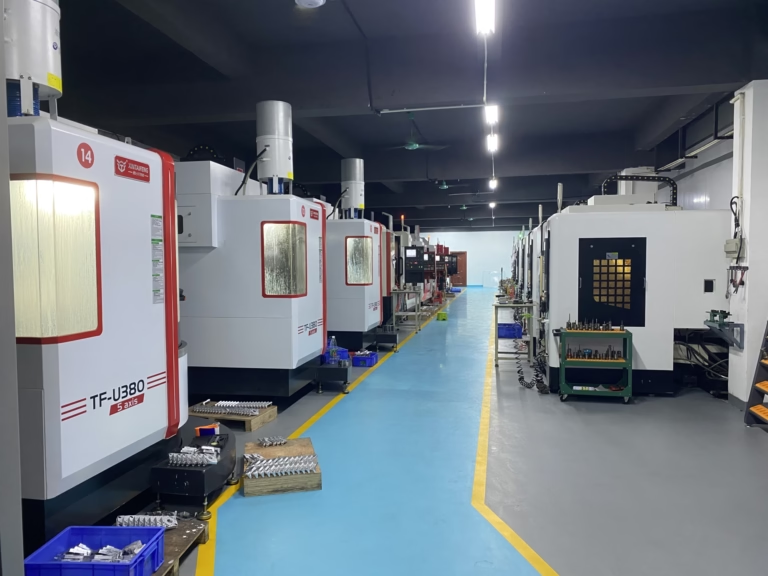
Machine count alone says little. What matters is the mix. A shop with 127 high-precision CNC machines, including 16 simultaneous 5-axis machining centers, 12 four-axis mills, 27 three-axis machines, and 16 mill-turn centers, can route a part to the right machine instead of forcing it onto the closest available spindle. That routing decision affects both tolerance and price.
Travel limits decide whether your part fits at all. Large travels of 4,000 × 400 × 150 mm cover long structural parts and extrusion housings. Medium travels of 750 × 1,150 × 550 mm and 600 × 600 × 600 mm handle most enclosures and manifolds. Compact travels of 500 × 500 × 450 mm and 500 × 310 × 200 mm suit small precision components and connector bodies.
A Ø400 mm rotary table is often the difference between one setup and three. Parts with radial holes, angled faces, or compound features can be machined in a single operation when the table is large enough to support the part and rigid enough to hold position.
If your part needs turning and milling on the same feature, ask about mill-turn centers. They reduce handling, which reduces the chance of a concentricity error between operations.
Quotation speed, MOQ, and delivery risk
Quotation speed is a proxy for how the shop is organized. A cnc machine service manufacturer that returns a quotation and free DFM analysis within 12 hours is usually working from a live capacity picture. One that needs a week is often collecting prices from subcontractors, which means it does not control its own schedule.
MOQ is the second filter. No minimum order quantity means you can run one prototype and then a 10,000+ part production run with the same supplier. That matters because the fixture, the toolpath, and the inspection plan carry over. Re-sourcing between prototype and production adds weeks and a fresh set of first-article risks.
Delivery risk is worth asking about directly. Historical late-delivery probability below 2% is a real number, not a slogan. Ask what it covers and how it is measured. Also ask when production can start. A shop that can begin within 24 hours after drawing release has slack in its schedule.
Parts shipping in 3–5 days is a normal target for machined components with standard finishing. If your part needs hardcoat anodizing or a specific plating, add time and ask whether the finish is done in-house or sent out.
Certifications that match your industry
ISO 9001:2015 is the baseline quality system. It says the shop documents its processes and can trace material and inspection records. For general industrial work, that is usually enough.
IATF 16949:2016 is the automotive standard. It adds requirements for traceability, change control, and production-part approval that matter when a part goes into a vehicle. If you build EV components, ask for it. ISO 13485:2016 is the medical device standard. It is relevant when parts need a documented history and controlled changes.
ISO 27001:2022 covers information security. It matters when you send CAD files and drawings that should not leave the building. Combined with an NDA, it gives a clear answer to the question every engineering manager asks: who sees our design?
Certificates are only useful if the scope covers the work you are buying. Ask for the current certificate and read the scope statement. A certificate for one process does not automatically cover another.
Materials and finishing options to check before quoting
Material availability drives cost more than machining time on many parts. A shop that stocks 6061, 7075, 304, 316L, 17-4PH, and Ti-6Al-4V can quote quickly and avoid a material substitution that changes your strength or corrosion assumptions.
Titanium and Inconel are slow to cut. Tool wear is high, feeds are low, and heat stays in the cut zone. Quote these parts with realistic cycle times, and expect surface finish specs to be harder to hit than on aluminum.
Finishing is where hidden lead time lives. Anodizing in clear, color, hardcoat, and conductive grades, electroless nickel, zinc, silver and gold plating, powder coating, and black oxide are standard options. Bead blasting, tumbling, brushing, and polishing change the surface before plating, so the order of operations matters.
Laser marking and engraving have a practical limit. Minimum character height is 1.5 mm. If your part number needs to be smaller than that, plan for a different marking method.
Step by step: how to compare cnc machine service manufacturers
Run the same process on every supplier so the comparison is fair.
- 1Send one real drawing to every supplierUse a part you actually need, with GD&T and finish callouts. A test RFQ shows more than any capability page.
- 2Ask for the tolerance at your part sizeWrite the size range in the RFQ. Compare the answers, not the marketing claims.
- 3Request a DFM note with the quoteA shop that flags a thin wall or an unreachable feature is reading your drawing. A quote with no comments usually means no review.
- 4Separate the cost linesAsk for material, machining, finishing, inspection, and freight as separate lines. Then compare totals, not unit prices.
- 5Confirm MOQ and prototype pricingOrder a one-piece prototype from the finalists. Check dimensions and finish before discussing volume.
- 6Check the certification scopeRequest current certificates and confirm the scope covers your process and industry.
- 7Agree on the inspection reportDecide which dimensions get measured and what data ships with the parts. Do this before the first article, not after.
Frequently asked questions
How fast can a cnc machine service manufacturer quote a job?
A quotation and free DFM analysis within 12 hours is a realistic target when the shop has its own capacity and a live schedule. If a supplier needs several days for a simple part, the quote is probably being sourced from a subcontractor.
Is there a minimum order quantity for CNC machining?
It depends on the supplier. Some shops set a 500-piece minimum, which pushes prototype work elsewhere. Others have no minimum order quantity and run from one prototype to 10,000+ part runs on the same floor.
What tolerance should I expect on a 5-axis machined part?
±0.005 mm is achievable on compact parts in a single setup with the right fixturing and temperature control. On long or thin parts, the practical tolerance widens. Always state the part size when you discuss tolerance.
Which certifications matter for automotive and medical parts?
IATF 16949:2016 for automotive and ISO 13485:2016 for medical devices. ISO 9001:2015 is the baseline for general work. If your drawings are sensitive, look for ISO 27001:2022 as well.
How long does production take after the drawing is released?
Production can start within 24 hours when capacity is open, and parts ship in 3–5 days for standard machined components. Add time for special finishing or material that is not in stock.
Can I keep my design confidential during quoting?
Yes. Uploads are secure and confidential, and an NDA is available on request. Ask for it before you send the first drawing if the design is sensitive.
Get a quote you can compare
Send your drawing and get a quotation with DFM feedback within 12 hours. No minimum order quantity, and every part is inspected before it ships.
12-hour quote100% inspectionNo minimum orderNDA on request
More from the shop floor
We publish setup notes, tooling trials and inspection data from the factory floor.











