
CNC Machine Service Price
A quoted price is the output of a calculation, not a catalog number. This guide is for design engineers and sourcing staff who need to read that calculation, compare suppliers on equal terms, and spot a quote that will move after the PO is signed.
In this article
- 1
- 2
- 3
- 4
- 5
- 6
- 7
What actually drives the number
What a CNC machine service price should itemize
Use this table to compare two quotes line by line. If a line is missing on one side, the two prices are not comparable.
| Line item | What to look for | Red flag |
|---|---|---|
| Material | Grade, temper, and stock form named | Grade left as alloy steel |
| Setup | Separate from per-part cycle time | Setup blended into unit price |
| Cycle time | Minutes per part at stated quantity | No quantity basis given |
| Tolerance | General tolerance plus GD&T callouts | Blanket ±0.005 mm claim |
| Finish | Process and Ra range specified | Finish listed as machined |
| Inspection | Report type and sampling plan | Certificate promised verbally |
| Freight and duty | Incoterm and who pays | Shipping added at invoice |
| Tooling or fixture | One-time charge, who owns it | Repeated on every reorder |
How a shop builds a CNC machine service price
Every quote starts as an estimate of machine time. The programmer reads the drawing, picks a stock size, chooses tools, and estimates how long each feature takes at a realistic feed and speed. Setup, tool changes, and in-process checks are added on top. That total, multiplied by the shop's hourly rate, forms the base of the price.
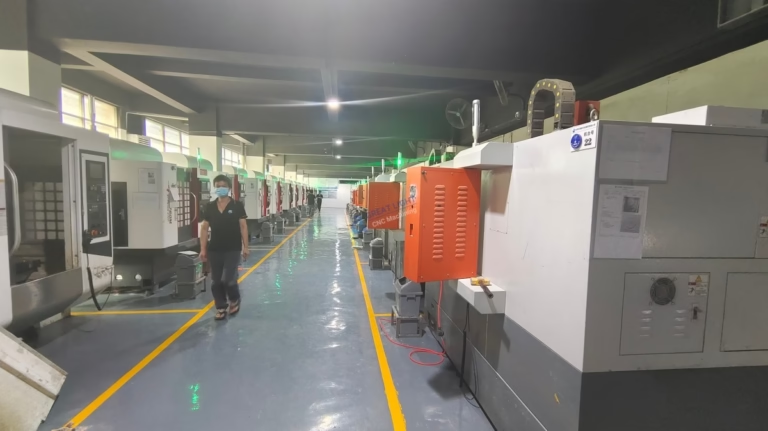
The hourly rate is not a pure profit number. It carries machine depreciation, spindle hours, tooling consumption, coolant, compressed air, floor space, and the wages of the operator and programmer. A shop running 16 simultaneous 5-axis machining centers has a different cost base than a job shop with three-axis mills, and the rate reflects that.
Material sits on top of machine time. Aluminum 6061 machines fast and is cheap to buy, while 17-4PH stainless or Inconel needs slower speeds, more tool wear, and often more scrap risk. The material line in a quote should name the grade and the stock form, because a bar cut from plate and a near-net forging are priced differently.
Finally come finishing, inspection, and logistics. Anodizing, plating, and powder coating are usually subcontracted and priced per batch or per part. CMM reports, first article inspection, and material certificates add engineering hours. Freight and duty depend on the Incoterm. A quote that groups all of this into one number is hard to audit, and hard to compare against a competitor.
- 1Machine timeCycle time plus setup, tool changes, and in-process checks
- 2MaterialGrade, temper, and stock form, including scrap allowance
- 3FinishingPlating, anodizing, coating, or polishing, often per batch
- 4Quality and freightReports, certificates, packing, and shipping terms
Part geometry and tolerance: the levers you control
Geometry is where the buyer has the most influence. Deep pockets, thin walls, and features that need a long reach force the shop to use smaller tools, lower feed rates, and more passes. A wall thinner than 1 mm in aluminum or 0.8 mm in stainless will chatter unless the shop slows down or adds supports, and both add cost.
Tolerance works the same way. A general tolerance of ±0.05 mm is routine on most three-axis work. Asking for ±0.005 mm on every dimension means the shop must control thermal drift, use a temperature-stable room, and inspect more often. Reserve tight tolerances for the features that mate with something else.
Surface finish follows the tolerance. As-machined surfaces in the Ra 1.6–3.2 μm range need no extra operation. Fine finishes at Ra 0.2–0.8 μm usually need a separate finishing pass, a different tool, or hand polishing, and the price reflects the extra time.
A good DFM review catches these points before the first chip is cut. We return a quotation and free DFM analysis within 12 hours, so the geometry discussion happens before the PO, not after the first article fails inspection. That is where most of the savings live.
- 1Wall thicknessBelow 1 mm in aluminum and 0.8 mm in stainless needs special handling
- 2Deep pocketsDepth-to-diameter above 4:1 slows the cut and increases tool breakage
- 3Tolerance zonesApply ±0.005 mm only to mating features, not whole drawings
- 4Finish calloutsSpecify Ra per surface, not one value for the whole part
Quantity, lead time, and how they move the price
Setup is a fixed cost. On a single prototype, the full setup, programming, and fixturing cost lands on one part, which is why a one-off is expensive per unit. At 50 parts the same setup is spread across 50 pieces. At 1,000 parts it nearly disappears from the unit price, and material and cycle time dominate.
That curve flattens. Going from 1,000 to 10,000 parts rarely cuts the unit price in half, because the machine still runs the same cycle. Above a certain volume, processes like die casting or stamping become cheaper than cutting, and a good supplier will say so even though it means less machining work.
Lead time is a separate variable. Standard quotes from our shop ship parts in 3–5 days, and production can start within 24 hours of a confirmed order. Compressing that further usually means overtime, expedited material, or splitting the batch across machines, all of which carry a cost. A rush fee is real, not a penalty.
There is also a hidden cost in long lead times. Engineering changes that arrive mid-run force rework, and rework is priced at the same hourly rate as new work. If your design is still moving, a shorter run with a planned second order is often cheaper than one large order you have to scrap.
- 11 to 50 partsSetup cost dominates the unit price
- 2100 to 1,000 partsMaterial and cycle time become the main drivers
- 310,000+ partsCompare machining against casting or stamping
- 4Rush ordersOvertime and expedited stock carry a real premium
Supplier checks that protect the price you agreed
Certification tells you which quality system governs the job. ISO 9001:2015 covers general manufacturing discipline. IATF 16949:2016 adds automotive traceability and change control. ISO 13485:2016 applies to medical devices. ISO 27001:2022 covers information security, which matters when your drawings are the intellectual property.
Ask how inspection is handled. We inspect 100% of parts before shipment and can provide raw material checks, in-process monitoring, and final inspection reports on request. Our qualification rate is 99.99%. A supplier who cannot describe the sampling plan or the report format is a risk on any tolerance-critical job.
Machine capacity matters for the geometries you actually have. If your part needs five-sided access in one setup, a shop with 16 simultaneous 5-axis machining centers and a Ø400 mm rotary table can hold position better than a shop that re-fixtures three times. Our largest travel is 4,000 × 400 × 150 mm, with medium and compact platforms for smaller work.
Commercial terms round out the picture. We work with no minimum order quantity, from one prototype to 10,000+ part runs, and we sign NDAs on request. Uploads stay secure and confidential. Those terms remove the two most common sources of surprise billing: minimum charges and scope disputes over confidential work.
- 1CertificatesMatch the certificate to the industry the part serves
- 2Inspection planAsk for the sampling plan and the report format in writing
- 3Machine fitConfirm the shop can reach your features in one setup
- 4Commercial termsMOQ, NDA, and upload handling should be stated up front
How to get a comparable CNC machine service price
Follow these steps in order. Each one removes a source of price movement before the order is placed.
- 1Lock the drawing revisionSend one revision number with a date. Two suppliers quoting different revisions will never agree, and the difference usually surfaces as a change order.
- 2State quantity tiersAsk for 1, 50, and 500 pieces on the same RFQ. The spread shows how much of the price is setup and how much is cycle time.
- 3Separate critical from general tolerancesMark only the mating features at ±0.005 mm. Leave the rest at ±0.05 mm unless the function demands otherwise.
- 4Name the material grade and temperWrite 6061-T6 or 17-4PH, not aluminum or stainless. Grade changes of one step can move the price by double digits.
- 5Specify finish per surfaceGive Ra ranges where they matter, for example Ra 0.8–1.6 μm on a sealing face and as-machined elsewhere.
- 6Request the DFM notes with the quoteA supplier who flags a thin wall or a deep pocket before cutting is cheaper than one who discovers it during the run.
- 7Confirm inspection and documentationAgree on the report type before production. Material certificates and dimensional reports take engineering time to prepare.
- 8Agree on freight and IncotermSettle who pays duty, insurance, and packing. This is the last line where a comparable quote can drift.
Questions buyers ask about CNC machine service price
Why is one supplier much cheaper than another for the same drawing?
The most common reason is a different scope. One quote may assume general tolerances and as-machined finish, while the other prices tight tolerances and anodizing. Compare the line items before comparing the total.
The second reason is machine time. A shop with spare capacity on a slow week may quote lower to fill a spindle. That price is real, but it is not a stable basis for a recurring order.
Does a higher quantity always lower the unit price?
Yes, but the curve flattens. Setup is amortized quickly, so the drop from 1 to 50 parts is steep. From 1,000 to 10,000 parts the change is small because cycle time and material dominate.
At very high volumes, casting or stamping can beat machining. A supplier who tells you that is being useful, not turning down work.
How much does a tighter tolerance add to the price?
There is no fixed percentage. It depends on how many features are tight and whether the shop needs a separate finishing pass, a temperature-controlled room, or more frequent inspection.
A practical rule: apply tight tolerance only where parts mate. Blanket tight tolerances across a drawing are the single most common way buyers pay more than they need to.
What does the quote not include?
Usually freight, duty, and any certification beyond a standard inspection report. Tooling or fixtures may also sit outside the unit price on the first order.
Ask directly. A written list of exclusions is the cheapest form of insurance against a revised invoice later.
Can I get a price before the design is final?
Yes, and it is often the right move. A budget quote on a near-final model shows which features carry the cost, so you can change the design while changes are still free.
We return a quotation and free DFM analysis within 12 hours, so the feedback arrives while the design is still open.
How do certifications affect the price?
Certification adds process control, traceability, and documentation, all of which take engineering time. ISO 9001:2015 is the baseline. IATF 16949:2016 and ISO 13485:2016 add more record keeping for automotive and medical work.
The cost shows up in inspection and paperwork, not in the cutting speed. If your industry does not require a specific certificate, do not pay for it.
Send your drawing, get a price and DFM notes in 12 hours
One revision, one quantity tier, one itemized quote. No minimum order quantity, NDA on request, and 100% inspection before shipment.
12-hour quoteNo MOQ100% inspectionNDA on request
More from the shop floor
We publish setup notes, tooling trials and inspection data from the factory floor.











