
CNC Machine Service Texas: How to Vet a Supplier
This guide is for engineers and sourcing managers in Texas who need a CNC machine service outside their region. It lists the checks that actually change part quality and delivery: tolerance capability, certifications, order size, quote scope and inspection records. Read it before you send a drawing.
In this article
- 1
- 2
- 3
- 4
- 5
- 6
- 7
- 8
Key takeaways
What to Compare Across CNC Machine Service Texas Suppliers
Use the left column as a checklist. The right two columns show what a capable supplier should be able to state in writing, and what a weak answer sounds like.
| Check | Strong answer | Weak answer |
|---|---|---|
| Tolerance | States machine class and inspection method for ±0.005 mm | Claims tight tolerance with no method |
| Certifications | ISO 9001, IATF 16949, ISO 13485, ISO 27001 on file | Verbal only, no certificate numbers |
| Order size | One prototype to 10,000+ parts, no MOQ | Minimum charge or lot fee unexplained |
| Quote speed | Quote plus DFM feedback within 12 hours | Days pass, no DFM notes |
| Production start | Can start within 24 hours of approved files | Vague queue position |
| Delivery window | Parts ship in 3–5 days for standard work | No shipment date in writing |
| Inspection | 100% before shipment, reports on request | Sample check only |
| Confidentiality | NDA available, secure uploads | Files sent by plain email |
The Short Version
Pick the supplier that answers the machine, certificate, order size and date questions in writing. A low unit price with no inspection plan costs more than it saves.
Tolerance Is a Machine Question, Not a Marketing Question
When a Texas buyer asks for CNC machine service, the first real question is which machine will cut the part. A 5-axis machining center with a Ø400 mm rotary table can hold position on a turbine housing in one setup, which removes the stacked error you get from refixturing. A 3-axis machine doing the same part in four setups adds error at every clamp change.
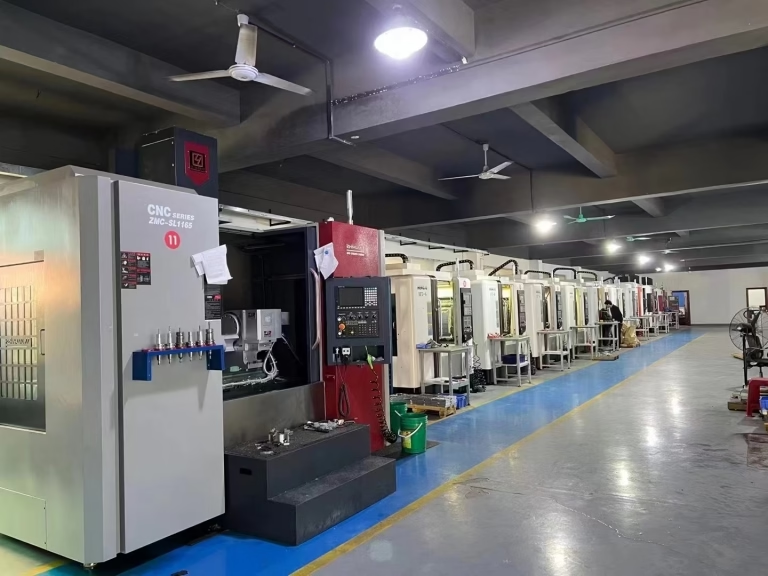
GreatLight runs 127 high-precision CNC machines: 16 simultaneous 5-axis centers, 12 four-axis mills, 27 three-axis machines and 16 mill-turn centers. The 5-axis group handles contoured surfaces and angled holes. Mill-turn centers cut and turn a shaft in one cycle, so concentricity between a bearing journal and a thread stays inside ±0.005 mm instead of drifting.
Tolerance also depends on material. Aluminum 6061 and 7075 cut clean and hold ±0.005 mm with light finishing passes. Titanium Ti-6Al-4V (TC4) and Inconel work-harden, so a heavy pass at the wrong feed pushes the tool and moves the wall. A supplier who quotes the same parameters across all materials has not machined much titanium.
Ask for the inspection plan, not just the tolerance number. GreatLight inspects 100% of parts before shipment with raw material checks, in-process monitoring and a final review, and sends reports on request. A shop that checks only the first article is telling you the risk is yours.
- 1One setup beats four5-axis work removes refixturing error on contoured and angled features.
- 2Material changes the feedTitanium and Inconel need slower speeds and lighter passes than aluminum.
Match Certifications to Your Industry, Not to a Logo Wall
Certificates matter only when they map to your program. GreatLight holds ISO 9001:2015 for general quality management, IATF 16949:2016 for automotive work, ISO 13485:2016 for medical devices, and ISO 27001:2022 for information security. If you build EV battery housings or engine brackets, IATF 16949 is the one your quality team will ask about. For a surgical instrument housing, ISO 13485 is the gate.
A certificate is not a process. IATF 16949 means the supplier runs documented process control, traceability and corrective action. Ask to see how material lots are tracked from incoming stock to finished part. If the answer is a spreadsheet nobody updates, the certificate is decoration.
Information security matters more than buyers expect. Drawings for a defense-adjacent or medical part carry design intent. ISO 27001:2022 plus an NDA and secure uploads keep those files off shared drives. GreatLight offers an NDA on request and treats uploads as confidential.
One caution: certification scope has limits. A supplier certified for machining does not automatically cover plating, anodizing or heat treatment. If your part needs hardcoat anodizing or electroless nickel, ask whether that step is in-house or subcontracted, and who inspects it.
- 1Automotive and EVIATF 16949:2016 with lot traceability and process control.
- 2Medical devicesISO 13485:2016 plus controlled document flow.
- 3Confidential programsISO 27001:2022, NDA on request, secure uploads.
MOQ, Unit Cost and the Real Cost of a Cheap Quote
Texas programs often start small and scale fast. A Houston engineering team may need two prototypes this month and 4,000 units after the design freeze. A supplier with a minimum order quantity forces you to buy inventory you may never use, or pay a lot fee that never disappears.
GreatLight has no minimum order quantity. One prototype and a 10,000+ part run go through the same quoting path. That matters because the prototype is where you learn whether the wall thickness machines clean, whether the thread holds torque, and whether the finish meets a sealing spec. You want that learning on one part, not on a full lot.
Compare quotes line by line. A quote that shows only a unit price hides the rest. Material grade, machining time, surface finishing, inspection reports and freight each carry cost. Anodizing in clear, color, hardcoat or conductive form is not the same operation, and hardcoat costs more than clear. If two quotes differ by a wide margin, the cheaper one usually omits finishing or inspection.
Volume changes the process, not just the price. At low quantity, a mill-turn center or 5-axis setup is efficient because it finishes in one or two operations. At high volume, the same part may move to a fixture that cuts cycle time. Ask the supplier how the process changes at 10, 1,000 and 10,000 parts.
- 1No MOQFrom one prototype to 10,000+ parts on the same quote path.
- 2Finishing is a line itemHardcoat anodizing and plating cost more than clear anodizing.
Lead Time: Separate Quote, Start and Ship Dates
Lead time is three dates, not one. The first is the quote and DFM analysis, which GreatLight returns within 12 hours. The second is production start, which can begin within 24 hours once files are approved. The third is shipment, where standard parts ship in 3–5 days. Suppliers who quote a single vague window are hiding which of these three they cannot control.
DFM feedback is the part buyers underuse. A supplier that flags a 0.5 mm wall that will chatter, or a deep pocket that needs a smaller tool and more time, saves you a scrapped lot. That feedback should arrive with the quote, not after the first parts fail inspection.
Distance from Texas to a supplier in Dongguan adds transit time, so plan the freight leg separately from the machining leg. GreatLight has a Singapore factory at No.3 Joo Koon Circle, Singapore 629032, which can shorten routing for some programs. Ask which plant will run your part before you commit to a schedule.
Historical performance is a useful signal. GreatLight records a late-delivery probability below 2%. That figure only means something if the supplier tracks it. Ask any candidate how they measure on-time delivery and what happened in the last quarter when a job slipped.
- 1Quote in 12 hoursIncludes free DFM analysis, not just a price.
- 2Start in 24 hoursProduction begins after file approval.
- 3Ship in 3–5 daysStandard machining work, before freight transit.
Which Process Fits the Part in Front of You
Not every part belongs on a 5-axis machine. A flat bracket with two holes and a pocket is cheaper on a 3-axis mill. A round fitting with a thread and a groove is a lathe job or a mill-turn job. A contoured housing with holes at compound angles is where 5-axis earns its cost by removing setups.
Size drives the choice too. GreatLight machines up to 4,000 mm maximum processing size, with travels of 4,000 × 400 × 150 mm for long parts, 750 × 1,150 × 550 mm and 600 × 600 × 600 mm for mid-size work, and 500 × 500 × 450 mm or 500 × 310 × 200 mm for compact parts. A 4,000 mm rail or beam will not fit a compact machine, so the quote should name the machine envelope.
Material narrows the list as well. The shop stocks aluminum 6061, 6061-T6, 2024, 5052, 5083, 6063, 6082, 7075 and ADC12; stainless 303, 304, 316, 316L, 420, 430, 431, 440C and 17-4PH; steel 1018, 1045, 4130, 4140, 4340 and A36; copper and brass including C36000 and beryllium copper; titanium TA1, TA2, TC4; Inconel; magnesium AZ31B and AZ91D; and plastics from ABS and POM to PEEK and carbon fiber.
When a part needs a finish, plan it early. Anodizing, electroless nickel, zinc, silver and gold plating, powder coating, black oxide, bead blasting, tumbling, brushing and polishing each change dimensions slightly. Laser marking needs a minimum character height of 1.5 mm. Put the finish callout on the drawing before the first cut, not after.
- 13-axis for flat and simpleBrackets and plates with one or two faces.
- 25-axis for compound anglesContoured housings and angled holes in one setup.
- 3Mill-turn for round partsShafts and fittings with threads and grooves.
Step by Step: How to Vet a CNC Machine Service Texas Supplier
Work through these steps with any candidate before you release a purchase order. Each step names what to ask and what a good answer looks like.
- 1Send one drawing with calloutsInclude material grade, tolerance, finish and any critical feature. A supplier who returns questions about datum and finish within 12 hours is reading the drawing. One who quotes immediately without questions is guessing.
- 2Ask which machine holds the tight featureFor a ±0.005 mm bore, ask for the machine class and the inspection method. A 5-axis center or mill-turn center with a Ø400 mm rotary table is a credible answer. A three-axis machine with four setups needs a different argument.
- 3Request DFM feedback in writingLook for notes on wall thickness, tool reach, thread depth and finish. If the wall is under 1 mm in aluminum or under 1.5 mm in stainless, expect a note about deflection and a suggested change.
- 4Check certificates against your programISO 9001:2015 is the baseline. Add IATF 16949:2016 for automotive, ISO 13485:2016 for medical, and ISO 27001:2022 when drawings are sensitive. Ask for the certificate scope, not just the logo.
- 5Confirm order size flexibilityState your prototype quantity and your expected production quantity. A supplier with no MOQ will quote both on the same terms. If a lot fee appears, ask what it covers.
- 6Get the three dates in writingQuote date, production start date and ship date. Compare against 12-hour quoting, 24-hour start and 3–5 day shipment for standard work. Treat a missing date as a risk you carry.
- 7Settle inspection and reportsAsk for 100% inspection before shipment and a report you can file. Name the dimensions you want measured. Raw material check, in-process monitoring and final inspection should all be in the plan.
- 8Sign the confidentiality termsUse an NDA when the drawing carries design intent. Confirm that uploads are secure and that files are not shared outside the quoting and production team.
Questions Texas Buyers Ask
Can a supplier outside Texas hold ±0.005 mm on a complex part?
Yes, if the machine and the inspection plan support it. GreatLight holds ±0.005 mm (about ±0.0002 in) on 5-axis and mill-turn work, with 100% inspection before shipment and reports on request.
The risk is not distance. It is a supplier that quotes tight tolerance without naming the machine or the measurement method.
Do I have to order a large batch to get a quote?
No. GreatLight has no minimum order quantity and quotes from one prototype to 10,000+ part runs. The prototype and the production run go through the same quoting path.
That lets you verify fit, thread torque and finish on one part before committing to a full lot.
Which certifications should an automotive or medical program require?
Automotive programs usually require IATF 16949:2016 for process control and traceability. Medical device programs usually require ISO 13485:2016. ISO 9001:2015 is the baseline for general machining.
GreatLight holds all three, plus ISO 27001:2022 for information security. Ask for the scope of each certificate, because a machining certificate does not cover a subcontracted finishing step.
How fast can parts start and ship?
GreatLight returns a quotation with free DFM analysis within 12 hours. Production can start within 24 hours after file approval, and standard parts ship in 3–5 days.
Freight transit from the plant to Texas is a separate leg. If you need a shorter route, ask which plant will run the job, since GreatLight also operates a Singapore factory.
What surface finish is realistic without extra cost?
As-machined finish is Ra 1.6–3.2 μm. A high finish is Ra 0.8–1.6 μm, and fine finishing reaches Ra 0.2–0.8 μm.
Put the finish callout on the drawing. Sealing surfaces, bearing bores and sliding faces usually need Ra 0.8–1.6 μm or finer, and that changes the machining time.
How do you handle confidential drawings?
Uploads are treated as secure and confidential, and an NDA is available on request. ISO 27001:2022 covers the information security process.
Tell the supplier which features are design intent. That helps them plan inspection and keeps the sensitive dimensions inside the controlled workflow.
Send a Drawing and Get a Real Answer
Upload your files for a quote and free DFM analysis within 12 hours. No minimum order quantity, 100% inspection before shipment, and an NDA on request.
12-hour quoteNo MOQ100% inspectionNDA on request
More From GreatLight
We publish setup notes, tooling trials and inspection data from the factory floor.











