
CNC Machined Service Products: A Buyer Guide for Engineers
This page explains how to compare CNC machined service products from a supplier's side: tolerance, size limits, lead time, MOQ, certifications, and how quotes are built. It is written for design engineers and sourcing staff who need to pick a shop and defend the choice with numbers, not sales talk.
In this article
- 1
- 2
- 3
- 4
- 5
- 6
- 7
- 8
What matters when you compare shops
Which machining route fits your part
Match part geometry and volume to the process before you ask for a price.
| Part situation | Recommended route | Why | Watch out for |
|---|---|---|---|
| One-off prototype, simple prismatic shape | 3-axis milling | Fast setup, low fixturing cost | Undercuts need a second setup |
| Part with features on 4 faces | 4-axis milling | One rotary setup replaces three | Rotary table clearance limits part size |
| Complex contoured surface, tight blend | 5-axis simultaneous | Cutter reaches the whole surface in one pass | Programming time adds 1–2 days |
| Turned shaft with milled flats | Mill-turn center | Turning and milling in one clamping | Not cost-effective for simple round parts |
| Long part over 1,000 mm | Large-travel gantry mill | Travel up to 4,000 mm | Few shops hold ±0.005 mm over that length |
| 10,000+ identical small parts | CNC turning + bar feeder | Cycle time drops, unit cost drops | Tool wear drifts diameter over a long run |
The short version
Pick the shop whose machine list, tolerance statement, and certifications match your part and your industry. Then confirm setup count, inspection scope, and quantity breaks in writing before the run starts.
How to read a tolerance claim on CNC machined service products
A shop that quotes ±0.005 mm is stating a process limit, not a default. That number applies to a defined feature on a defined material under controlled temperature. On a 6061 aluminum bracket held in a vise, it is routine. On a 316L stainless part with a 300 mm thin wall, thermal growth and cutting force will move the wall more than the tolerance unless the shop plans around it.
Ask which feature the tolerance covers. Datum surfaces, bores, and mating faces usually need the tight number. Clearance holes, chamfers, and non-critical pockets can sit at ±0.1 mm and cost less. When a drawing applies ±0.005 mm to every dimension, the shop either adds cost to be safe or machines slowly to hold it. Both show up in the price.
Surface finish and tolerance interact. A Ra 0.2–0.8 μm finish on a bore normally needs a finishing pass with a small stepover, which adds cycle time. Ra 0.8–1.6 μm is a normal machined finish and Ra 1.6–3.2 μm is as-machined. If the drawing calls for a mirror finish on a non-sealing surface, that is money spent for nothing.
- 1Name the critical featuresMark the 3–5 dimensions that actually control function and let the rest run at general tolerance.
- 2State the material and temper6061-T6 and 6061-O machine differently. Temper changes chip formation and final size.
- 3Say how you will measureCMM, micrometer, and optical comparator give different numbers on the same part edge.
Machine count and travel: the real size limit
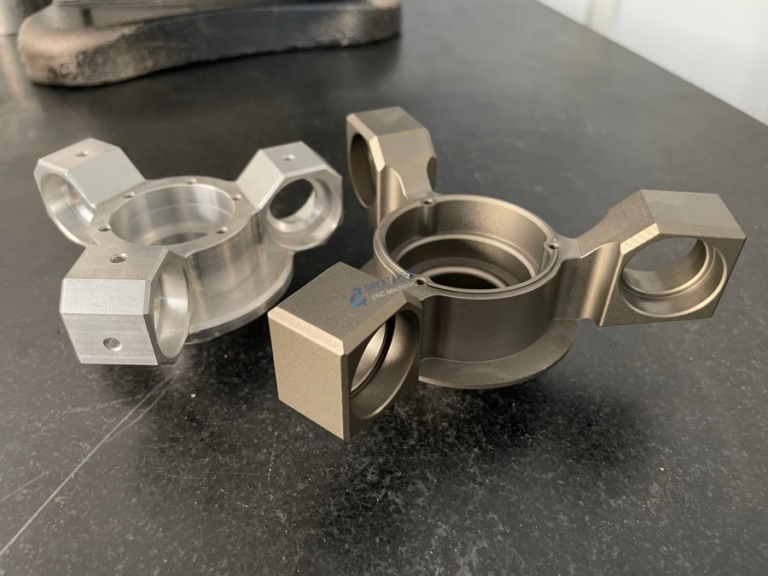
A supplier's machine list tells you what they can accept without subcontracting. GreatLight runs 127 high-precision CNC machines: 16 simultaneous 5-axis machining centers, 12 four-axis mills, 27 three-axis machines, and 16 mill-turn centers. That mix covers contoured aerospace housings, turned shafts with cross features, and simple plates in the same building.
Travel decides feasibility more than tonnage. The large-travel machines reach 4,000 × 400 × 150 mm, so a 4,000 mm extrusion can be machined in one setup. Medium machines run 750 × 1,150 × 550 mm and 600 × 600 × 600 mm. Compact machines handle 500 × 500 × 450 mm and 500 × 310 × 200 mm, which is where most prototype work lands. A Ø400 mm rotary table supports round parts that need radial features.
If your part exceeds the travel of the machine you assumed, the shop splits it into two setups. Every extra setup adds a datum transfer and a new error source. For tight parts, ask for the machine model and the setup count in the quote. It is a fair question, and a real shop answers it in one line.
Lead time, MOQ, and what a quote should contain
Lead time on CNC machined service products splits into three parts: quoting, material, and machining. GreatLight returns a quotation and a free DFM analysis within 12 hours, starts production within 24 hours, and ships parts in 3–5 days for standard jobs. Those windows assume the drawing is final and the material is in stock. A specialty titanium grade or a long forging will push the material leg out.
MOQ is the clearest signal of who a shop serves. No minimum order quantity means one prototype and a 10,000+ part run are both normal. If a shop quotes a 500-piece floor on a bracket, they are set up for production and your prototype will be priced as an interruption.
A usable quote lists material grade, machine route, number of setups, tolerance class, finish, inspection method, and unit price at each quantity break. If the quote is one number with no assumptions, you cannot compare it to another shop. The cheapest quote often assumes general tolerance and no inspection report.
- 1Quantity breaks, not one priceAsk for 1, 10, 100, and 1,000 pieces so you can see where setup cost stops dominating.
- 2Inspection scope in writing100% inspection before shipment with reports on request is a different scope from a spot check.
- 3Freight termsEx-works and delivered prices differ by more than the freight rate when duties and clearance are included.
Certifications and material traceability
Certifications narrow the field fast. ISO 9001:2015 covers general quality management and is the baseline for any export shop. IATF 16949:2016 is required for automotive and EV parts. ISO 13485:2016 applies to medical hardware. ISO 27001:2022 covers information security, which matters when your uploads are proprietary CAD files. GreatLight holds all four.
Material traceability runs alongside certification. For aerospace and medical work, the mill certificate must match the heat number on the delivered parts. Ask how the shop stores and links that paperwork. A shop that tracks heat numbers through receiving, machining, and shipping can answer a customer audit in an afternoon.
For IP-sensitive work, confidentiality is a process too. Uploads should be handled as confidential, and an NDA should be available on request before the first drawing changes hands. Confirm who inside the shop can open the files, and whether the quoting engineer is the same person who programs the job.
Materials and finishes that change the price
Material choice drives cycle time more than most buyers expect. Aluminum grades like 6061, 7075, and 6082 cut fast and hold size well. Stainless 303 and 304 are common but work-harden, so feeds and speeds need control. 17-4PH and Inconel are machined at low surface speed and eat tooling, which shows up as a higher unit price and a longer lead time.
Finishes add a second operation and a second chance for scrap. Anodizing, plating, powder coating, and black oxide all change the final dimension slightly. If an anodized bore must stay within ±0.005 mm, the shop has to mask it or machine undersize before coating. Say this on the drawing, not in an email after the parts ship.
Laser marking has a floor: minimum character height 1.5 mm. Smaller text fills in or loses contrast. If you need a serial number or a data matrix, keep the marked area flat and away from edges where the head cannot focus.
- 1Match material to functionDo not pay for 7075 strength on a cover plate that carries no load.
- 2Sequence finish after machiningTolerance stack changes once plating or anodizing is applied.
- 3Bead blasting hides tool marksIt is a low-cost way to clean up a visible cosmetic surface.
Six steps to qualify a CNC machining supplier
Run these in order. Skipping step 3 is the most common reason a first article fails.
- 1Send a complete 3D model and 2D drawingSTEP plus a drawing with datums, critical dimensions, material, and finish. Missing GD&T is the top cause of a wrong first quote.
- 2Request DFM feedback with the quoteLook for specific comments on wall thickness, tool reach, and tolerances that will be hard to hold, not a generic thank-you note.
- 3Confirm the machine route and setup countAsk which machine will run the part and how many setups are planned. Two setups on a ±0.005 mm part needs a stated datum strategy.
- 4Check certifications against your industryISO 9001 for general work, IATF 16949 for automotive, ISO 13485 for medical, ISO 27001 when files are confidential.
- 5Order one piece before the production runInspect the first article against the drawing. Fix tolerance and finish issues while the quantity is still one.
- 6Agree on inspection and shipping termsSet the inspection scope, report format, and freight terms in writing before the run starts.
Questions buyers ask before the first order
What is the smallest quantity you will run?
There is no minimum order quantity. A single prototype and a 10,000+ part run both go through the same shop.
For very small quantities, setup and programming dominate the unit price. Ask for a 10-piece and 100-piece price so you can see where the curve flattens.
How fast can I get a quote and finished parts?
Quotation and free DFM analysis come back within 12 hours. Production can start within 24 hours, and standard parts ship in 3–5 days.
Specialty materials and multi-operation parts take longer. The quote should state which leg drives the date.
Which tolerances can you actually hold?
The stated process limit is ±0.005 mm (±0.0002 in) on defined features with controlled fixturing and inspection.
On long or thin-walled parts, discuss the feature-by-feature tolerance before the run. A general tolerance on every dimension raises cost without improving function.
Do you handle both prototypes and production runs?
Yes. Rapid prototyping, bridge tooling, and production machining are all in-house, across 127 machines and three wholly-owned plants.
Prototype parts are often machined on the same equipment that will run production, which keeps the process transfer clean.
How is my design data protected?
Uploads are treated as secure and confidential, and an NDA is available on request. The shop holds ISO 27001:2022 for information security.
Ask for the NDA before the first file transfer if the program is sensitive.
What inspection do I get with the parts?
Inspection covers raw material check, in-process monitoring, and final inspection, with 100% inspection before shipment. Reports are available on request.
For regulated industries, agree on the report format and sampling plan before the run so the paperwork matches your quality system.
Send your drawing, get a quote and DFM notes in 12 hours
Upload a STEP file and a 2D drawing. We return pricing, a setup plan, and DFM feedback you can act on.
12-hour quoteNo MOQ100% inspectionNDA on request
More from GreatLight
We publish setup notes, tooling trials and inspection data from the factory floor.











