
Machining and casting: which is better?
Both processes can make the same part on paper. They behave very differently once wall thickness, tolerance, and volume come into play. This page gives you the checks we use on the shop floor to pick one.
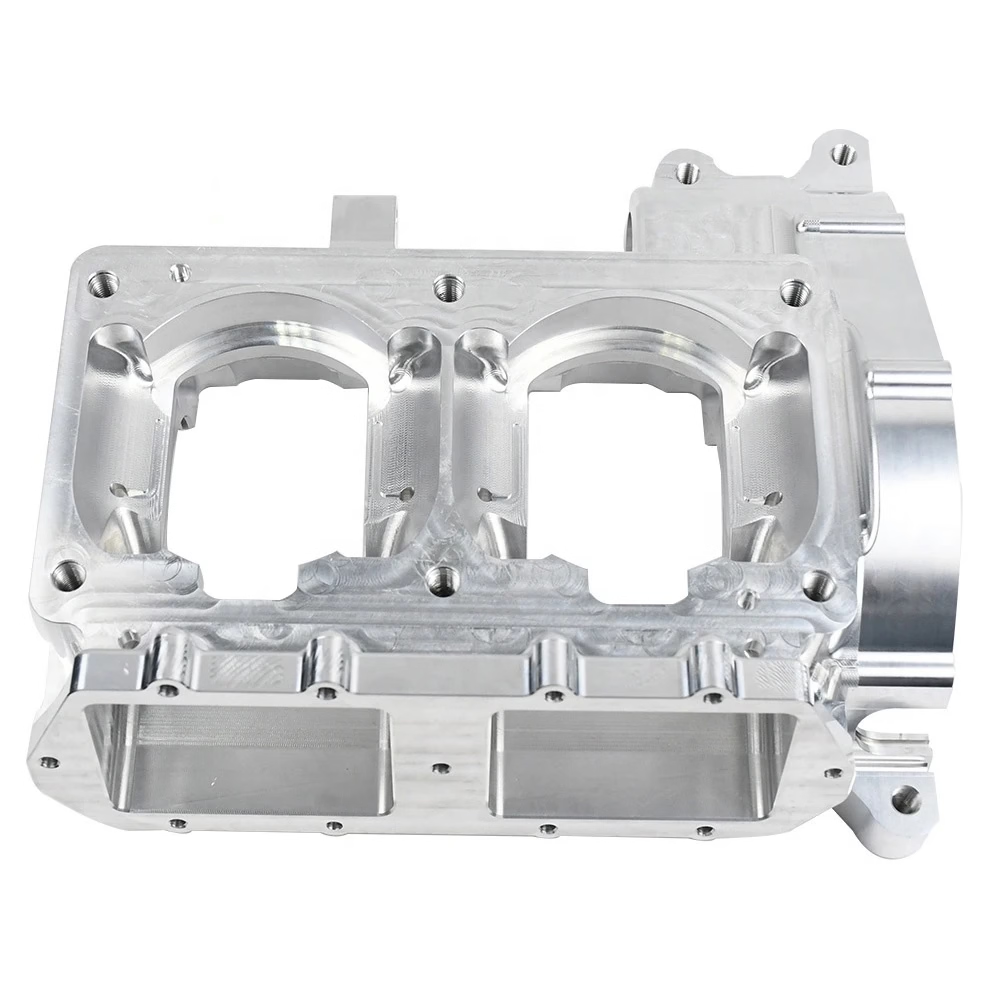
Machining and casting compared at a glance
Figures are typical for the processes we run. Your geometry can shift them.
| Factor | CNC machining | Casting (die / vacuum) |
|---|---|---|
| Achievable tolerance | ±0.005 mm | ±0.1 mm to ±0.5 mm as cast |
| Wall thickness | 0.5 mm and thinner | 2–3 mm minimum for good fill |
| Tooling cost | Fixtures only | Pattern or die, often five figures |
| Break-even volume | Low to mid, no MOQ | Roughly 1,000+ parts to amortize tooling |
| Lead time, first part | 3–5 days | 4–10 weeks including tooling |
| Surface finish | Ra 0.2–3.2 μm as machined | Ra 3.2–12 μm, needs secondary work |
| Material choice | Any bar or plate stock | Must be castable alloy |
| Design changes | Edit the program | Cut a new tool |
What actually separates machining and casting
Machining starts with a solid block, bar, or plate. A rotating cutter removes material until the shape is left. Nothing about the shape is locked in until the toolpath runs, so a design change is a program edit. That is the core reason machining wins on low-volume work and on parts that are still moving.
Casting goes the other way. Molten metal fills a cavity and solidifies into the near-final shape. The cavity is the expensive part. Once you cut a die or build a pattern, every part after that is cheap and fast, but the shape is fixed. Change a rib or a boss and you are cutting a new tool.
The two are not always rivals. A lot of production parts are cast first and machined second. Casting gets you close to net shape cheaply, then machining brings the critical faces, bores, and sealing surfaces into tolerance. That hybrid path is often the cheapest way to make a complex part at volume.
So the real question is not which process is better in general. It is which one owns the critical features on your drawing, and whether the remaining features can tolerate as-cast accuracy.
Where casting stops and machining starts
As-cast tolerances on a die casting typically land around ±0.1 mm on small dimensions and drift wider on long spans. Add draft angles, parting line mismatch, and shrinkage, and you get a part that is close but not precise. Sand casting is looser still.
Machining holds ±0.005 mm on the same feature without drama. We hit that on our 5-axis and mill-turn centers every day, and we inspect it before the part ships. If your drawing has a bore that must fit a bearing, a face that must seal, or a hole pattern that must align with a mating part, that feature belongs on a machine.
Surface finish tells the same story. As-cast surfaces sit around Ra 3.2–12 μm and usually need blasting or tumbling before paint. Machined surfaces come off the tool at Ra 0.8–1.6 μm, and we can push to Ra 0.2–0.8 μm with finer passes and the right insert.
The practical rule: cast the shape, machine the function. Anything that touches another part, seals a fluid, or carries a bearing fit should be machined after casting.
Wall thickness, draft, and internal features
Casting likes thick, uniform walls. Thin sections cool faster than the surrounding metal and can fail to fill, especially far from the gate. In aluminum die casting we generally want 2–3 mm minimum wall, and thicker is safer. Machining has no such floor. A 0.5 mm wall on a machined aluminum housing is routine, it just needs light passes and good workholding.
Casting wins on internal voids and complex cores. An intake manifold with curved internal runners is hard to machine and easy to cast. The core makes the passage, then you machine the flanges. Machining that same runner from solid would mean a long reach tool, a lot of material removal, and a real risk of chatter.
Draft angle is the hidden cost in casting. Every vertical face needs a degree or two of taper so the part releases from the mold. If your design calls for a truly vertical wall, you are either accepting the draft or machining it back to square.
Undercuts go the same way. Casting needs a side core or a collapsible core to make them. Machining just reaches in with a 5-axis move or an angled setup.
Tooling cost, volume, and lead time
The break-even between the two processes sits almost entirely in tooling. Machining needs fixtures and a program, which is cheap. Casting needs a pattern or a die, which can run into five figures for a die casting tool. You pay that once, then parts are cheap.
So the math is simple. If you need 50 parts, tooling dominates and machining is the clear answer. If you need 50,000 identical parts, the die cost spreads thin and casting wins. The crossover usually lands somewhere around 1,000 parts, but it moves with part size, feature count, and how much machining the casting still needs.
Lead time flips the other way. A machined prototype can ship in 3–5 days from a released model. A cast part needs tooling first, which is weeks. If your schedule cannot absorb a tooling cycle, casting is off the table no matter how good the unit price looks.
Design changes are the last cost. Editing a CAM program takes an afternoon. Cutting a new die takes weeks and real money. Early in a program, when the design is still moving, that difference decides the process.
Five checks that settle the decision
Run these in order. The first one that fails decides the process for you.
Check the tolerance callout. If any feature is tighter than ±0.05 mm, that feature is machined. If the whole part is tight, machine the whole part.
Check the wall thickness. Below 2 mm in a castable alloy, casting gets risky and machining gets easier by comparison.
Check the volume. Under roughly 1,000 parts, tooling rarely pays back. Over that, run the numbers on a cast-then-machine route.
Check the schedule. If you need parts in weeks rather than months, casting cannot help you yet.
Check how settled the design is. If the geometry is still changing, machined parts let you iterate without scrapping a tool.
The verdict
If your part has tight tolerances, thin walls, or a design that is still moving, machine it. If it has thick uniform walls, complex internal passages, and you need thousands of identical parts, cast it and machine the critical faces afterward.
Questions we get every week
Can I machine a casting to get the best of both?
Yes, and it is common. We cast the near-net shape, then machine the bores, sealing faces, and mounting holes to ±0.005 mm. You get the low unit cost of casting on the bulk shape and the accuracy of machining where it matters.
The catch is that you need enough machining allowance on the casting. Leave 0.5–1.5 mm on faces that will be cut, and plan the fixturing before the casting is ordered.
How thick does a cast wall need to be?
For aluminum die casting we usually want 2–3 mm minimum, and thicker sections fill more reliably. Walls that are too thin can fail to fill or show cold shuts.
Machining has no minimum wall in the same sense. A 0.5 mm machined wall is normal in aluminum if the part is supported well during cutting.
Which process gives a better surface finish?
Machining, without much argument. As-machined surfaces land around Ra 0.8–1.6 μm, and we can reach Ra 0.2–0.8 μm with fine passes.
As-cast surfaces run roughly Ra 3.2–12 μm and often need blasting, tumbling, or painting before they look finished. If appearance or sealing is critical, plan a machining or finishing step.
At what volume does casting become cheaper?
Roughly 1,000 parts is a fair starting point for a die casting tool, but it is not a fixed number. Larger parts, more features, and more post-cast machining all push the crossover higher.
Below that, machining is almost always the lower total cost because there is no tooling to amortize and no minimum order quantity.
Does casting limit which alloys I can use?
Yes. The alloy has to be castable and behave well as it fills the mold and solidifies. That rules out some high-strength wrought alloys and most free-machining grades.
Machining works from bar or plate, so the material list is far wider. We machine 6061, 7075, 316L, 17-4PH, Ti-6Al-4V, Inconel, and engineering plastics like PEEK and POM.
Send us the drawing and we will tell you which route is cheaper
Upload your model and we will return a quote and DFM notes within 12 hours, including a cast-then-machine comparison if the volume justifies it.
12-hour quoteNo MOQ100% inspection
More process notes from the shop floor
We publish setup notes, tooling trials and inspection data from the factory floor.











