
Closed Loop CNC Machines vs Open Loop: Which Fits Your Parts?
Closed loop cnc machines read the real axis position and correct it; open loop machines send pulses and hope. One difference, two very different part outcomes. This page compares both, shows where each wins on real work, and gives you the checks to pick correctly.
Open Loop vs Closed Loop: The Short Comparison
Same cutting tools, same spindle. The control architecture is what changes.
| Point | Open loop | Closed loop |
|---|---|---|
| Position feedback | None. Steppers count pulses. | Encoder or linear scale per axis |
| Typical accuracy | ±0.05 mm to ±0.1 mm on light cuts | ±0.005 mm achievable |
| Error handling | Drift stays uncorrected | Read and corrected in real time |
| Load behavior | Missed steps under heavy cut | Servo adds torque to hold position |
| Cost and setup | Lower cost, faster to commission | Higher cost, more tuning |
| Best for | Soft material, loose tolerance, short cycles | Hard material, tight tolerance, long cycles |
| Weak point | No alarm when position slips | Tuning, encoder faults, service skill |
| Control type | Open loop cnc machines | Closed loop cnc machines |
What the Feedback Loop Actually Changes
Every CNC axis is a motor, a screw, and a slide. The controller wants the slide at a commanded point. In an open loop machine, the controller sends a counted number of pulses to a stepper motor and assumes the slide arrived. Nothing measures the result. If the tool load, the screw friction, or the acceleration exceeds what the motor can push, the slide lags and the pulses are lost. The machine keeps cutting a wrong position for the rest of the path.
A closed loop cnc machine adds a measuring device to each axis, usually a rotary encoder on the motor shaft or a linear scale on the slide. The controller compares commanded position with measured position and adjusts current until the error is inside a window. When the tool bites into 4140 steel, the servo pushes harder instead of losing steps.
That single difference drives the rest of the comparison: accuracy, surface finish, tool life, and how much the operator has to babysit the cut. It also drives cost, because encoders, servo drives, and tuning time are not free.
A quick way to remember it: open loop trusts, closed loop checks. For rough work in soft metal, trust is often enough. For anything with a tolerance callout tighter than ±0.05 mm, checking is what keeps you out of trouble.
Where Open Loop CNC Machines Still Make Sense
Open loop machines are not junk. They are simple, and simplicity has a price advantage. A stepper-driven router or a small drill-tap center can run all day on soft material, and the bill is lower than a servo machine of the same table size.
The right work looks like this: aluminium and plastics, light depths of cut, tolerances of ±0.1 mm or looser, and features that do not stack up from a single datum. Drilling, slotting, rough profiling, engraving, and chamfering all sit comfortably here.
Watch the cutting force. If a 12 mm end mill takes a 6 mm axial depth in 6061, a small stepper machine may hold it. Push the same cutter into 17-4PH stainless and the axis will lag, the step loss will go undetected, and the part will come out undersize on one side and oversize on the other.
Heat is the second limit. After two hours of continuous cutting, the screw, the bearings, and the motor warm up. Open loop control has no way to know the axis has grown, so a long finishing pass at the end of a shift can drift out of tolerance without a single alarm.
When Closed Loop CNC Machines Earn Their Cost
Closed loop cnc machines pay back when a single feature is expensive to scrap. A medical housing, a fuel-system body, or an aerospace bracket can carry hours of machining before the critical bore is finished. Losing that part to a 0.06 mm position error costs more than the price gap between the two machine types.
Hard and tough materials are the clearest case. Titanium TC4, Inconel, 17-4PH, and hardened tool steel fight the cutter, and the axis load swings with every tooth engagement. A servo loop absorbs that swing. An open loop axis absorbs it as lost position.
Long cycles matter too. Thermal growth over a four-hour cycle will move the work whether or not the control can see it. With a linear scale, the machine reads the slide itself rather than the motor, so screw pitch error and thermal expansion are both inside the correction.
Multi-axis work is the third case. On a 5-axis machine, small rotary position errors get amplified by tool length. A 0.02° error on a rotary table with a 200 mm tool standoff moves the tip by roughly 0.07 mm. That is enough to break a profile tolerance on a thin-wall rib.
None of this means every job needs a servo machine. It means the choice should follow the tolerance and the material, not the price tag alone.
Cost, Setup, and Maintenance Trade-offs
Purchase price is the visible gap. Servo motors, drives, encoders, and the tuning labor to make them work together push a closed loop build above a stepper build of the same size. For a shop buying its first machine for light work, that gap can decide the purchase.
Setup favors open loop. There are no loop gains to tune, no encoder offsets to set, and no following-error limits to adjust. A small open loop machine can be square and cutting within a day.
Maintenance runs the other way. A closed loop machine will tell you when something is wrong: following error, encoder fault, overcurrent. An open loop machine stays quiet. It keeps running with a worn screw or a dragging way until the parts fail inspection, and by then you may have a full pallet of scrap.
Downtime cost usually decides the argument in production. If a machine stop costs hundreds of dollars an hour, servo diagnostics pay for themselves. If the machine runs one-off brackets in a job shop, the simpler control is easier to live with.
There is also a hidden labor line. Closed loop tuning and encoder repair need a technician who understands servo systems. If that skill is not in-house, the service call is part of the machine cost.
5 Checks Before You Choose
Run these against the part print and the shop schedule.
- 1Check the tightest toleranceTighter than ±0.05 mm on a critical feature, or a stacked tolerance chain, points to closed loop. ±0.1 mm or looser is open loop territory.
- 2Check the materialAluminium, brass, and plastics cut kindly. Titanium, Inconel, and hardened steel swing the axis load and favor a servo loop.
- 3Check the cycle lengthCycles over about two hours invite thermal drift. A linear scale corrects it; an open loop machine cannot see it.
- 4Check the scrap costIf one bad part wipes out the price gap between the two machines, the servo machine is the cheaper choice.
- 5Check the service skillClosed loop needs tuning and encoder know-how. If nobody in the building has it, budget for outside support before you buy.
The Verdict
Soft material, loose tolerance, short cycle, tight budget: choose open loop. Hard material, ±0.005 mm features, long cycles, or expensive scrap: choose closed loop. If the print sits in the middle, the deciding factor is what one scrapped part costs you.
Frequently Asked Questions
Can an open loop machine hold ±0.005 mm if I cut slowly?
Sometimes, on a short light finishing pass in aluminium, with a warm machine and a sharp cutter. It is not repeatable. The moment load rises or the screw warms, position error grows and nothing in the control reports it.
If the print carries ±0.005 mm on a critical feature, treat closed loop as the requirement, not the upgrade.
Does closed loop mean the machine is automatically accurate?
No. The loop corrects position error at the slide. It does not fix a worn spindle bearing, a bent tool, thermal growth in the workpiece, or a bad setup.
Accuracy is the sum of the whole system. The feedback loop removes one large error source, and that is all it removes.
Is a rotary encoder as good as a linear scale?
Not quite. An encoder on the motor shaft measures motor rotation, so it cannot see backlash or pitch error between the motor and the slide. A linear scale measures the table itself.
For most 3-axis work an encoder is enough. For tight work on a large machine, or for a machine running warm all day, a scale on the critical axis is worth the extra cost.
How often does closed loop control need tuning?
After a drive replacement, an encoder swap, or a mechanical repair on the axis. Routine tuning is not a weekly task on a healthy machine.
If following error alarms keep returning, look for a mechanical cause first: loose coupling, worn way, or a binding ball screw.
What about hybrid stepper systems with encoders?
They sit between the two. The motor is a stepper, and an encoder detects lost steps and issues a correction or an alarm.
Accuracy improves and missed steps stop being silent, but torque and speed still trail a true servo. It is a reasonable middle step for light machines.
Which type do you use for the parts you quote?
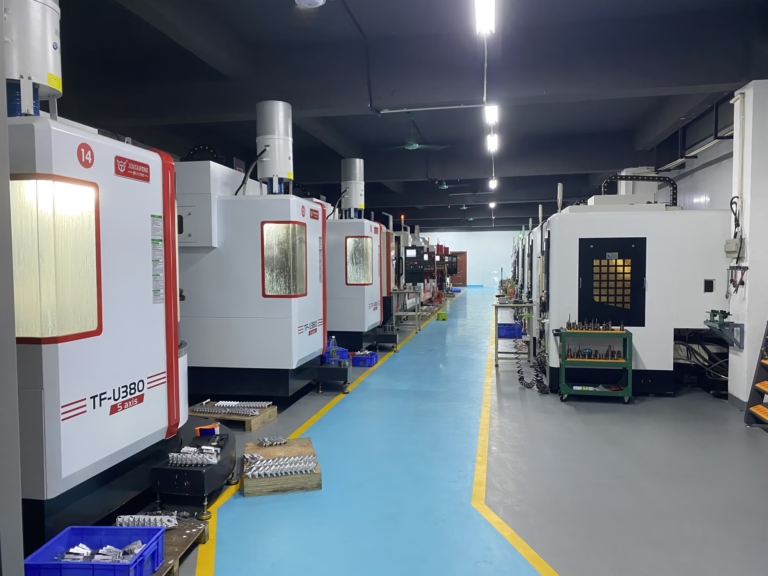
We run 127 high-precision CNC machines, including 16 simultaneous 5-axis machining centers, and we hold ±0.005 mm with 100% inspection before shipment.
Tell us the material, the tolerance, and the annual quantity. We return a quotation and a free DFM analysis within 12 hours, and production can start within 24 hours.
Send the Print, Get a Straight Answer
Upload your drawing and tell us the tolerance and material. We will quote the process that holds it, with DFM feedback in 12 hours.
12-hour quote100% inspectionNo minimum order
More Machining Notes
We publish setup notes, tooling trials and inspection data from the factory floor.











