
CNC Machining Companies Near Me: 7 Costly Red Flags You Must Avoid
Searching for cnc machining companies near me usually starts with a quote button and ends with a rejected first article. This page lists the seven warning signs that cost the most money, why each one appears, and how to check a shop before you release a PO. Written for design engineers and sourcing staff who order metal and plastic parts in the 1 to 10,000 piece range.
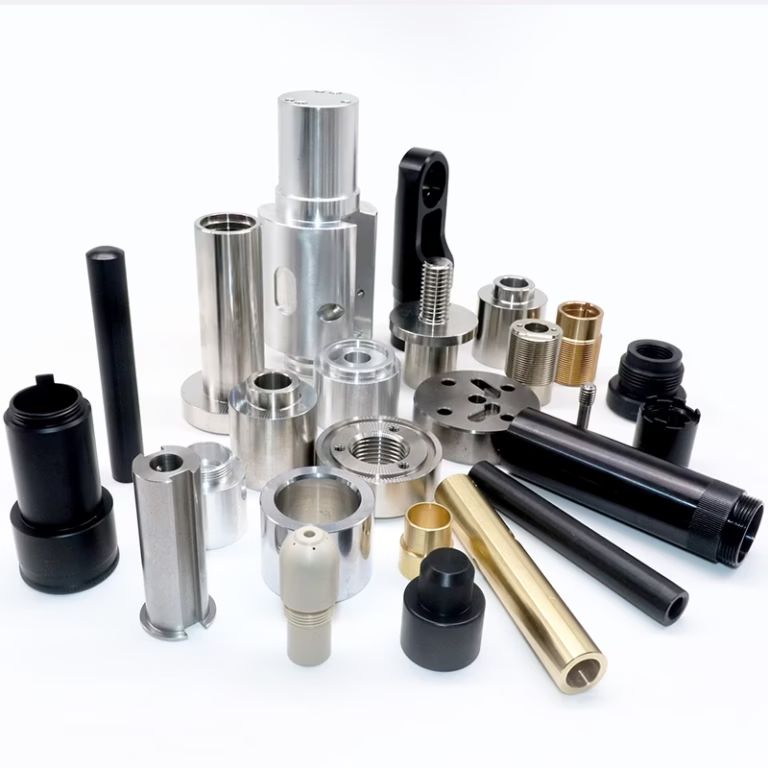
CNC machining companies near me: symptoms, causes, and fixes
Read the left column as what you see in the quote or on the shop floor. The middle column is the usual root cause. The right column is the check that settles it.
| Symptom you notice | Likely cause | What to do |
|---|---|---|
| ±0.005 mm promised for every feature | Quote written before geometry is reviewed | Ask which dimensions hold the tolerance |
| Certificate PDF has no scope text | Scope covers a different process | Request certificate with process scope |
| No 5-axis machine on the floor | Complex faces need multiple setups | Confirm simultaneous 5-axis capacity |
| Finishing sent to a third party | Color and gloss vary between lots | Ask for in-house anodizing or plating |
| Quote arrives after three or more days | No engineer reviewed the drawing | Request DFM notes with the quote |
| Duplicate tooling quoted twice | Two suppliers read one model file | Ask for a setup and tooling breakdown |
| First article drifts on the third batch | No in-process probing | Require inspection reports per lot |
Choose the shop that answers questions in writing
Red flags are not about size or price. They are about whether the shop can explain how it holds your tolerance, finishes your part, and catches a bad lot before it ships.
Tolerance, certification, and machine capacity claims
The first red flag shows up in the quote itself. A supplier that offers ±0.001 mm on every dimension without asking about material, wall thickness, or batch size is guessing. On a 6061 aluminum bracket, ±0.005 mm is normal on a milled bore. On a 300 mm long 316L shaft, thermal drift alone eats that budget. The number on the quote should match the number on your drawing, feature by feature.
Certification is the second. A PDF that shows only a logo is not proof. ISO 9001:2015, IATF 16949:2016, ISO 13485:2016, and ISO 27001:2022 each carry a published scope. If the scope covers trading or assembly but not machining, it says nothing about the parts you ordered. Read the scope line. Then ask how incoming material is traced to the finished lot.
The third red flag is capacity that exists on the website but not on the floor. A shop with only 3-axis mills will cut a part with undercuts in four or five setups. Each setup adds a datum shift. If the drawing needs true five-axis motion, ask how many simultaneous 5-axis centers run that work and what the largest part envelope is. A 4,000 mm part will not fit a 500 mm machine.
None of these three checks takes more than a phone call. Ask for the machine list, the certificate scope, and a capability study on a similar part. Vague answers are the answer.
- 1Capability studyAsk for Cpk data on a similar feature, not a marketing number
- 2Certificate scopeConfirm the scope line names machining, not trading
- 3Machine envelopeMatch part size to travel, not to the shop's biggest claim
Finishing and engineering communication gaps
Surface finish is where quotes tend to be cheapest and delivery tends to be slowest. If anodizing, plating, or bead blasting is subcontracted, the shop loses control of rack marks, color batch, and turnaround. Two anodizing lots of the same part rarely match under a 5000 K light. Ask whether the finish is done in-house and whether first-article color is approved before the run.
Laser marking has a hard limit too. Minimum character height is 1.5 mm on most fibers. If your drawing calls for a 0.8 mm serial number, it will not resolve. That is a design issue, not a supplier failure, but a shop that never mentions it is not reading your drawing.
Communication is the fifth red flag and the easiest to measure. A quote that arrives in 12 hours with three DFM notes is a shop that read the file. A quote that arrives in five days with no comment is a shop that priced the file. Ask for the DFM analysis in writing, then check whether the suggested change actually reduces cost or just moves the problem.
One useful test: send a drawing with a known thin wall, 0.6 mm on aluminum. A shop that flags it has an engineer on the quote. A shop that does not has a sales inbox.
The quote timing itself is data. If the same part gets three quotes and one is 30 percent below the rest with no notes, the difference is usually hidden in setup, stock, or inspection, not in efficiency.
- 1In-house finishingFewer handoffs means fewer color and scratch claims
- 2Marking limitKeep laser text at 1.5 mm or taller
- 3DFM in writingAsk for the note, not a verbal promise
Scalability and hidden cost in the quote
A shop that runs 20 prototypes well may still fail at 5,000 pieces. The difference is not skill, it is process. Volume work needs fixture design, tool life tracking, and incoming inspection that catches a bad bar of 17-4PH before it becomes 400 scrapped parts. Ask what changes between a one-piece run and a 10,000-piece run at that shop.
Machine count matters here. A shop with 127 high-precision CNC machines across three plants can move a hot job to another spindle. A shop with six machines cannot. Ask how many machines cover your part family and what happens when one is down.
The last red flag is the quote that looks clean and is not. Setup charged once per operation instead of once per order. Material quoted as bar stock when the part is machined from plate. Inspection listed as a line item, then charged again on the invoice. Ask for a breakdown: material, setup, run time, finishing, inspection, packaging.
Then compare two suppliers on the same breakdown. The gap between them is usually one or two line items, and it tells you more than the total. A low total with an unclear breakdown is a change order waiting to happen.
- 1Volume planAsk what changes from 1 piece to 10,000 pieces
- 2RedundancyMore spindles means fewer schedule slips
- 3Line-item quoteCompare breakdowns, not totals
How to verify a supplier before you release a PO
Run these in order. Each step takes minutes and removes a specific risk.
- 1Send a drawing with one tight featurePick a bore or slot at ±0.01 mm and ask which machine holds it. A specific answer names the machine and the probing method. A general answer names a brochure.
- 2Request the certificate scope pageRead the scope line. Confirm it names CNC machining, turning, or the process you are buying. Note the expiry date and the issuing body.
- 3Ask for the machine list and envelopeMatch your largest part dimension to the machine travel. If your part is 800 mm long, a 500 mm machine cannot run it in one setup.
- 4Ask about finishing locationIn-house anodizing, plating, and bead blasting reduce handoffs. If it is outsourced, ask who owns the color approval and the rework cost.
- 5Request a written DFM note with the quoteOne or two suggestions is enough. Look for a changed radius, a relaxed tolerance, or a different stock size. That is evidence of engineering review.
- 6Demand a line-item quoteMaterial, setup, run time, finishing, inspection, packaging. Compare two suppliers field by field, not by the bottom line.
- 7Ask what happens on a failed lotA clear answer covers containment, root cause, and who pays for remachining. Silence here is the most expensive red flag of all.
Questions engineers ask before choosing a shop
Is a local shop always better than an overseas one?
Not automatically. Local wins on travel time and in-person visits. It loses when the local shop has no 5-axis capacity or no in-house finishing, so your part travels anyway.
Judge on process fit, not on distance. A shop that can hold ±0.005 mm, finish in-house, and return a DFM note in 12 hours is a shorter path than a nearby shop that outsources three steps.
How do I check a tolerance claim without sending a real part?
Send a test coupon in the same material with one or two critical features. Ask for a dimensional report, not just the part.
Compare the report to the drawing. Two or three coupons across separate days show you repeatability, which matters more than a single good result.
What if the shop has no minimum order quantity?
No MOQ is useful for prototypes, but ask how the same shop handles a 10,000-piece run. The answer should cover fixture design and tool life planning.
A shop that runs one piece and 10,000 pieces needs different controls at each end. Ask what changes between them.
How long should a quote take?
For a simple milled part, 12 hours is reasonable and it should include a DFM note. Three to five days usually means no engineer touched the file.
Complex parts with several operations take longer. The tell is not the clock, it is whether the quote contains a technical comment.
Do I need an NDA before sharing CAD files?
If the design is not public, yes. Ask for the NDA before you upload, not after. A supplier that hesitates is worth crossing off the list.
Secure upload and confidential handling should be standard. Ask how files are stored and who inside the shop can open them.
What is the cheapest way to find out a shop cannot hold tolerance?
Order the smallest possible lot of the hardest feature. One part, one critical dimension, one inspection report.
If the first article drifts, the process is not capable. Finding that on one part costs far less than finding it on 500.
Send a drawing and get a DFM note in 12 hours
Upload your CAD file and we return a quotation with engineering comments, a machine match, and a finish plan. No minimum order quantity, from one prototype to 10,000+ parts.
12-hour quote100% inspectionNDA on request
More machining notes
We publish setup notes, tooling trials and inspection data from the factory floor.











