GreatLight CNC Machining Factory logo
CNC Machining
Rapid Prototyping
Materials
Industries
News
About GL

Get Instant Quote

Humanoid Robot Parts

CNC Machining Unitree G1 Humanoid Robot Components

Joint housings, arm and leg links, sensor brackets and frame plates cut from 6061, 7075 and Ti-6Al-4V. We hold ±0.005 mm on bore fits and wall thickness so the G1 moves the way its kinematics model says it should.

±0.005 mm tolerance16 five-axis centersNo minimum order quantityQuotation in 12 hours
Unitree G1 Humanoid Robot Compact Powerhouse for Robotics Innovation
±0.005 mmAchievable tolerance
16Simultaneous 5-axis centers
3–5 daysTypical ship time
99.99%Qualification rate
Where G1 parts go wrong

Four failures we see on humanoid robot components

Most of these show up after assembly, not at incoming inspection.

01

Joint bore runs out of tolerance after anodizing

A hip or knee housing machined to ±0.01 mm can shift by 0.02 mm once the hardcoat builds up on the bore. The bearing then sits loose, and the joint develops play within a few hundred cycles. We cut bores undersize on purpose and mask them before coating.

02

Thin walls flex during the last finishing pass

Arm links on the G1 are often 2–3 mm thick to keep mass down. Clamp pressure and tool push-off bend those walls, so the two mounting faces end up non-parallel. Fixture the part from the inside and take light finishing cuts, and the geometry holds.

03

Bolt-hole patterns do not line up between parts

If the left and right leg brackets are machined on separate setups with different datums, the hole patterns drift apart. Assembly turns into reaming and shimming. Machine both from one datum and one program, and they drop in.

04

Surface finish scratches show up after bead blasting

Visible covers and forearm shells are cosmetic parts. Tool marks left at Ra 3.2 μm will still read through a light blast. Step up to a finer finishing pass before blasting if the part is customer-facing.

How we machine G1 hardware

One shop for the structural and cosmetic parts of the G1 platform

Five-axis work, tight bore fits and finish control from the same setup.

Unitree G1 Humanoid Robot
Structural parts

Joint housings and load-bearing links

The G1 carries 23 degrees of freedom in the base model and up to 43 on the EDU variant, with knee torque up to 90 N·m on the G1 and 120 N·m on the EDU. Those loads land on the housings and links. Bore concentricity between the motor mount and the bearing seat matters more than any single dimension on the print.

We machine these on simultaneous 5-axis centers so the bearing bores, motor faces and mounting holes come off one datum. That removes the stack-up you get from flipping the part across three setups. Material is usually 6061-T6 or 7075 for the links, Ti-6Al-4V where wear resistance at the joint matters.

  • 1
    One datumBores, faces and hole patterns cut without re-fixturing.
  • 2
    Bore-to-bore concentricityHeld tight enough that bearings seat without shimming.
  • 3
    Material choice6061-T6, 7075, Ti-6Al-4V or 17-4PH depending on load and wear.

Get Instant Quote

Unitree Humanoid Robot
Covers and brackets

Sensor brackets, covers and wiring pass-throughs

The G1 routes its electrical harness through hollow sections to keep the body clean and serviceable. That puts a lot of small brackets, standoffs and pass-through plates into the build, each with its own hole pattern and clearance requirement.

These parts are small and easy to get wrong by hand. We run them on 3-axis and 4-axis mills with soft jaws or dedicated fixtures, batch by batch, so a 50-piece run matches the first article. Cosmetic covers get a finer finishing pass, then bead blasting or anodizing.

  • 1
    Repeatable small partsFixture-based runs keep piece 50 at the same size as piece 1.
  • 2
    Clearance controlHole sizes set for the fastener class you actually use.
  • 3
    Finish optionsAnodizing, bead blasting, brushing, laser marking.

Get Instant Quote

Part selection

Which process fits which G1 part

Pick the process by load path and quantity, not by habit.

Part familyProcessWhy
Hip, knee or shoulder housing5-axis millingBores and faces off one datum
Arm or leg link5-axis millingThin walls, angled faces
Sensor bracket, standoff3-axis or 4-axis millingSmall parts, high repeat count
Cosmetic forearm cover3-axis milling + finishingSurface finish matters more than load
Motor shaft, pivot pinCNC turning or mill-turnRound geometry, tight concentricity
Frame plate, chassis panelSheet metal or millingFlat parts, quantity dependent
Housing shell in volumeMetal die casting + machiningCost drops above a few thousand units
Services

What we run for robotics builds

One supplier for the machined, formed and finished parts of a humanoid platform.

01

5-Axis CNC Machining

Sixteen simultaneous 5-axis centers for joint housings and links with bores and faces cut in one setup.

02

4-Axis and 3-Axis Machining

Twelve 4-axis mills and twenty-seven 3-axis machines for brackets, standoffs and plate work in volume.

03

CNC Milling & Turning

Mill-turn centers for motor shafts, pivot pins and any part that mixes round and prismatic features.

04

Rapid Prototyping

First articles and design iterations before you commit to a production run. No minimum order quantity.

05

Sheet Metal Fabrication

Frame plates, chassis panels and mounting trays when the part is flat and the quantity justifies forming.

06

Surface Finishing

Anodizing, plating, powder coating, bead blasting and laser marking with a 1.5 mm minimum character height.

Capability

Machining envelope and quality numbers

ItemRangeNotes
Tolerance±0.005 mm±0.0002 in on critical features
Surface finishRa 0.2–3.2 μmFine to as-machined, by requirement
Maximum part size4,000 mmLong frame rails and extrusions
5-axis travels750 × 1,150 × 550 mmPlus 600 × 600 × 600 mm
Compact travels500 × 500 × 450 mmFor small brackets and housings
Rotary tableØ400 mmFor parts needing rotation
Inspection100% before shipmentRaw material, in-process, final
Order quantity1 to 10,000+Prototype through production
Why GreatLight

Numbers behind the work

15Y

Machining since 2011

Fifteen years of precision work across three wholly-owned plants and 7,600 m² of floor space.

127

CNC machines on the floor

Sixteen 5-axis, twelve 4-axis, twenty-seven 3-axis and sixteen mill-turn centers, so capacity is not the bottleneck.

±0.005 mm

Tolerance we hold

On bore fits, wall thickness and face parallelism. Reports available on request.

12 hrs

Quote turnaround

Quotation and a free DFM analysis inside 12 hours of receiving your files.

24 hrs

Production start

Once the drawing and material are locked, we can start cutting within 24 hours.

4

Certifications held

ISO 9001:2015, IATF 16949:2016, ISO 13485:2016 and ISO 27001:2022.

7,600 m²Manufacturing space
150Technicians
3Wholly-owned plants
<2%Historical late-delivery rate
Results

What these programs require, and what we deliver

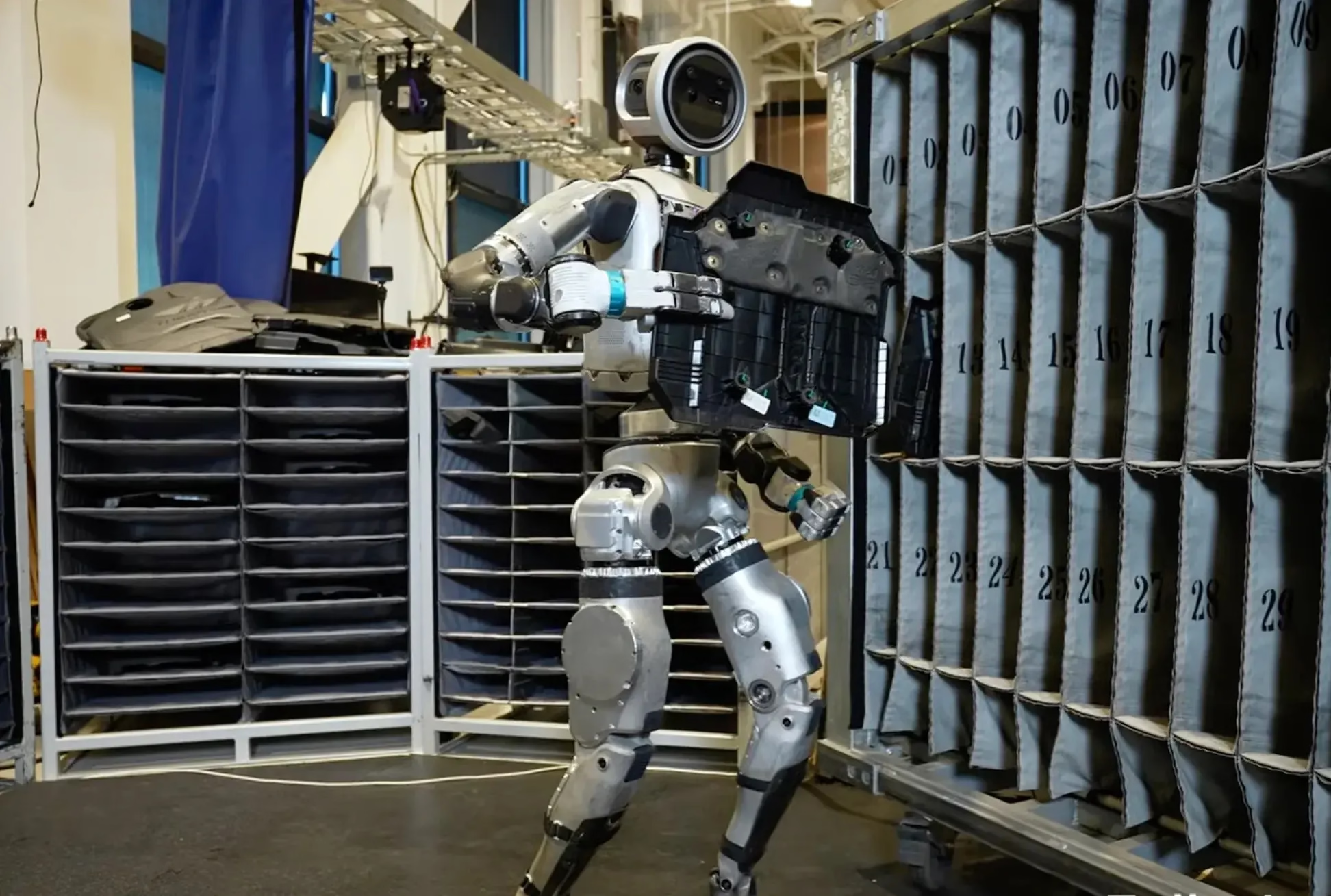
Boston Dynamics Humanoid Robot

Leg and hip assemblies

High cycle counts demand bores that stay round after coating. We machine undersize and mask before anodizing.

  • ±0.005 mm bore fit
  • 100% inspection
Kung Fu Robot

Dynamic motion links

Fast joint movement loads thin arm links. Controlled finishing passes keep wall thickness uniform.

  • Ra 0.8–1.6 μm
  • 7075 or Ti-6Al-4V
Unitree G1 Humanoid Robot Price

Sensor and harness brackets

Depth camera and LiDAR mounts need repeatable hole patterns across a batch, not one good sample.

  • Piece 50 matches piece 1
  • No MOQ
Comprehensive Guide to Buying Humanoid Robot Key Considerations and Brand Analysis

Cosmetic housing shells

Visible covers go through a finer pass, then bead blasting or anodizing, so tool marks do not read through.

  • Anodizing and hardcoat
  • Laser marking 1.5 mm
FAQs

Questions engineers ask before sending G1 parts

Can you machine replacement parts for a G1 if I only have a partial drawing?

Yes, if the critical features are defined. Send what you have: a STEP file, a 2D print, or a scan of the original part.

We will flag anything that cannot be set from the files during the DFM review, which comes back with the quote. Bores, fits and hole patterns need a stated tolerance or we will ask.

Which material should I pick for a knee or hip joint?

6061-T6 is the default for most housings. It machines cleanly, takes anodizing well and keeps mass low.

Move to 7075 if the part sees high bending load and you can accept lower corrosion resistance. Ti-6Al-4V is worth the cost where the joint wears against another surface and you need the extra hardness.

How do you handle hardcoat anodizing on a bore?

Hardcoat builds roughly 0.025 to 0.05 mm per surface, which will close a bearing fit. We cut the bore undersize by the coating thickness and mask it where the bearing seats.

Tell us the coating spec and target fit at the quoting stage. Retrofitting that decision after machining usually means remaking the part.

What is the smallest batch you will run?

There is no minimum order quantity. We will run one part for a fit check and the same program for a 10,000-part production run.

For one-offs the setup cost dominates. If a bracket is still in design, prototyping on a 3-axis mill is usually cheaper than committing to a fixture.

How do you keep the left and right leg parts matching?

Both are programmed from the same datum and cut on the same machine where the geometry allows. Mirror parts are built as mirror toolpaths, not as a flipped setup.

That keeps hole patterns and bore positions consistent across the pair. Batch inspection data is available if you want it.

Will you sign an NDA before I share files?

Yes. An NDA is available on request, and uploads are handled as secure and confidential.

Robot designs are competitive work. We keep drawings and CAD files tied to your project and do not reuse them across customers.

What do you need to quote?

A STEP or IGES file, a 2D drawing with tolerances and finish callouts, the material, and the quantity.

Without a drawing we can still quote general tolerances, but tight bore fits and surface finish need to be stated. Quote and DFM feedback come back within 12 hours.

How fast can parts ship?

Typical turnaround is 3 to 5 days after production starts, and production can begin within 24 hours of a locked drawing and material.

Small brackets and simple plates move fastest. Five-axis housings with multiple tight bores take longer because of setup and inspection time.

Send your G1 part files for a quote

Upload a STEP file and a drawing. You get a price and a DFM review within 12 hours, with no minimum order quantity.

12-hour quote100% inspectionNo MOQNDA on request

Trusted by engineers and manufacturers worldwide

Tesla Ford Motor Company BYD Auto Denso Magna International Boeing Airbus Medtronic KUKA FANUC