
CNC Machining Services for OEM Projects: A Buyer's Checklist
This guide is for engineers and sourcing managers who need a machining partner that can move from one prototype to a 10,000-part release without changing the process. It covers the checks that decide whether a shop fits your project: tolerance capability, machine envelope, certification scope, MOQ and quoting rules.
In this article
- 1
- 2
- 3
- 4
- 5
- 6
- 7
- 8
Key takeaways
What to check before you award an OEM machining contract
Use this table to compare two or three candidate shops on the points that actually drive risk.
| Check | What to ask | Red flag |
|---|---|---|
| Tolerance | Can you hold ±0.005 mm on this geometry? | Claims a number without a first-article report |
| Machine envelope | What is your maximum part size? | No stated travel limits or rotary table size |
| Certifications | Which certificates are in scope for my industry? | Lists certificates with no scope statement |
| MOQ | Can you run one piece first? | Insists on a large minimum before sampling |
| Quoting | What is included in the price? | Quote has no material or finish breakdown |
| Lead time | How many days from PO to shipment? | You cannot start production until tooling is made |
| Inspection | What is measured, and what report do I get? | No in-process checks, only final inspection |
| Confidentiality | Will you sign an NDA before files are sent? | Refuses to sign before receiving CAD data |
Pick the shop you can audit, not the one with the biggest advert
If a supplier can show real tolerance data, a defined machine envelope, certificates in scope and a quote with every line item, the project risk drops before the first chip is cut. Send your drawing and we will tell you whether CNC machining is the right process for it.
Tolerance: what a number on a website does not tell you
Every shop advertises a best-case tolerance. The useful question is whether that tolerance survives your part. A thin-walled aluminium housing at 6061-T6 behaves differently from a 17-4PH shaft, and a five-axis cut on a curved surface holds size differently than a flat face milled on a three-axis machine. Ask for the tolerance on the specific feature, not for the shop's floor number.
GreatLight works to ±0.005 mm (±0.0002 in) on turned and milled features, with surface finish options from Ra 0.2–0.8 μm for sealing faces up to Ra 1.6–3.2 μm for as-machined brackets. Those ranges are not a promise for every part. Long slender parts, deep pockets and thin webs push you toward the looser end unless you accept extra setups and more inspection time.
The practical test is the first article. Before a full run, we measure the critical dimensions, record the actual values and send the report with the parts. If a dimension sits at 80% of the tolerance band on the first piece, it will drift. A shop that shows you real numbers is easier to work with than one that only repeats a spec sheet.
- 1Tight featuresBores, bearing seats and sealing faces justify ±0.005 mm and Ra 0.2–0.8 μm.
- 2Loose featuresCovers, brackets and mounting holes are fine at Ra 1.6–3.2 μm.
- 3Geometry mattersDeep pockets and thin walls are harder than the tolerance alone suggests.
Machine capacity: the check that kills projects late
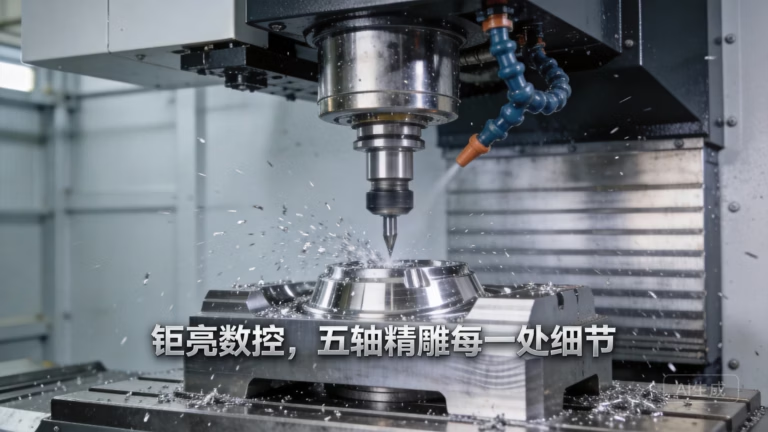
An OEM project usually starts small and grows. The shop that cut your prototype must be able to cut part number 8,000 on the same process, or you will pay for a second qualification. That means looking at the machine list, not the brochure. GreatLight runs 127 high-precision CNC machines, including 16 simultaneous five-axis centers, 16 mill-turn centers, 27 three-axis machines, 12 four-axis mills and a Ø400 mm rotary table.
Size limits decide more projects than most buyers expect. The largest travel is 4,000 × 400 × 150 mm. Medium work fits on 750 × 1,150 × 550 mm or 600 × 600 × 600 mm tables. Compact parts run on 500 × 500 × 450 mm or 500 × 310 × 200 mm machines. If your part is 4,200 mm long, no amount of five-axis skill helps. Check the envelope before you send a purchase order.
Scope matters too. A shop that only mills will send your turned parts elsewhere, and you lose control of the schedule. Look for milling and turning under one roof, plus finishing and assembly if the drawing calls for anodizing or laser marking. GreatLight offers five-axis, four-axis and three-axis machining, mill-turn, rapid prototyping, sheet metal fabrication, die casting, vacuum casting, 3D printing and surface finishing.
- 1Ask for travel limitsGet the X, Y and Z numbers for the machine that will run your part.
- 2Check the second operationTurning, finishing and marking should stay in the same supply chain.
- 3Plan for volume growthConfirm the same process can scale from 1 piece to 10,000+.
Certifications: read the scope, not the logo
Certificates are only useful when they cover the work you are buying. ISO 9001:2015 is a general quality system and fits most industrial machinery, robotics and electronics parts. Automotive and EV programs usually require IATF 16949:2016. Medical device work needs ISO 13485:2016. If your drawings or data are sensitive, ISO 27001:2022 covers information security.
GreatLight holds all four: ISO 9001:2015, IATF 16949:2016, ISO 13485:2016 and ISO 27001:2022. The point is not the wall of logos. It is that the audit trail, document control and traceability procedures are already in place, so you are not paying a supplier to build a quality system on your project.
Two questions cut through most certification claims. First, which site is certified? A group certificate may not cover the plant that will run your parts. Second, what does the inspection record look like? Ask for a sample report. If the shop cannot show you one, the certificate will not help when a dimension drifts.
- 1Industrial partsISO 9001:2015 is the baseline requirement.
- 2Automotive and EVIATF 16949:2016 is normally required by the customer's quality team.
- 3Medical devicesISO 13485:2016 applies to the manufacturing process, not only the product.
- 4Sensitive designsISO 27001:2022 governs how files and data are handled.
MOQ, quoting and lead time: where budgets slip
Minimum order quantity is a hidden cost. A shop that demands 500 pieces before it will quote forces you to buy inventory before the design is proven. GreatLight has no minimum order quantity, so you can start with one prototype and scale to a 10,000+ part run on the same process. That is useful when a design is still moving and you need real machined parts for a test fixture.
Lead time should be split into stages. Ask how long the quote takes, when production starts and when parts ship. GreatLight returns a quotation and free DFM analysis within 12 hours, can start production within 24 hours, and ships parts in 3–5 days. The historical late-delivery probability is below 2%. Those numbers apply to normal jobs, not to parts that need a new mold or an unusual material.
Quoting is the last place to check. A price without a material grade, finish and inspection line is not a price. Ask whether the quote includes material certification, first-article inspection and packaging. If the answer changes after you place the order, the original quote was incomplete.
- 1No MOQOne prototype is a valid order, and volume pricing comes later.
- 2Quote in 12 hoursIncludes a free DFM analysis so you can fix problems before cutting.
- 3Ship in 3–5 daysProduction can start within 24 hours of a released PO.
When CNC machining is the wrong choice for an OEM project
CNC machining is the right call for tight tolerances, low to medium volume and parts that must be functional, not just shaped. It is the wrong call when the part is a large thin shell with no critical dimensions, when the annual volume is high enough that tooling pays back, or when the geometry is a hollow form that only molding can produce.
Die casting and vacuum casting usually beat machining on cost once volume passes the tooling break-even point. Sheet metal fabrication is faster for flat brackets and enclosures. 3D printing wins when you need a form-and-fit check in days and the material properties are secondary. A shop that offers all of these can tell you which one fits, instead of pushing the process it owns.
There is also a middle path. A machined prototype can validate the design, then the same shop can quote a die-cast or vacuum-cast version for production. That keeps the interface dimensions consistent and avoids a second round of tolerance stack-up work.
- 1Choose CNCTight tolerance, functional parts, low to medium volume.
- 2Choose castingHigher volume where tooling cost is recovered by piece price.
- 3Choose sheet metalFlat or folded parts with generous tolerances.
- 4Choose 3D printingFast form-and-fit checks where material strength is not critical.
Step by step: qualify an OEM machining partner in 7 moves
- 1Send a drawing with real tolerancesInclude GD&T, material grade and finish callouts. A drawing without tolerances gets a quote that will change later.
- 2Ask for the machine envelopeRequest the X, Y and Z travel and the rotary table size for the machine that will run your part. Compare against your largest dimension.
- 3Request a first-article sampleOrder one piece before the full run. Measure the critical dimensions yourself or ask for a report with actual values.
- 4Confirm the certificate scopeAsk which site holds the certificate and whether it covers your industry. Get a sample inspection report.
- 5Check the MOQ and ramp planConfirm you can start with one piece and scale to 10,000+ without changing the process or re-qualifying fixtures.
- 6Read the quote line by lineMaterial grade, finish, inspection and packaging should each appear. If a line is missing, ask before you approve.
- 7Sign the NDA before sending CADKeep the confidentiality step early. Secure upload and an NDA protect your design before any tooling is discussed.
Questions buyers ask before awarding an OEM contract
What tolerance can you actually hold on an OEM production run?
On turned and milled features, ±0.005 mm (±0.0002 in) is the working tolerance. Surface finish ranges from Ra 0.2–0.8 μm on sealing faces to Ra 1.6–3.2 μm on as-machined surfaces.
The number that matters is the one on your critical feature. Long slender parts, deep pockets and thin walls may need a looser tolerance or extra setups. We confirm this during the free DFM review before quoting.
Can you run one prototype and then scale to 10,000 parts?
Yes. There is no minimum order quantity, so a single prototype is a valid order. The same process and fixtures carry into higher volume, which avoids a second qualification round.
For very high annual volume, we may recommend die casting or vacuum casting as a lower piece-price option and quote both paths.
Which certifications cover automotive and medical OEM work?
Automotive and EV programs are normally run under IATF 16949:2016. Medical device work is covered by ISO 13485:2016. ISO 9001:2015 is the baseline quality system for industrial parts.
ISO 27001:2022 covers information security for sensitive drawings and data. Ask which site holds the certificate, because a group certificate does not always cover every plant.
How fast is a quote and how fast do parts ship?
Quotation and free DFM analysis come back within 12 hours. Production can start within 24 hours of a released purchase order.
Standard parts ship in 3–5 days. Jobs that need a new mold, an unusual material or a long finishing sequence take longer, and we will say so in the quote.
What materials and finishes do you work with?
Aluminium grades include 6061, 6061-T6, 2024, 5052, 5083, 6063, 6082, 7075 and ADC12. Stainless options run from 303 and 304 to 17-4PH. Steel, copper, brass, titanium, Inconel, magnesium and engineering plastics such as POM, PEEK and PC are also available.
Finishes include anodizing, electroless nickel, zinc, silver and gold plating, powder coating, black oxide, bead blasting, polishing, and laser marking down to 1.5 mm character height.
How do you protect our design before tooling starts?
Uploads are handled as secure and confidential. An NDA is available on request, and we sign it before CAD files are exchanged.
Document control follows ISO 27001:2022 procedures, so access to your drawings is limited to the people who need it for the job.
Send your OEM drawing for a 12-hour quote
Upload your CAD and we will return a quotation with a free DFM analysis, so you can see the tolerance, material and finish plan before you commit.
12-hour quoteNo MOQ100% inspection before shipmentNDA on request
More OEM machining notes
We publish setup notes, tooling trials and inspection data from the factory floor.











