
CNC Machining Services India: A Buyer Guide for Engineers
This page is for engineers and sourcing teams comparing cnc machining services india suppliers against overseas partners. It covers the checks that actually decide a PO: tolerance capability, lead time, MOQ, certifications and how a shop writes its quotation. Read it before you send drawings.
In this article
- 1
- 2
- 3
- 4
- 5
- 6
- 7
- 8
- 9
Key takeaways
What to check against what you are buying
Use the row that matches your part, then read the columns left to right.
| Part situation | First check | Red flag |
|---|---|---|
| Mating bore or bearing seat | Per-feature tolerance and gauge | Only a general ±0.1 mm note |
| Thin-wall or long shaft | Fixture and 5-axis capability | Quote with no setup note |
| Prototype, one piece | MOQ and setup fee policy | Minimum order of 100 pieces |
| Regulated medical or auto | ISO 13485 / IATF 16949 scope | Certificate with no scope page |
| Cosmetic visible surface | Finish range in Ra | Ra stated without a range |
| Large frame up to 4,000 mm | Machine travel and flatness | Travel quoted from a brochure |
| Tight deadline build | Quote turnaround time | Quote promised but not dated |
Tolerance: read the drawing, not the brochure
Every supplier advertises a tight number. The useful question is which feature that number applies to. A shop can hold ±0.005 mm on a 20 mm bore turned in one setup and still struggle on a 600 mm plate that moves after stress relief. Ask the shop to mark up your drawing with the tolerance it can hold per feature, then compare that against your functional requirement.
Two things drive the achievable number: machine geometry and the number of setups. A part cut on a simultaneous 5-axis center in one fixturing sees far less stack-up than the same part run across three 3-axis operations. If your design has true position callouts or datum features on opposite faces, setup count matters more than spindle speed.
Inspection is the other half. A tolerance is only real if someone measures it and writes it down. For a first article, ask for dimensional reports on the critical features, and for material certificates on the heat. On production runs, ask how many parts are checked and at what interval.
- 1Send the drawing with GD&T intactStripped drawings invite a price on the easy features only.
- 2State the fit, not just the numberA press fit and a slip fit need different control.
- 3Ask for the gaugeCMM, bore gauge or pin gauge changes what is actually verified.
Lead time: separate quote time from production time
Lead time in a quotation is often three numbers blended into one. There is the time to quote, the time to start, and the time on the machine. A shop that returns a quotation and a DFM analysis within 12 hours is telling you something about how it plans work. A shop that takes a week to price a simple bracket is telling you something else.
Ask when production can start after PO and material arrival. If the answer is within 24 hours for a standard material like 6061 aluminium or 304 stainless, the shop probably keeps stock and has open spindle capacity. If it is two weeks, the queue is long or the material is not on the shelf.
For the run itself, ask for a ship window in days, not a vague month. A shop that ships standard parts in 3–5 days is running a stable process. Push back on any promise that sounds like a round number with no material lead attached.
- 1Quote timeHow fast the shop reads your drawing and comes back.
- 2Start timeWhen the first chip is cut after PO and material.
- 3Run timeMachine hours plus finishing plus inspection.
MOQ, setup cost and what the quote actually covers
Minimum order quantity tells you how the shop is set up. A supplier that accepts one prototype and a 10,000 part run without changing its process is working from a standard setup library, not from a one-off tooling build. That flexibility usually shows up as a lower total cost on low-volume engineering builds.
Read the quote line by line. Does it include material, machining, finishing, inspection and packing, or only the machine time? Anodizing, electroless nickel and laser marking are separate operations with their own lead times. A quote that omits them is not cheaper; it is incomplete.
Watch for setup fees buried in the unit price on small quantities. A 50-piece order priced like a 5-piece order hides a setup charge. Ask for the setup line to be shown separately so you can compare two suppliers on the same basis.
- 1No MOQ means no setup penaltyOne piece to 10,000+ without a process change.
- 2Finishing is a second lead timeBuild it into the schedule, not after.
- 3Ask for the setup lineIt makes two quotes comparable.
Certifications: scope matters more than the frame on the wall
ISO 9001:2015 tells you a quality system exists. For medical work, ISO 13485:2016 is the relevant standard. For automotive and EV parts, IATF 16949:2016 is the one your customer will ask about. For anything with drawings and IP attached, ISO 27001:2022 covers how the files are handled.
Ask to see the scope statement, not just the certificate number. A certificate that lists a different process, a different plant or a different product family may not cover the part you are buying. If your part runs at a second site, the certificate must name that site.
Then ask the operational question: what happens when a part fails in-process inspection? A written containment and rework procedure is worth more than a laminated certificate. The answer should name who decides, what is quarantined, and how you are notified.
- 1Match the standard to the industry9001 for general, 13485 for medical, 16949 for auto.
- 2Check the scope pagePlant and process must match your part.
- 3Ask for the nonconformance pathHow you are told, and when.
Process fit: when a supplier is the wrong choice
A good machine shop is not automatically a good fit for your part. If your design is a thin-wall enclosure with cosmetic surfaces on five sides, a shop that mostly runs heavy shafts will fight it. If your part needs an as-machined Ra 1.6–3.2 μm finish, do not send it to a shop that only quotes fine finishes at Ra 0.2–0.8 μm and adds cost you did not ask for.
Material is a second filter. Inconel, titanium TC4 (Ti-6Al-4V) and 17-4PH stainless cut slowly and wear tools. A shop without experience on those grades will underquote the cycle time. Ask what it ran last month in the same family before you trust the number.
Finally, match the shop to the quantity curve. Prototype work rewards fast setup and DFM feedback. Production work rewards repeatability, fixture design and inspection density. A supplier strong in one is not always strong in the other.
- 1Cosmetic thin-wall partsNeed fixture discipline and surface control.
- 2Hard alloysInconel, Ti-6Al-4V and 17-4PH cut slowly; check past work.
- 3Prototype vs productionDifferent strengths; ask which one the shop is built for.
How to compare a domestic supplier with an overseas one
The comparison is rarely about the hourly rate. Add the cost of the engineering time you spend chasing status, the cost of a rework loop that crosses a border, and the cost of a late build. Those three items often erase a lower unit price.
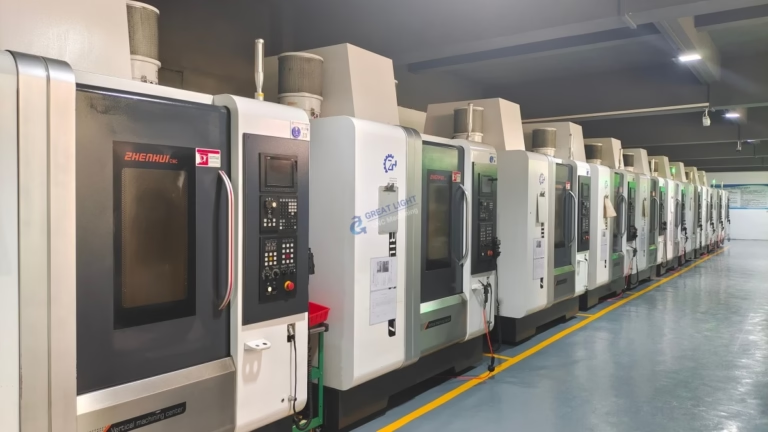
Overseas suppliers that publish their capacity and quality numbers are easier to audit. If a shop lists 127 high-precision CNC machines, 16 simultaneous 5-axis centers and a 4,000 mm maximum processing size, you can match your part envelope to real equipment instead of guessing. The same applies to a stated tolerance of ±0.005 mm and a qualification rate of 99.99%.
Communication is the deciding factor for many teams. A shop that answers a process question the same day, in writing, with a drawing markup, is easier to work with than one that needs a call to explain a tolerance. Test this during the quote, not after the PO.
- 1Add the soft costsChasing, rework shipping, and schedule recovery.
- 2Match envelope to machine listTravel and table size should be published.
- 3Test responsiveness at quote stageThat is the cheapest test you will run.
Seven steps to qualify a supplier before the PO
Run these in order. Each step is cheap and catches a different failure mode.
- 1Send a marked-up drawingInclude GD&T, datums and the fit intent. Ask the shop to reply with the tolerance it can hold per feature and the setup count. Compare that reply against your functional requirement before discussing price.
- 2Ask for quote and DFM turnaroundA realistic target is a quotation with DFM notes within 12 hours. If the shop cannot date its reply, treat the lead time in the eventual quote as unverified.
- 3Confirm material availabilityName the exact grade, for example 6061-T6, 17-4PH or Ti-6Al-4V. Ask whether it is in stock or ordered. Material is the most common hidden delay.
- 4Ask when production can startFor standard grades, a shop with open capacity can start within 24 hours of PO. If the answer is weeks, check whether the queue or the material is the constraint.
- 5Get the finishing and inspection scope in writingList the finish callout and Ra range, then the inspection level. Ask how many parts are checked, on what gauge, and what report you receive.
- 6Request the certificate scope pageMatch the standard and the plant to your part. ISO 9001:2015, IATF 16949:2016, ISO 13485:2016 and ISO 27001:2022 cover different risks.
- 7Run one small order firstBuy 5 to 20 parts and measure the critical features yourself. Check the packing, the paperwork and the promised ship window. Then scale.
Questions buyers ask before placing an order
What tolerance should I expect from a cnc machining services india supplier?
It depends on the feature, not the supplier's headline. On small turned and milled features in aluminium or stainless, ±0.005 mm is achievable when the part is cut in one setup and measured on a CMM.
On large frames, thin walls or parts that need multiple setups, expect the practical number to loosen. Ask for tolerance per feature and get the inspection method named before you agree.
Is there a minimum order quantity for prototypes?
Not at every shop. Some suppliers accept a single prototype and also run 10,000+ part batches without changing the process. That matters because a prototype order is where you find out whether the shop reads drawings carefully.
If a supplier insists on 100 pieces for a first article, the setup cost is being spread rather than reduced. Ask for the setup line to be shown separately so you can compare.
How fast can parts ship after a purchase order?
For standard materials and simple geometry, a shop with open capacity can start production within 24 hours of PO and ship parts in 3–5 days. Add time for finishing operations such as anodizing or plating.
Treat any ship date as tied to material arrival. Ask what is in stock and what is on order before you accept the date.
Which certifications actually matter for my part?
ISO 9001:2015 covers a general quality system. Medical device work usually needs ISO 13485:2016, and automotive or EV parts usually need IATF 16949:2016. ISO 27001:2022 covers information security, which matters when you send CAD files.
Check the scope statement for the plant and process, not just the certificate number. A certificate for a different site does not cover your order.
How do I compare two quotes fairly?
Normalise them. Confirm both include material, machining, finishing, inspection and packing. Ask for setup cost as a separate line. Then compare lead time measured from the same start point.
A quote that omits finishing or inspection is not lower cost. It is an incomplete scope that will come back as a change order.
What should I do before scaling to production volumes?
Run a small order first, measure the critical features yourself and review the paperwork. Check that the ship window was met and that the finish matches the callout.
Once the first batch is verified, scale the quantity. Keep the drawing revision and the inspection report from that batch as your reference.
Send a drawing and get an engineer's read
We reply with a quotation and a DFM analysis within 12 hours, and every part is inspected before it ships. No minimum order quantity, from one prototype to 10,000+ parts.
12-hour quoteNo MOQ100% inspectionNDA on request
More from the shop floor
We publish setup notes, tooling trials and inspection data from the factory floor.











