
CNC Machining Services Sandoval County NM: A Buyer's Checklist
This guide is for engineers and procurement teams in Sandoval County who need machined parts and want to qualify a supplier before the first PO. It covers tolerance, machine selection, MOQ, certifications and quoting so you can compare vendors on facts rather than brochures.
In this article
- 1
- 2
- 3
- 4
- 5
- 6
- 7
- 8
Key takeaways
What to check before you award a machining job
Use this as a screening sheet. A supplier that cannot answer a row in writing is a risk on that row.
| Check | What to ask | Good answer | Warning sign |
|---|---|---|---|
| Tolerance | What can you hold on my material? | ±0.005 mm on critical features | Only 'tight tolerance' with no number |
| Machine fit | Which machine runs this part? | 5-axis for multi-sided, 3-axis for flat | One machine quoted for everything |
| Minimum order | Can you run one piece? | No MOQ, prototype to 10,000+ | Large minimum before any quote |
| Certifications | Which certificates apply? | ISO 9001, IATF 16949, ISO 13485 | Certificate claimed, not shown |
| Inspection | How much is inspected? | 100% before shipment | AQL sample only, no report |
| Lead time | When do parts ship? | Quote in 12 h, ship in 3–5 days | Vague 'depends' with no range |
| Confidentiality | Will you sign an NDA? | NDA on request, secure uploads | No written confidentiality |
The short version
Pick the supplier that answers tolerance, machine, MOQ and inspection questions in writing. Everything else is a brochure.
Tolerance and geometry decide the machine, not the other way around
Start with the tightest callout on your drawing. A bore at Ø20 H7, a flatness callout under 0.02 mm, or a true position of 0.05 mm all push the job toward a different setup than a bracket with general ±0.1 mm dimensions. When you ask for CNC machining services Sandoval County NM suppliers, ask what they can hold on your specific material and feature size. Aluminum 6061 behaves differently from 17-4PH stainless at the same tolerance.
GreatLight quotes to ±0.005 mm on critical features where the geometry allows it, with a 99.99% qualification rate across production runs. That number is not a promise for every part. A deep, thin-walled pocket in titanium will move during cutting no matter who machines it. A good shop says so at quote stage, before the chips fly.
Quantify the features that drive cost. Deep holes, sharp internal corners and thin floors need more passes, more tool changes and more inspection. If your design has a corner radius smaller than the tool that can reach it, the shop either adds EDM time or asks you to open the radius. Both cost money.
- 1Send the 3D model and the 2D drawingModels carry geometry; drawings carry tolerance and finish. Missing either one slows the quote.
- 2Flag critical-to-function featuresMarking three or four dimensions as critical lets the shop focus inspection where it matters.
- 3State the finish up frontRa 0.8–1.6 μm is a normal machined finish; Ra 0.2–0.8 μm needs extra time.
Which machine class fits your part
Three-axis machining handles flat plates, covers and housings where every feature is reachable from one direction. It is the cheapest route and the easiest to schedule. If your part has holes on four sides, though, a 3-axis shop will run four setups, and each setup adds a positional error stack and queue time.
Four-axis and mill-turn centers add a rotary table or a second spindle. A Ø400 mm rotary table lets the tool reach around the part without re-clamping, which matters for cylindrical parts with cross-drilled holes. Mill-turn work suits shafts, fittings and parts that need turning and milling in one cycle.
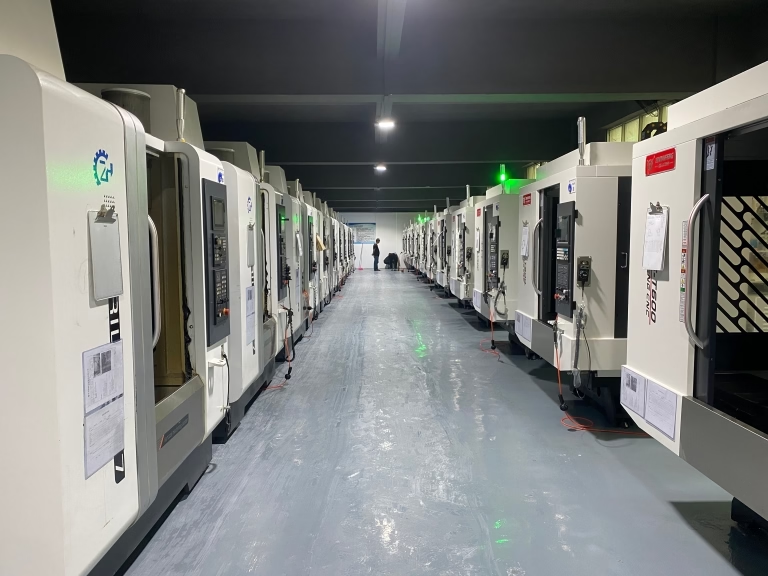
Five-axis machining is the answer for contoured surfaces, impellers, and parts with features on five or more faces. Sixteen simultaneous 5-axis centers in one plant means the shop can hold angular relationships that no sequence of 3-axis setups can repeat. The trade-off is programming time and hourly rate, so reserve it for parts that actually need it.
Size drives the choice too. GreatLight runs a 4,000 mm maximum processing size for long parts, plus cells at 750 × 1,150 × 550 mm and compact 500 × 500 × 450 mm for small, high-mix work. Sending a 1,200 mm rail to a shop whose largest machine is 600 mm creates a problem you cannot design around.
- 1Count the setupsEvery re-clamp adds tolerance stack. Fewer setups usually means a more repeatable part.
- 2Check the work envelopePart size plus fixture size must fit the travel. Ask for the travel numbers, not 'big enough'.
Materials, finishes and what they change
The material list should be broad enough to cover your program without a second vendor. Common picks include 6061-T6 and 7075 aluminum, 303 and 316L stainless, 17-4PH, 4140 and 4340 steel, C360 brass, and Ti-6Al-4V. Plastics matter too: POM and PEEK machine cleanly, while carbon fibre and some filled plastics wear tooling fast and need slower feeds.
Finish is where quotes drift. As-machined surfaces at Ra 1.6–3.2 μm are fine for internal brackets. Anodizing, hardcoat, electroless nickel and powder coating add a vendor step and a lead-time step. If your part needs laser marking, note the minimum character height of 1.5 mm, because finer text will not survive the marking process cleanly.
Ask where the finishing happens. A shop that machines and finishes under one roof controls the schedule. A shop that outsources anodizing hands your delivery date to a third party it does not manage. That is a real risk on a build that is already late.
- 1Name the alloy, not just 'aluminum'6061 and 7075 machine differently and price differently.
- 2Decide if finish is cosmetic or functionalHardcoat for wear, clear anodize for looks. They are not interchangeable.
What the certifications actually cover
ISO 9001:2015 covers the general quality system: document control, traceability, corrective action. It is the baseline. IATF 16949:2016 adds automotive requirements such as statistical process control and failure mode analysis, which is what a Tier-1 auto buyer expects to see. ISO 13485:2016 is the medical device standard and governs process validation and record retention.
ISO 27001:2022 is less common among machine shops. It covers information security, which matters when you upload CAD files, drawings and program data to a supplier portal. For defense-adjacent or IP-sensitive programs, that certificate plus a signed NDA is a reasonable starting point.
Inspection is the part buyers forget to ask about. GreatLight inspects 100% of parts before shipment, with raw material checks, in-process monitoring and a final inspection, and provides reports on request. That is a different posture from a shop that samples with an AQL plan and ships. On low-volume, high-value parts, 100% inspection is usually the cheaper option, because a field failure costs more than the inspection time.
- 1Match certificate to industryAuto: IATF 16949. Medical: ISO 13485. General: ISO 9001.
- 2Ask for the inspection reportReports on request are normal. A refusal to provide dimensional data is not.
Lead time, MOQ and the quoting process
Lead time has three parts: quote, production start, and shipping. GreatLight returns a quotation with a free DFM analysis within 12 hours, can start production within 24 hours, and ships parts in 3–5 days. Historical late-delivery probability sits below 2%. Those numbers describe normal conditions, not a promise for a job with an exotic alloy and a hardcoat finish.
MOQ is the clearest signal of how a shop is organized. No minimum order quantity means the shop can run one prototype and then the same part at 10,000+ without moving to a different process. If a supplier quotes a high minimum on a prototype, they are either protecting a setup cost or they are not set up for low-volume work. Either way, you learn something useful.
The quote itself should be a DFM conversation, not a price list. A useful quote names the machine, the stock size, the number of setups, the inspection plan and the finish route. If a quote is one line with a number, ask for the breakdown. That request filters out shops that are guessing.
- 1Ask for the DFM notesFree DFM analysis on the quote is normal for a competent shop.
- 2Check the late-delivery historyA stated late-delivery rate is more useful than an optimistic ship date.
How to qualify a supplier in seven steps
Run these in order. Stop at the first step where the answer is vague.
- 1Send a complete data packageSTEP, IGES or native CAD plus a 2D drawing with tolerance, finish and material callouts. Missing data guarantees a slow, padded quote.
- 2Ask for tolerance on your featuresRequest the holdable tolerance for the specific material and feature. A number like ±0.005 mm with a note on where it does not apply is a good answer.
- 3Confirm the machine and work envelopeAsk which machine class runs the part and the travel dimensions. If the part is 1,200 mm long, confirm the machine can take it plus the fixture.
- 4Check MOQ against your volumeAsk for pricing at one piece, 100 pieces and 10,000 pieces. A wide, coherent range shows the shop can scale with you.
- 5Verify certifications for your industryAsk for the certificate number and scope. Match it to your sector: ISO 9001, IATF 16949 or ISO 13485.
- 6Agree the inspection planDecide what is measured, how often and what report you get. 100% inspection before shipment removes the sample-size argument.
- 7Sign the NDA before file transferUpload through a secure portal and get the NDA in place before drawings move. ISO 27001 is a useful signal here.
Questions buyers ask before the first PO
What tolerance can a shop actually hold?
It depends on material, feature geometry and how the part is fixtured. GreatLight quotes to ±0.005 mm on critical features where the geometry allows, and states where a looser tolerance applies.
Ask the question feature by feature. A single tolerance number for the whole drawing usually means the shop has not thought about it.
Do I need 5-axis machining for my part?
Only if features sit on several faces, or if the geometry is contoured. Five-axis cuts setup count and holds angular relationships that stacked 3-axis setups cannot repeat.
For flat plates and simple housings, 3-axis is faster and cheaper. Ask the shop to justify the machine choice in the quote.
Is there a minimum order quantity?
GreatLight runs no minimum order quantity, from one prototype to 10,000+ part runs. That lets you validate a design before committing to tooling or a large batch.
If a supplier insists on a high minimum for a prototype, that is a sign their process is set up for volume only.
How fast can parts ship?
Quotation with free DFM analysis comes back within 12 hours, production can start within 24 hours, and parts ship in 3–5 days. Historical late-delivery probability is below 2%.
Exotic materials, tight finishes and large part counts extend the schedule. Get the extended date in writing before you approve.
Which certifications should a machine shop hold?
ISO 9001:2015 is the baseline. Automotive work needs IATF 16949:2016; medical work needs ISO 13485:2016; programs with sensitive files benefit from ISO 27001:2022.
Ask for the certificate scope, not just the logo. A certificate that does not cover your process step is not much help.
How do I protect my design files?
Sign an NDA before you transfer anything, and upload through a secure portal rather than email attachments. GreatLight offers an NDA on request and treats uploads as confidential.
If a supplier will not sign a mutual NDA, treat that as a hard stop.
Send your drawing and get a DFM-backed quote
Upload your model and drawing, and we return a quotation with free DFM analysis within 12 hours. No minimum order quantity, 100% inspection before shipment.
12-hour quote100% inspectionNo MOQNDA on request
More from GreatLight
We publish setup notes, tooling trials and inspection data from the factory floor.











