
CNC Machining Services Texas Buyers Can Verify
A practical sourcing guide for Texas engineers and procurement teams comparing local machine shops with overseas precision suppliers. Read this and you will know which questions to ask, which numbers actually matter, and where a supplier will quietly add cost or delay.
In this article
- 1
- 2
- 3
- 4
- 5
- 6
- 7
- 8
- 9
Key takeaways
Texas machine shop vs. overseas precision supplier
Same part, different supply chain. Use this to decide where each job belongs.
| Factor | Local Texas shop | Overseas precision supplier | What to verify |
|---|---|---|---|
| Typical lead time | 3–10 days for simple parts | 3–5 days once production starts | When does the clock start? |
| Complex geometry | Often 3-axis only | 16 simultaneous 5-axis centers | Ask for the setup plan |
| Tolerance floor | ±0.013 mm common | ±0.005 mm (±0.0002 in) | Batch-wide or single part? |
| Minimum order | Varies, often 10–50 pcs | No minimum, 1 to 10,000+ | Any setup surcharge? |
| Certifications | Varies by shop | ISO 9001, IATF 16949, ISO 13485, ISO 27001 | Check scope, not just logo |
| Shipping | Domestic truck, 1–3 days | Air freight, customs clearance | Who files the paperwork? |
| Engineering feedback | Walk-in possible | DFM report in 12 hours | Is DFM free before PO? |
The verdict
If your part needs true 5-axis geometry, tight tolerance across a batch, or a run that starts at one piece, a verified overseas precision supplier usually wins. If it is simple, urgent and local, stay close to home.
What a tolerance claim actually means
Every supplier advertises a tight number. Few explain where it applies. A shop may hold ±0.005 mm on a 20 mm aluminum bracket and miss it on a 900 mm steel rail, because thermal growth and tool deflection scale with length. Before you compare quotes, ask for the tolerance on your longest critical dimension, not the smallest feature.
Material matters as much as geometry. Aluminum 6061 and 7075 cut cleanly and hold ±0.005 mm in stable temperature. Austenitic stainless such as 304 and 316L work-hardens, so light passes and sharp tooling matter more than spindle speed. Titanium TC4 (Ti-6Al-4V) and Inconel move under heat; a shop without coolant-through tooling and in-process probing will drift mid-run.
Thin walls are the usual failure point. Below 1 mm wall on aluminum and 1.5 mm on stainless, vibration shows up as chatter marks and taper. If your design has a 0.8 mm rib, say so in the RFQ. A supplier that responds with a tooling plan is worth more than one that simply says yes.
Surface finish is separate from dimensional accuracy. Ra 1.6–3.2 μm is standard as-machined. Ra 0.8–1.6 μm needs a finishing pass and often a different insert. Ra 0.2–0.8 μm usually means additional lapping or polishing, which adds cost and a second inspection step.
- 1State the critical dimensionOne or two features matter most. Mark them on the drawing.
- 2Name the material grade"Stainless" is not enough. 304, 316L and 17-4PH behave differently.
- 3Separate finish from toleranceThey are quoted and inspected as different requirements.
How machine capacity changes your part and price
A 5-axis machine does not make every part cheaper. It makes certain parts possible. Undercuts, angled ports, contoured impeller faces and deep pockets with non-orthogonal walls are where 3-axis work needs multiple fixtures and each fixture adds positional error. On a part with four angled faces, moving to simultaneous 5-axis can remove three setups and the associated stack-up.
Size sets the limit. GreatLight runs a 4,000 mm maximum processing size, with a large travel envelope of 4,000 × 400 × 150 mm for long extrusions and rails. Medium envelopes of 750 × 1,150 × 550 mm and 600 × 600 × 600 mm cover most housings and brackets. Compact work such as 500 × 500 × 450 mm and 500 × 310 × 200 mm suits small precision components. A Ø400 mm rotary table handles round parts that need indexing.
Turning and milling in one setup is underrated. Mill-turn centers machine a shaft and its flats without re-chucking, which protects concentricity. If your part has a turned bore and a milled slot on the same axis, ask whether it can be done on a mill-turn center instead of two machines.
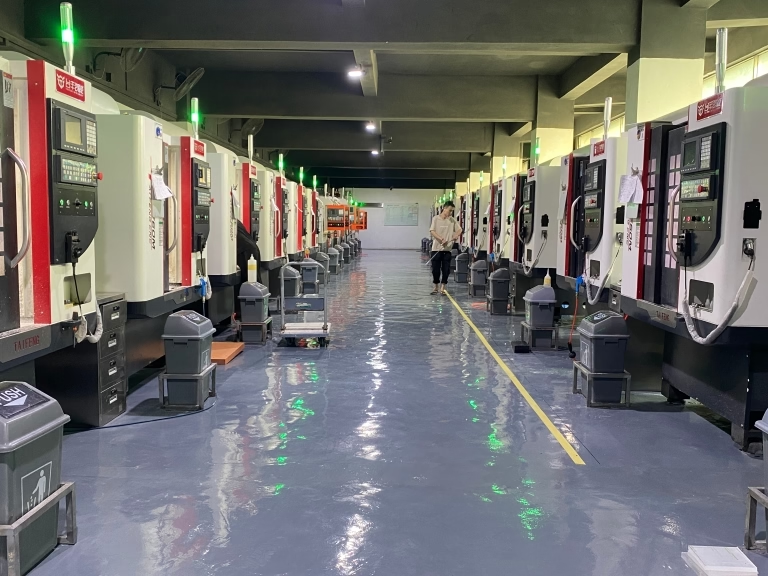
Capacity also means scheduling. A shop with 127 high-precision CNC machines can absorb a rush order without pushing your job. A shop with six spindles cannot. Ask how many machines are dedicated to jobs like yours and what happens when a hot job lands.
- 1Count the setupsEach setup adds tolerance stack-up and labor.
- 2Check the envelopePart size plus fixture must fit the travel.
- 3Ask about mill-turnOne chucking beats two for concentric features.
Lead time, quote time and the hidden third clock
Buyers compare lead time as a single number. It is three. First is quoting: how long before you get a price and a DFM note. GreatLight returns quotation and free DFM analysis within 12 hours. Second is material release, which depends on whether the grade is stocked. Third is machining and inspection, where production can start within 24 hours and parts ship in 3–5 days.
The hidden clock is inspection. A supplier that promises 3-day shipping but inspects only the first article will ship a batch you have to screen. GreatLight runs 100% inspection before shipment: raw material check, in-process monitoring and final inspection, with reports on request. That step costs time but removes the rework loop that eats far more.
Ask about late-delivery history, not just the promise. A supplier tracking its own on-time rate can tell you the real number. GreatLight's historical late-delivery probability is below 2%. Any shop that cannot describe how it measures on-time delivery is guessing.
Customs and freight belong on the timeline too. Air freight from Dongguan to a Texas address adds transit days and clearance. Build that into your schedule rather than discovering it after the PO. For repeat programs, a small buffer stock of finished parts often beats expedited shipping.
- 1Quote clock12 hours including DFM feedback.
- 2Production clockStart within 24 hours, ship in 3–5 days.
- 3Inspection clock100% inspection before shipment, reports on request.
Certifications and what they cover
Certificates are only useful if the scope matches your part. ISO 9001:2015 covers a general quality management system. IATF 16949:2016 adds automotive-specific process control and traceability, which matters for powertrain and EV components. ISO 13485:2016 applies to medical device manufacturing and brings tighter documentation and change control. ISO 27001:2022 covers information security, which matters if you are sending proprietary CAD.
Ask for the certificate scope, not the logo. A shop may hold ISO 9001 for one facility and machine your parts at another. GreatLight operates three wholly-owned plants, so confirm which site will run the job and that its scope covers your process.
Confidentiality is a procurement issue, not a legal afterthought. Uploads are secure and confidential, and an NDA is available on request. If your drawings carry export-controlled geometry, raise it before the RFQ, not after.
For medical and aerospace work, also ask about material traceability. A mill certificate tied to the heat number should travel with the parts. If the supplier cannot connect a finished part back to a material lot, the certification is decoration.
- 1Match scope to industryISO 9001 is the floor, not the ceiling.
- 2Confirm the siteCertificates are issued per facility.
- 3Request traceabilityHeat number to finished part.
MOQ, tooling and the cost of a bad quote
Minimum order quantity quietly decides whether a prototype is affordable. GreatLight has no minimum order quantity, so a single prototype and a 10,000+ part run go through the same quoting path. That matters for Texas R&D teams that need three parts to test before committing to a production tool.
Watch for setup charges buried in the unit price. A quote that folds a $600 fixture into a 5-piece order looks expensive per part; the same fixture spread over 500 pieces disappears. Ask for the setup cost as a separate line so you can model both volumes.
Material substitution is the most common silent cost. A supplier quoting 6061 instead of 7075 will look cheaper and fail your strength requirement. Insist that the quote names the grade and temper. If a grade is unavailable, the supplier should ask, not substitute.
Finishing is a second supply chain. Anodizing, electroless nickel, powder coating and laser marking are often outsourced, which adds days and a handoff. GreatLight keeps post-processing in-house, including anodizing in clear, color, hardcoat and conductive types. Ask where finishing happens and who owns a rejection.
- 1No MOQOne prototype to 10,000+ parts.
- 2Separate setup costModel it at low and high volume.
- 3Name the grade6061 and 7075 are not interchangeable.
Seven things that should stop a purchase order
A quote that arrives in an hour with no questions is not efficient, it is careless. Every machined part has at least one feature worth asking about: a thin wall, a tight true position, a surface finish that needs a second operation. Silence on all of them means nobody read the drawing.
Other warnings are structural. A supplier who cannot name the machines that will run your job, who quotes a tolerance without saying where it applies, or who treats certification as a logo on a website is asking you to carry the risk. Cheap unit price rarely survives the first rejected batch.
Also watch the communication channel. If the only contact is a sales inbox and engineering questions disappear, your DFM feedback will be slow. A direct line to a process engineer shortens every iteration.
None of this means overseas suppliers are risky by default. It means the vetting questions change. With a local shop you can visit. With an overseas partner you verify through documentation, sample parts and a clearly stated inspection plan.
- 1No questions askedA real shop always has at least one.
- 2Tolerance without scopeWhere does the number apply?
- 3Sales-only contactEngineering access shortens iterations.
How to run a CNC machining RFQ that gets comparable quotes
Follow these in order. Skipping step 3 is the most common reason two quotes cannot be compared.
- 1Send 3D and 2D togetherSTEP or IGES for geometry, PDF for tolerances and finish. A 3D file alone hides GD&T.
- 2Mark critical featuresFlag the one or two dimensions that decide fit. Everything else can run general tolerance.
- 3State material grade and temperWrite 6061-T6 or 17-4PH (SUS630), not "aluminum" or "stainless".
- 4Separate finish from toleranceList Ra 0.8–1.6 μm or anodize type as its own line so it is priced, not assumed.
- 5Give annual volume and first-order quantityPrototype vs. 10,000+ changes the process choice. Suppliers quote differently at each volume.
- 6Ask for a DFM note with the priceGreatLight returns quotation and free DFM analysis within 12 hours.
- 7Confirm inspection and reportingAsk what is measured, on how many parts, and whether a report ships with the parts.
- 8Agree on the delivery clockDefine whether 3–5 days starts at PO, material release or first chip.
Questions Texas buyers ask before the first order
Can a supplier in Dongguan really hold ±0.005 mm on parts shipped to Texas?
Yes, within limits. GreatLight holds ±0.005 mm (±0.0002 in) on features that fit the machine envelope and use stable materials such as 6061, 7075 or 17-4PH. The number is verified by in-process monitoring and final inspection.
Two conditions matter: the feature must be reachable without excessive tool overhang, and the part must not be so large that thermal variation dominates. For long parts, we quote tolerance per feature rather than one blanket number.
What is the minimum order quantity for a prototype?
There is no minimum order quantity. A single prototype and a 10,000+ part run use the same quoting process, so R&D teams can test three parts before committing to production volume.
Setup cost is the real variable at low volume. Ask for it as a separate line so you can see how the unit price falls as quantity rises.
How fast can parts ship after I approve the quote?
Production can start within 24 hours of approval, and parts ship in 3–5 days. Quotation and free DFM analysis come back within 12 hours of receiving your files.
Add air freight and customs clearance to your own schedule. Those days sit outside the machining window and vary by port and season.
Which certifications apply to medical and automotive parts?
ISO 13485:2016 covers medical device manufacturing, and IATF 16949:2016 covers automotive. ISO 9001:2015 is the general quality system, and ISO 27001:2022 covers information security for your CAD data.
Ask which facility will run your job and confirm that site's certificate scope. Certificates are issued per plant, not per brand.
Are my drawings and CAD files kept confidential?
Uploads are secure and confidential, and a non-disclosure agreement is available on request. Raise export-control or ITAR-adjacent concerns before the RFQ so the right process is used from the start.
Keep the NDA and the technical discussion in the same thread. Splitting them across channels is how scope gets lost.
When is a local Texas shop the better choice?
Choose local when the part is simple, the volume is low, and you need same-week delivery with a walk-in conversation. Also choose local when the design is still changing daily and physical proximity shortens the loop.
Choose an overseas precision supplier when geometry needs 5-axis work, when tolerance is tighter than ±0.013 mm, or when volume swings from one prototype to thousands. The trade is transit time for capability and unit cost.
Send your drawing, get a real answer
Upload STEP and PDF files and we return a quotation with free DFM analysis within 12 hours. No minimum order quantity, 100% inspection before shipment.
12-hour quoteFree DFM analysisNo MOQ100% inspection
More machining notes
We publish setup notes, tooling trials and inspection data from the factory floor.











