
CNC Milling Machine Factory: How to Vet One Before You Send a PO
This guide is for engineers and sourcing managers shortlisting a milling supplier. It covers the numbers that actually predict part quality: axis configuration, tolerance and finish, inspection method, material range, order quantity, and what a usable quote should contain. Read it and you can rank three factories without a plant visit.
In this article
- 1
- 2
- 3
- 4
- 5
- 6
- 7
Key takeaways
What to check against what it tells you
Use this as a scoring sheet. Weight the rows by your own program risk, not by the supplier's marketing.
| Check | Weak answer | Strong answer | Why it matters |
|---|---|---|---|
| Axis setup | 3-axis only | 16 five-axis centers in house | Undercuts and angled faces done in one setup |
| Tolerance | "high precision" | ±0.005 mm with CMM report | Measured, not promised |
| Inspection | Sampling | 100% inspection before shipment | Catches the last part, not only the first |
| Order range | MOQ 500 | From one prototype to 10,000+ | Fits both prototyping and production |
| Material list | "metals" | Aluminium, stainless, steel, titanium, PEEK | Wrong grade callouts cause scrapped lots |
| Quote content | Price only | Price plus DFM notes in 12 hours | Shows the model was actually read |
| Certifications | ISO 9001 | 9001, IATF 16949, ISO 13485, ISO 27001 | Audit trail for auto, medical, IP-sensitive work |
| Confidentiality | Verbal promise | NDA on request, secure uploads | Protects drawings and tooling data |
Machine setup: what a CNC milling machine factory can actually cut
The first question is not how many machines a factory owns. It is how many axes move at the same time on one spindle. A three-axis mill cuts flat faces, pockets and drilled holes well, and it is still the cheapest way to make a bracket. Add a fourth axis and the part can index to four sides without a second op. Add a fifth and the tool reaches undercuts and blended surfaces at angles a three-axis setup cannot hold.
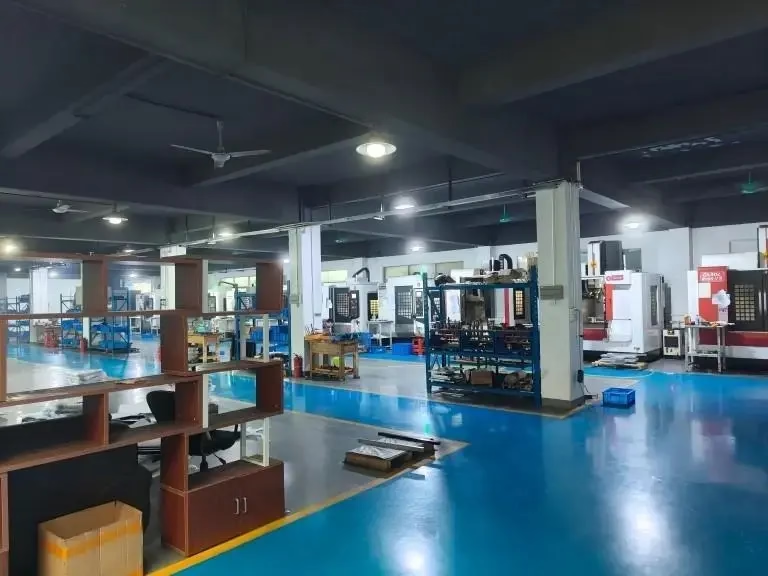
GreatLight runs 16 simultaneous five-axis machining centers, 12 four-axis mills, 27 three-axis machines and 16 mill-turn centers, part of a total of 127 high-precision CNC machines across three wholly-owned plants. That mix matters more than the headline count. A shop with only five-axis machines will quote your simple plate at five-axis rates. A shop with only three-axis machines will decline your impeller rather than tell you it cannot reach the geometry.
Size sets the ceiling. Our large travel is 4,000 × 400 × 150 mm, which covers long extrusion profiles and rails that arrive in one piece. Medium travels are 750 × 1,150 × 550 mm and 600 × 600 × 600 mm, and compact travels are 500 × 500 × 450 mm and 500 × 310 × 200 mm. A Ø400 mm rotary table handles parts that need four-sided work in one load. If your part is longer than the largest travel, no amount of skill fixes it; it becomes two parts and a joint, and that is a design decision, not a machining one.
When five axes is the wrong choice: a flat plate with through-holes, a simple housing, a shim, a bushing. Five-axis time is billed at a higher rate, and for prismatic parts it adds nothing. Three-axis or a mill-turn center will hit the same tolerance for less. Ask the factory to tell you which machine it plans to use and why. A vague answer here usually means the quote was priced from a rate card, not from your geometry.
- 1Undercuts and blended radiiFive-axis, one setup, no re-fixturing error.
- 2Prismatic plates and housingsThree-axis or mill-turn is the cost-correct route.
- 3Parts over 4,000 mmPlan a joint, or split the drawing before quoting.
- 4Turned features plus milled flatsMill-turn centers remove a second operation and its stack-up.
Tolerance, surface finish and how the factory proves both
Tolerance is a process window, not a sticker. A factory quoting ±0.005 mm must control spindle thermal growth, tool wear, fixture rigidity and material stress relief at the same time. On aluminium 6061 and 7075 that is routine. On 17-4PH stainless or Inconel, the same number demands slower feeds, sharper inserts and often a stress-relief step between roughing and finishing.
Surface finish is quoted in Ra and should be specified per face, not for the whole part. As-machined finish runs Ra 1.6–3.2 μm, a high finish runs Ra 0.8–1.6 μm, and fine finish reaches Ra 0.2–0.8 μm. A sealing face needs the fine band; a mounting pad does not. Over-specifying finish across every surface is one of the most common ways buyers inflate cost without gaining function.
Proof comes from inspection, not from the quote. We inspect 100% of parts before shipment and run raw material checks, in-process monitoring and a final inspection, with reports on request. Our qualification rate is 99.99%. Ask any candidate factory three questions: what instrument measures the tightest callout, who signs the first-article report, and how many parts per lot get measured. If the answer is 'we check the important ones', your tolerance is being managed by hope.
Material grade is part of accuracy. A 6061-T6 billet and a 6061-T4 billet machine differently and move differently after machining. When the drawing says 7075-T6 and the shop buys generic aluminium, flatness drifts after the part leaves the machine. Send the grade, the temper and the heat-lot requirement with the model.
- 1Specify finish per faceSealing and sliding surfaces get the tight band; cosmetic areas do not.
- 2Ask for the instrumentCMM, height gauge, profilometer. Name and model, not a promise.
- 3Fix the temper6061-T6 and 7075-T6 behave differently from annealed stock.
Material range: the fast way to spot a mismatch
A factory's material list is a fingerprint of its customer base. Ours covers aluminium 6061, 6061-T6, 2024, 5052, 5083, 6063, 6082, 7075 and ADC12; stainless 303, 304, 316, 316L, 420, 430, 431, 440C and 17-4PH; steel 1018, 1045, 4130, 4140, 4340 and A36 plus tool steel; copper and brass including C101, C103, C110, beryllium copper, C27400, C28000 and C36000; titanium TA1, TA2 and TC4 (Ti-6Al-4V); Inconel; magnesium AZ31B and AZ91D; and plastics from ABS and POM through PEEK, PP, HDPE and carbon fibre.
Read that list against your part. If you need 17-4PH in the H1025 condition and the shop's list stops at 304 stainless, the gap is not a formality. Precipitation-hardening stainless needs different speeds, more tool changes and often a post-machining age. If you need beryllium copper, the shop must handle beryllium dust controls. A supplier who lists everything but machines only aluminium will learn on your parts.
Finishing is the second half of material choice. We offer anodizing in clear, colour, hardcoat and conductive grades; electroless nickel, zinc, silver and gold plating; powder coating and black oxide; bead blasting, tumbling, brushing and polishing; and laser marking with a minimum character height of 1.5 mm. Hardcoat anodizing adds a dimensional layer, so the drawing must state whether the tolerance applies before or after coating. Getting that wrong is a classic scrapped lot.
Post-processing is a supply-chain risk, not a free extra. Every outside step adds a handling move, a queue and a chance of damage. Ask whether finishing is done in house or brokered. Both can work. The difference is who owns the part when the anodize line scratches it.
- 1Match grade and temperH1025, T6, annealed: the suffix changes the cut.
- 2Flag coating growthHardcoat anodize moves dimensions by tens of microns.
- 3Ask who owns finishingIn-house or brokered, one party must own the result.
MOQ, lead time and the quote details worth reading
Order quantity is where most first contacts fail. Some factories quote only above 500 pieces because setup and programming cost dominates their floor. We take no minimum order quantity, from one prototype to 10,000+ part runs, which means a design iteration in week one can become a production run on the same fixtures in month three. That continuity removes a re-qualification step and a second first-article report.
Lead time should be quoted as a chain, not a single number. Our quotation and free DFM analysis come back within 12 hours, production can start within 24 hours, and parts ship in 3–5 days. Our historical late-delivery probability is below 2%. When you compare two factories, compare the same three points: how fast the quote arrives, how fast the spindle starts, and how long the run takes. A shop that quotes in five days but starts in 24 hours is not slower than a shop that quotes in one day and starts next week.
The quote itself is a sample of the factory's attention. A usable quote lists the machine, the number of setups, the stock size, the finish per face, the inspection method, the packing method and the DFM notes. A price with a total and nothing else tells you the engineer never opened your model. Send one part with a tight tolerance and one with a loose tolerance; the DFM notes should differ.
Confidentiality belongs on this list too, especially for tooling, medical and defence-adjacent work. Our uploads are secure and confidential, and an NDA is available on request. If a factory treats an NDA request as an insult rather than paperwork, that is information about how it handles your drawings.
- 1Quote three timestampsQuote, production start, ship date. Compare all three.
- 2Demand DFM notesIf the notes are generic, the model was not reviewed.
- 3NDA on requestStandard paperwork, not a special favour.
Step by step: how to vet a CNC milling machine factory
Run these seven steps before you release a PO. Each one produces a document or a number you can compare across suppliers.
- 1Send a model with a tight and a loose featureInclude one ±0.005 mm callout and one general ±0.1 mm callout. See whether the quote prices them differently. A flat price for both means the shop is not reading tolerances.
- 2Ask for the machine and setup planRequire the machine type, axis count and number of setups in writing. Three setups on a part we would run in one is a cost and stack-up warning.
- 3Request the inspection methodName the instruments for the tightest callout and ask what percentage of the lot is measured. Compare against 100% inspection before shipment.
- 4Check certifications against your industryISO 9001:2015 for general work, IATF 16949:2016 for automotive, ISO 13485:2016 for medical, ISO 27001:2022 where data and IP controls matter. Certificates should be current.
- 5Test the material listSend two grades you actually use, including one specialty such as 17-4PH or TC4. Confirm the shop has cut it, not just listed it.
- 6Time the quote and the DFMLog the hours from upload to reply. Free DFM analysis inside 12 hours is our benchmark; a quote with no engineering notes fails this step.
- 7Run one prototype before the production orderInspect the first article in your own lab. Then ask what changes if the run goes to 10,000 pieces: fixture, gauge, packaging. A factory with a plan answers in specifics.
Questions buyers ask before committing
How do I compare two CNC milling machine factories that quote different prices?
Normalize the quotes first. Ask both to state machine type, number of setups, stock size, finish per face and inspection method. A 20% lower price often hides one fewer setup, a looser finish band or sampling inspection instead of 100%.
Then test the schedule chain. Compare quote time, production start time and ship time for the same part. A cheaper quote that starts a week later can cost more in program delay than it saves on the invoice.
Is five-axis always better than three-axis for my part?
No. Five-axis earns its rate on undercuts, angled faces, blended surfaces and parts that would otherwise need three or four fixtures. On a flat plate with drilled holes, a three-axis mill or a mill-turn center holds the same tolerance with less setup time.
Ask the factory to justify the axis choice. A supplier that puts everything on five-axis is optimizing its own scheduling, not your cost.
What does a factory need to quote accurately?
A STEP or native CAD file, a 2D drawing with tolerances and datum callouts, material grade and temper, surface finish per face, quantity and target date. Add any coating note, especially whether the tolerance applies before or after anodizing.
Missing datum callouts are the most common cause of a quote that changes later. If the drawing has no datums, the shop is guessing which face is the reference.
How much does order quantity change the process?
Below roughly 50 pieces, programming and fixturing dominate, so the per-part price is set by setup. Above a few hundred, cycle time and material yield take over and the shop may invest in a dedicated fixture or a soft jaw set.
We take no minimum order quantity, so a single prototype and a 10,000+ run can share the same fixture design. That keeps the first-article data valid when the order scales.
Do I need to visit the factory?
Not for a first order if the paperwork is complete. Ask for the machine list, current certificates, an inspection sample and a reference part report. A short video of the machine cutting your feature is a reasonable request.
Visit when the program is high value or regulated. Automotive and medical buyers usually audit in person, and the audit covers calibration records, gauge control and traceability, not just the machines.
How should confidentiality be handled?
Send files through a controlled upload rather than personal email, and put an NDA in place before the DFM review. Our uploads are secure and confidential and an NDA is available on request.
If the part is patent-pending or export-controlled, state that in the first message. It changes how the shop stores and shares the model internally.
Send your drawing and get a read on it
Upload a model and drawing; we return a quotation with DFM notes within 12 hours, and an engineer reviews the tolerance and finish callouts with you before anything is cut.
12-hour quoteFree DFM analysisNo MOQ100% inspection
Follow GreatLight
We publish setup notes, tooling trials and inspection data from the factory floor.











