
CNC Programming and Machining Services: How to Pick the Right Shop
This guide is for design engineers and sourcing teams comparing CNC programming and machining services. It covers the checks that separate a shop that can hold your tolerance from one that only quotes it well.
In this article
- 1
- 2
- 3
- 4
- 5
- 6
- 7
Key takeaways
What to compare before you send a PO
Use the same questions on every shop. The answers are easier to compare than a price list.
| Check | Weak answer | Strong answer | Why it matters |
|---|---|---|---|
| Tolerance callout | ±0.005 mm on all dims | Per-feature, with datum scheme | Blanket tolerance hides which features are critical |
| Programming ownership | Sent to a third party | In-house CAM with setup sheets | Toolpath control stays with the shop you audit |
| DFM feedback | None until parts arrive | Written DFM within 12 hours | Catches thin walls and deep pockets early |
| Inspection report | Certificate only | CMM report with datum callouts | You can verify the critical dims yourself |
| MOQ | 500 pieces minimum | One prototype to 10,000+ | Prototype runs stay affordable |
| Lead time | Vague 2–4 weeks | Parts ship in 3–5 days | You can plan the assembly build around it |
How CNC programming decides the machining result
CNC programming is the step between your CAD model and the spindle. A programmer reads the drawing, picks the stock, chooses tooling, and writes the toolpath in G-code or a CAM system. Every later decision, from clamping to cutter engagement, comes from that file.
Two shops can run the same part on the same machine and get different results. One uses a roughing pass that leaves 0.3 mm of stock, then a finishing pass at 0.1 mm radial engagement. The other leaves 1 mm and takes it in one pass. The second shop will fight chatter, and the surface finish will show it.
This is why programming quality shows up as tolerance drift, not as a line item on the quote. If a shop cannot describe its toolpath strategy in plain terms, the price is the only thing you are comparing.
- 1Setup sheetsAsk whether the shop issues them. They document workholding, tool numbers, and offsets.
- 2SimulationToolpath simulation before cutting catches gouges and collisions without scrapping stock.
- 3Version controlThe program revision should match the drawing revision you approved.
Match the machine to the part, not to the brochure
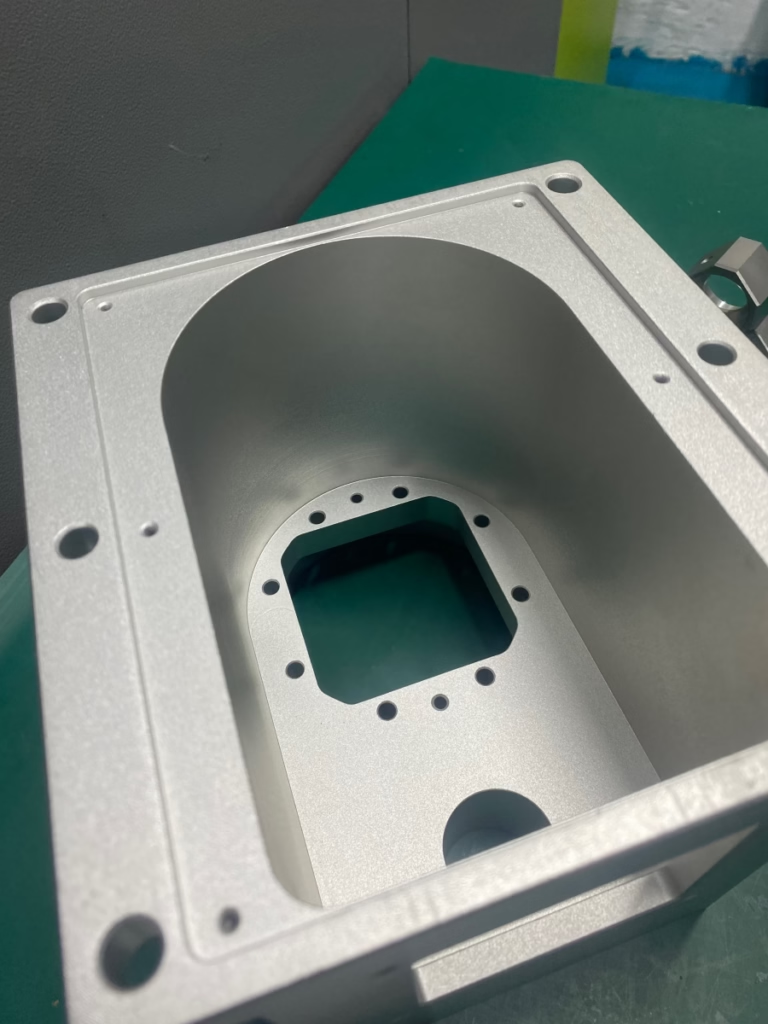
A 3-axis mill handles flat plates, housings with open pockets, and parts you can reach from one side. It is the cheapest and fastest option when the geometry allows it. Do not pay for 5-axis motion you do not need.
A 4-axis or mill-turn center wins when the part is cylindrical with cross-features, such as a shaft with flats and cross-holes. Turning the part once instead of three times cuts setup error and cycle time.
Simultaneous 5-axis matters when the part has undercuts, contoured pockets, or features on five faces that must share one datum. Aerospace brackets and medical housings are typical. The trade-off is programming time, which is often longer than the cut itself.
Size sets the limit. A 4,000 mm maximum processing size covers long beams and rails, while a Ø400 mm rotary table covers round parts that need indexing. Send the envelope with your RFQ so the shop can route the job to the right machine.
Material and finish choices that change the quote
Aluminium 6061-T6 is the default for prototypes and fixtures. It machines fast, holds ±0.005 mm on a good setup, and takes anodizing well. 7075 is stronger but galls more easily, so toolpaths need lighter passes.
Stainless 304 and 316L work-harden. If the programmer takes a full-depth cut at low feed, the cutter rubs and the surface hardens under it. 17-4PH (SUS630) is common for medical and aerospace parts that need both strength and corrosion resistance.
Titanium TC4 (Ti-6Al-4V) and Inconel punish wrong speeds. Heat stays in the cut, so coolant delivery and toolpath engagement matter more than spindle speed. Expect longer lead time and higher cost per part.
Plastics behave differently again. POM and PEEK hold tight tolerances but move with temperature. ABS and PC are cheaper but can chip at thin walls. Tell the shop which dimensions are functional before it picks the stock.
Certifications, confidentiality, and quote details
Certifications tell you which management systems are in place. ISO 9001:2015 covers general quality. IATF 16949:2016 applies to automotive work. ISO 13485:2016 applies to medical devices. ISO 27001:2022 covers information security, which matters if you send CAD files and drawings.
Confidentiality is a separate question. Ask whether uploads are treated as confidential by default and whether an NDA is available on request. If your drawings carry export-controlled content, confirm the handling process before you send anything.
Read the quote for what is missing. A good quote lists material, finish, tolerance, inspection, and shipping terms. A quote that only shows a part price leaves the rest to be negotiated after the PO, which is where delays start.
GreatLight runs 127 high-precision CNC machines across 7,600 m² in three wholly-owned plants, with 150 technicians. We quote and return free DFM analysis within 12 hours, and production can start within 24 hours after approval.
Step by step: how to evaluate a CNC programming and machining services quote
Run these steps in order. Each one filters out shops that cannot support the next stage.
- 1Send a complete data packageInclude 3D model, 2D drawing with datum callouts, material spec, finish spec, and quantity. Missing datum callouts are the most common cause of a slow quote.
- 2Ask for written DFM feedbackA useful response names specific features: wall thickness under 1 mm, depth-to-diameter ratio over 4:1, or a tolerance that needs a second setup.
- 3Confirm the tolerance per featureState which dimensions are functional. Critical bores at ±0.005 mm are reasonable; asking for that on every dimension adds cost without adding value.
- 4Check the inspection planAsk what is measured, on which machine, and whether the report is included. Request reports on critical dimensions before shipment.
- 5Test with a small run firstOrder one or two pieces before a 10,000-part run. A prototype reveals setup quality, surface finish, and how the shop handles questions.
- 6Agree on lead time in writingTie the schedule to DFM approval, not to the PO date. Confirm shipping terms and who owns the freight.
Frequently asked questions
What tolerance can CNC programming and machining services realistically hold?
On a stable setup with the right machine, ±0.005 mm (±0.0002 in) is achievable on critical features. That is not the same as holding it on every dimension of a large part.
For most parts, Ra 0.8–1.6 μm is a normal machined finish. Ra 0.2–0.8 μm needs a finishing pass and often a different tool, which adds cycle time.
Do I need 5-axis machining for my part?
Only if the geometry demands it: undercuts, contoured pockets, or features on five faces sharing one datum. If a 3-axis setup can reach every feature, 3-axis is cheaper and faster.
The test is simple. Count the setups. If the part needs three or more orientations and the datums stack, 5-axis usually wins on total cost.
What is the minimum order quantity?
There is no minimum order quantity. Runs can start from one prototype and scale to 10,000+ parts.
Small runs are quoted with the same programming effort as large ones, so the per-part price is higher. That is normal and not a sign of a bad quote.
How fast can I get a quote and parts?
Quotation and free DFM analysis come back within 12 hours. Production can start within 24 hours after approval, and parts ship in 3–5 days.
These times assume the data package is complete. A missing finish spec or datum scheme stops the clock until it is resolved.
How is my design kept confidential?
Uploads are secure and confidential. An NDA is available on request if your program requires one.
ISO 27001:2022 covers information security management, which is relevant when you share CAD models and drawings.
Which materials and finishes are available?
Aluminium grades 6061, 7075, 2024 and 6082; stainless 303, 304, 316L, 17-4PH; steels 1018, 1045, 4140; titanium TC4; and plastics such as POM, PEEK and PC.
Finishes include anodizing, electroless nickel, zinc and silver plating, powder coating, black oxide, bead blasting and laser marking with a minimum character height of 1.5 mm.
Send your drawings and get a DFM-backed quote
We review your part, flag the features that drive cost, and return a quote with tolerance, finish and inspection scope in writing.
12-hour quote100% inspectionNo MOQ
More from the shop floor
We publish setup notes, tooling trials and inspection data from the factory floor.











