
CNC Service Machining: How to Pick a Supplier Without Getting Burned
This guide is written for design engineers and procurement teams comparing CNC service machining quotes. It covers the checks that separate a supplier who can hold ±0.005 mm at volume from one who only hits the number on the first article. Read it before you release a drawing.
In this article
- 1
- 2
- 3
- 4
- 5
- 6
- 7
- 8
Key takeaways
CNC service machining supplier checks at a glance
Use this as a screening sheet before you request a quote.
| Check | What to ask | Weak answer | Strong answer |
|---|---|---|---|
| Tolerance | Which machine holds your tightest callout? | ±0.05 mm on all features | ±0.005 mm with in-process probing |
| Machine mix | Do you have 5-axis and mill-turn in-house? | Outsourced for complex parts | 16 five-axis, 16 mill-turn centers |
| MOQ | Can you run one prototype first? | 500 pc minimum | No MOQ, one to 10,000+ |
| Lead time | When do chips actually fly? | 2 weeks to schedule | Production starts in 24 hours |
| Quote speed | Do you flag DFM issues before quoting? | Price only, no feedback | Quote + DFM within 12 hours |
| Certifications | What is the scope of your IATF 16949? | General machining only | Scope covers your part family |
| Inspection | What ships with the parts? | Certificate of conformance | Inspection report on request |
| Finishing | Is anodizing done in-house? | Subcontracted, 5–7 days | In-house, no extra transit |
The short version
Pick the shop that tells you which machine will run your feature, when the first chip is cut, and how the part is measured. Everything else is a price comparison on assumptions.
What ±0.005 mm really requires from a CNC service machining shop
A tolerance callout is a number. Holding it across a production run is a system. The machine has to be rigid enough, the fixturing repeatable, and the shop has to measure the part the same way your drawing inspector will. Ask which machine will run your feature and what its positional accuracy is on that axis. If the answer is vague, the ±0.005 mm on the quote is marketing.
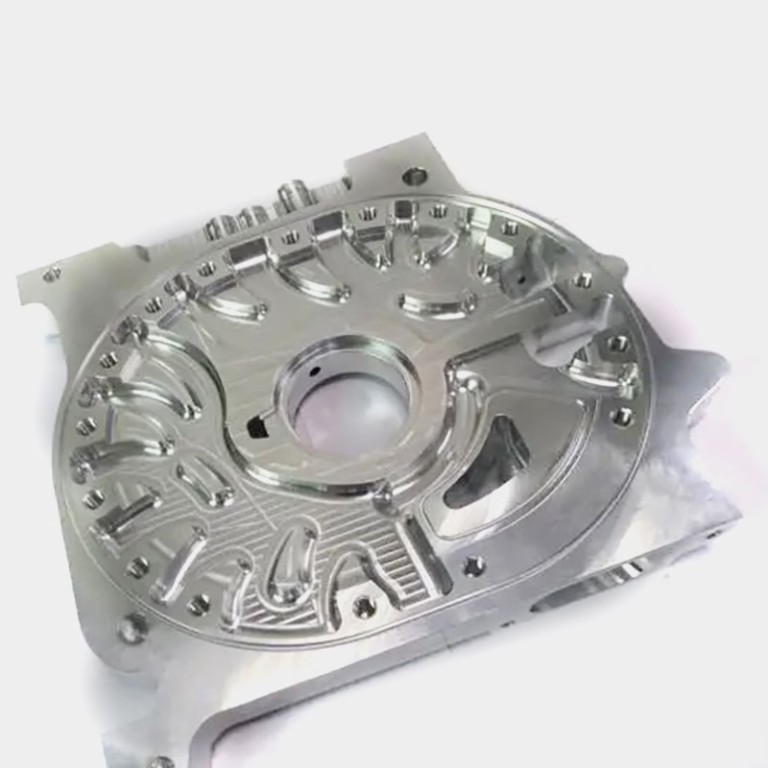
Feature geometry drives the machine choice. A shallow pocket on a flat plate is a 3-axis job. An undercut, a deep cavity, or a port that meets a bore at an angle usually needs 5-axis or mill-turn so the part stays in one setup. Every re-fixture adds stack-up error. A shop that machines your part in three setups has three chances to drift.
Temperature matters more than most buyers expect. Aluminium grows about 23 μm per meter per °C. A 4,000 mm part measured on the shop floor at 28 °C will not match a drawing checked at 20 °C. Good shops control the inspection room, not the whole floor, and they note the measurement temperature on the report.
Ask for the inspection method, not just the result. CMM with a stated probe tip, a bore gauge, a surface roughness tester. If a shop cannot name the instrument, they are not measuring to the tolerance they quoted.
- 1Single setup first5-axis or mill-turn removes re-fixturing error on angular features.
- 2Probe on the machineIn-process probing catches drift before the part leaves the vise.
- 3Measure where it is coldInspection room at 20 °C, report the temperature.
Reading a CNC service machining lead time quote correctly
Most quotes show one number: 10 days, 15 days. That number hides four separate clocks. Time to quote and DFM. Time to release to the floor. Time to cut. Time to finish and inspect. A shop can be fast at three of them and slow at the fourth, and your schedule pays for the slow one.
The floor-release clock is the one buyers forget. A shop with 127 machines but a full schedule may not start your job for a week. Ask when the first chip is cut, not when the order is confirmed. A shop that can start production within 24 hours is telling you it holds capacity for new work.
Finishing is the second hidden clock. Anodizing, plating, and powder coating sent to an outside vendor adds transit and a queue you do not control. If the finish is in-house, the part goes from the mill to the tank without a truck ride. That difference is often several days on a small batch.
Quoting speed is a proxy for how the shop works. If the quote takes a week and contains no DFM notes, the engineering review either did not happen or was not shared. A shop that returns a quote and a DFM analysis within 12 hours is reading your drawing before it prices it.
- 1Ask for four datesQuote, floor release, first cut, ship.
- 2Check finish ownershipIn-house anodizing and plating cut days off small runs.
- 3Treat slow quotes as a signalNo DFM feedback means no engineering review.
MOQ, tooling, and the prototype-to-production gap
A minimum order quantity is not only a pricing rule. It decides whether you can validate a design before you spend real money. A supplier with no MOQ lets you cut one prototype, measure it, change the drawing, and cut the next revision on the same fixture logic. That loop is cheap. A 500-piece minimum forces you to guess.
The same floor should run both the prototype and the production lot. If the prototype comes from a different shop than the 10,000-part run, the process changes and so does the part. Ask whether the prototype and the production order go through the same programming and setup review.
Watch for tooling that only exists for your part. Custom soft jaws, a dedicated fixture, a form tool. These are fine, but they should be quoted as a line item, not buried in the unit price. On a one-off prototype, a shop that machines from standard vises and soft jaws avoids a tooling charge entirely.
Material choice moves cost more than cycle time on small parts. A 6061-T6 bracket and a 7075 bracket can look identical on the drawing and differ sharply in price and in how they finish. Ask for the material grade in writing, not just 'aluminium'.
- 1No MOQ keeps revisions honestValidate one part before committing to a run.
- 2Same floor, both volumesPrototype and production should share programming review.
- 3Ask for the grade6061-T6 is not 7075, and the quote should say which.
Certifications, inspection, and what ships in the box
Four certificates on a website mean nothing until you read the scope. ISO 9001:2015 covers a quality system. IATF 16949:2016 is written for automotive production, and its scope line says which processes and sites it covers. ISO 13485:2016 covers medical device manufacturing. ISO 27001:2022 covers information security, which matters when your drawings are the asset.
Ask which certificate applies to the site that will make your part. A group can hold a certificate at one plant and route your job to another. The scope and the address on the certificate should match the address on the quote. If they do not, ask why.
Inspection is where the certificate becomes real. Raw material check on arrival, in-process monitoring during the run, and final inspection before shipment. A shop doing 100% inspection before shipment is telling you it does not sample on the way out. Reports should be available on request, not as a paid extra.
Confidentiality belongs in the same conversation. If your parts are pre-release, you want an NDA before the drawing leaves your building, and you want uploads handled on a controlled system. That is a process question, and it has a process answer.
- 1Read the scope lineMatch the certificate address to the plant on your quote.
- 2Ask about sampling100% before shipment is the answer you want.
- 3NDA before the drawingSign it before files move, not after.
Matching material and finish to the CNC service machining process
Not every material behaves the same on the same machine. Aluminium 6061 and 7075 cut cleanly at high spindle speeds. Stainless 316L work-hardens if the feed is too light, so the shop has to take a real depth of cut and keep the tool moving. Titanium Ti-6Al-4V needs low cutting speed and high coolant pressure or the tool edge fails early.
Plastics are their own problem. ABS, PC, POM, and PA move with heat, so a shop that runs them at metal feeds will hold neither the dimension nor the finish. PEEK and carbon fibre need sharp tooling and a plan for dust. Ask what feed and speed range the shop uses for your specific polymer.
Finishes interact with the base metal. Anodizing builds a layer, so a hardcoat anodized part grows on the order of tens of microns per surface and a tight thread callout has to account for it. Electroless nickel goes on more evenly than electroplated nickel and holds a tighter dimensional envelope.
Get the finish and the tolerance in the same document. A part quoted to ±0.005 mm before anodizing and inspected after it is a part quoted to the wrong number. The shop should know which dimensions are pre-finish and which are final.
- 1Stainless 316LDo not let the tool rub; light feeds cause work hardening.
- 2Ti-6Al-4VLow speed, high coolant pressure, fresh edges.
- 3Hardcoat anodizingPlan the build-up before you finalize thread callouts.
7 steps to qualify a CNC service machining supplier
Run these in order. Stop at the first step the supplier cannot answer clearly.
- 1Send the drawing with tolerances markedDo not send a STEP file alone. Mark the tightest callout and the datum scheme. A supplier who quotes without asking about the datum is guessing.
- 2Ask for a DFM note with the priceExpect feedback within 12 hours on wall thickness, tool reach, and any feature that needs a second setup. No DFM note means no engineering review.
- 3Confirm the machine for your featureGet the axis count and the work envelope. Undercuts and deep cavities need 5-axis or mill-turn. Large parts need a machine that travels past 750 mm.
- 4Pin down the four lead-time datesQuote, floor release, first cut, ship. Ask whether production can start within 24 hours of order confirmation.
- 5Ask where finishing happensIn-house anodizing, plating, and powder coating remove outside transit. If subcontracted, get the vendor's name and the added days.
- 6Check certificate scope and addressMatch ISO 9001, IATF 16949, ISO 13485, or ISO 27001 scope to the plant that will run the job. Group certificates do not always travel.
- 7Agree on inspection and NDA before releaseConfirm 100% inspection before shipment, ask for reports on request, and sign the NDA before files move. Uploads should be on a controlled system.
Questions buyers ask before placing a CNC order
What tolerance can CNC service machining realistically hold?
On a rigid machine with good fixturing and a controlled inspection room, ±0.005 mm is achievable on critical features. That is not the same as holding it on every dimension of a part.
Features far from the datum, thin walls, and long parts lose accuracy to deflection and thermal growth. Tell the shop which dimensions matter and let the rest run to a general tolerance block.
Is a low unit price a sign of a good CNC service machining supplier?
Not by itself. A low price often comes from a lighter setup, fewer inspections, or a subcontracted finish that adds days later.
Compare the quote line by line: material grade, machine, setup count, finish source, inspection scope. The cheapest quote is frequently the one with the most assumptions in it.
Do I need 5-axis machining for my part?
Only if the geometry demands it. Undercuts, compound angles, deep cavities, and ports that break into a bore usually need 5-axis or mill-turn to avoid a second and third setup.
A flat plate with simple pockets is faster and cheaper on 3-axis. Ask the shop to justify the axis count rather than defaulting to the more expensive machine.
How should finishing be handled on a tight-tolerance part?
Decide before quoting whether the tolerance applies before or after finishing. Anodizing, plating, and powder coating all change the surface by a measurable amount.
Electroless nickel builds more evenly than electroplated nickel. Hardcoat anodizing grows the surface enough to affect thread fits. Put the answer in the drawing notes.
What should be in the inspection report?
The dimensions checked, the instrument used, the nominal and actual values, and the measurement temperature. A certificate of conformance alone does not tell you whether the part is in tolerance.
For first articles, ask for a full dimensional report. For production lots, agree on which dimensions are checked every part and which are sampled.
Can a prototype and a production run come from the same supplier?
They should. The prototype validates the process, and the process is what you are buying. If a different shop runs the production lot, the setup, tooling, and inspection plan all change.
Confirm that the production order uses the same programming review and the same machine class as the prototype. Ask what changes between the two, and why.
Send a drawing, get a quote and a DFM note
Upload your files and we will return pricing and manufacturability feedback within 12 hours. No minimum order quantity, and production can start within 24 hours of confirmation.
12-hour quote + DFMNo MOQ100% inspection before shipmentNDA on request
More from the shop floor
We publish setup notes, tooling trials and inspection data from the factory floor.











