
CNC Turning and Milling Combined Processing: 5 Buying Checks
Combined processing means one machine turns the diameter and mills the flats, holes, and slots without releasing the part. This guide is for engineers and buyers comparing quotes. By the end you can tell whether your part belongs on a mill-turn center or on two separate machines.
In this article
- 1
- 2
- 3
- 4
- 5
- 6
- 7
- 8
- 9
Key takeaways
Which method fits which part
Match the part geometry to the machine before you compare price.
| Part feature | Turn + mill combined | Turn, then mill on a second machine | Prismatic only |
|---|---|---|---|
| Round body with cross holes | One setup, one datum | Two setups, datum shift risk | Not the right route |
| Concentric bore and face | Held to ±0.005 mm | Depends on re-chucking | Mill only |
| Slots on a cylindrical wall | Y-axis or C-axis interpolation | Separate fixture needed | Not the right route |
| Flat plate, no turning | Slow, wasted spindle time | Slow | Best fit |
| Batch of 1–50 pieces | Setup saving is the main gain | Setup cost dominates | Setup cost dominates |
| Batch of 1,000+ pieces | Cycle time decides the price | Can be cheaper on simple parts | Best fit |
| Length over 4,000 mm | Outside our range | Outside our range | Outside our range |
| Titanium thin-wall tube | Needs light passes and support | Re-chucking distorts the wall | Not the right route |
The verdict
If your part has a turned diameter tied to a milled feature, combined processing removes a setup and usually wins below 50 pieces. If it is a prismatic block, send it to a mill and save the premium.
What CNC turning and milling combined processing actually does
A mill-turn center holds the bar or blank in a main spindle that indexes in C, and it carries a milling spindle that moves in X, Y, and Z. The turning tool peels the outside diameter while the part spins. Then the spindle indexes, locks, and the milling spindle cuts a flat, a cross hole, or a slot. The part never leaves the chuck.
That single fact drives everything else. Every feature on the part shares one datum, so a cross hole drilled after a bore is concentric to that bore by construction, not by careful re-fixturing. On a two-machine route, the operator re-chucks the part, and the second op inherits whatever runout the chuck and the part's own out-of-roundness introduce.
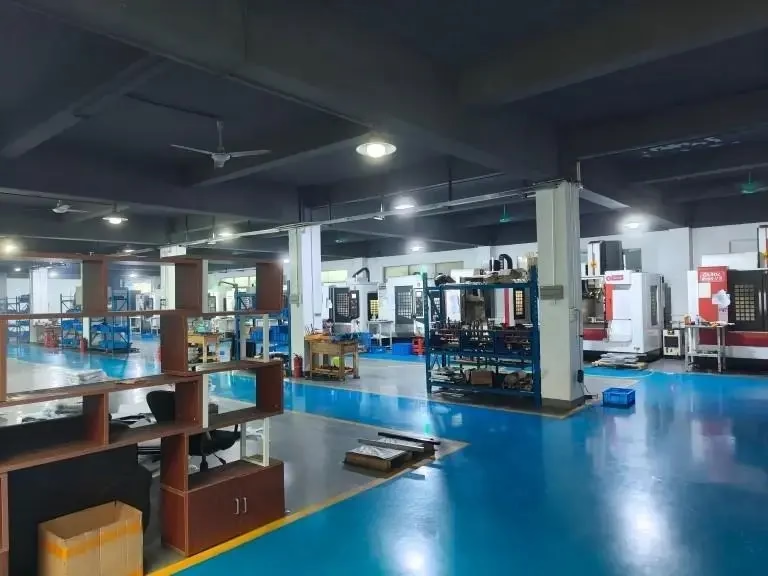
Combined processing is not a new machine category. It is a route choice. You can buy a dedicated mill-turn center, or you can use a live-tool lathe with a C-axis and a Y-axis. GreatLight runs 16 mill-turn centers alongside 16 simultaneous 5-axis machining centers, so we quote the route, not the machine.
The trade-off is real. Mill-turn centers cost more per hour than a plain lathe or a 3-axis mill. You pay that premium to remove a setup, not to cut faster. If the part has no turning content, the premium buys you nothing.
- 1One datumCross features stay true to the main bore.
- 2Fewer touchesLess handling, less chance of a ding on a finished surface.
- 3Higher hourly rateOnly worth it when a setup is actually removed.
Check 1: does the part have real turning content?
Start with geometry, not price. Look for a cylindrical body where the outside diameter, a bore, or a face must be machined. If the drawing is a rectangular block with pockets, you are holding a milling part. Send it to a 3-axis or 5-axis mill and keep the mill-turn capacity for work that needs it.
The clearest signal is a tolerance linking a turned surface to a milled feature. A Ø25 mm shaft with a 6 mm cross hole true to the axis within 0.02 mm, or a flange where the bolt circle must run concentric to a Ø40 mm bore, is mill-turn work. The tighter that relationship, the more the single setup is worth.
A second signal is a part that is difficult to hold twice. Thin-wall tubes, long slender shafts, and parts with a finished cosmetic surface all lose accuracy or finish when they are re-chucked. Combined processing keeps the fragile geometry in one grip.
If neither signal shows up, the part is a candidate for a simpler route. That is not a downgrade. It is the cheaper answer, and a shop that tells you so is reading your drawing instead of its own machine list.
Check 2: what tolerance and finish can the route hold?
GreatLight holds ±0.005 mm on combined processing work, with a 99.99% qualification rate across inspected jobs. That number is not the point. The point is which features that tolerance applies to, and on what material. A turned aluminium 6061 body with a cross hole is a different conversation from a 17-4PH stainless valve with a thin flange.
For roundness and concentricity on a mill-turn center, the practical limit comes from spindle bearing runout and thermal growth during the cycle. On a well-kept machine, bore-to-bore concentricity inside 0.01 mm is routine. Getting to ±0.005 mm means you also control the material, the tool wear, and the temperature of the shop.
Surface finish follows the tool and the pass. Milled faces and slot walls land at Ra 0.8–1.6 μm as a normal production value. Turned diameters reach Ra 0.2–0.8 μm with a finishing insert and the right feed. If your drawing calls for Ra 0.4 μm on a cross hole, that is a reaming or a fine-boring operation, not a single end mill pass.
Ask the shop which features they will inspect and with what. A CMM report on the critical bore is worth more than a blanket claim of precision on the whole part.
- 1±0.005 mmAchievable on controlled features with a stable process.
- 2Ra 0.8–1.6 μmStandard milled finish on combined processing work.
- 3Ra 0.2–0.8 μmTurned diameters with a finishing insert.
Check 3: does batch size change the answer?
The setup is a fixed cost. On a two-machine route you pay it twice, and you pay it again every time the operator re-chucks and dials in the second op. Below roughly 50 pieces, that fixed cost usually dominates the part price. Combined processing wins on setup alone, even when its cycle time is longer.
Above a few hundred pieces, cycle time takes over. A dedicated lathe with a second-op mill can still be cheaper on a simple part, because each machine does one job and does it fast. The mill-turn premium per hour starts to show when the part is easy to hold twice.
The crossover is not a fixed number. It depends on how long the second setup takes, how much scrap the re-chuck produces, and how expensive the material is. On a titanium or Inconel part, scrapping one piece at the second op can erase the savings of a cheaper route.
GreatLight runs no minimum order quantity, from one prototype to 10,000+ part runs. That means we can quote the same part both ways and show you where the crossover sits for your volume, instead of pushing one route.
Check 4: machine capacity, bar size, and part envelope
A mill-turn quote is only real if the machine can physically hold the part. Two numbers decide that: bar capacity or chuck size, and Y-axis travel. Bar capacity sets the maximum diameter you can feed through the spindle. Y-axis travel sets how far off-center the milling spindle can reach.
GreatLight machines cover a 4,000 mm maximum processing size, with travel envelopes of 4,000 × 400 × 150 mm, 750 × 1,150 × 550 mm, 600 × 600 × 600 mm, 500 × 500 × 450 mm, and 500 × 310 × 200 mm. A Ø400 mm rotary table handles round work that needs indexed positions around a large diameter.
Check the Y-axis before you promise a cross feature. A part that needs a slot 40 mm off the centerline may not fit a machine with 30 mm of Y travel, and the shop will fall back to C-axis interpolation, which is slower and can leave a scalloped floor.
Also check the length-to-diameter ratio. A 4,000 mm long part that is 30 mm in diameter needs a steady rest or a follow rest. Ask how the shop supports it, because unsupported turning on a slender shaft will chatter and miss the tolerance.
- 1Bar or chuck sizeSets the maximum diameter that fits the spindle.
- 2Y-axis travelSets how far off-center a milled feature can sit.
- 3L/D ratioLong slender parts need a steady rest, not just a bigger machine.
Check 5: quotes, lead time, and the paperwork behind them
Compare quotes on the same basis. Ask what is included: material certification, first-article inspection, in-process checks, and a final report. A low number that excludes inspection is not a lower price, it is a smaller scope. GreatLight inspects 100% before shipment and provides reports on request.
Lead time should come with a start date, not just a finish date. We return a quotation and a free DFM analysis within 12 hours, and production can start within 24 hours of approval. Parts ship in 3–5 days on standard work. Historical late-delivery probability is below 2%.
Certifications matter when your part feeds a regulated line. GreatLight holds ISO 9001:2015, IATF 16949:2016, ISO 13485:2016, and ISO 27001:2022. The last one covers information security, which is what your legal team will ask about before sending drawings.
Confidentiality should be settled before the first upload. Uploads are secure and confidential, and an NDA is available on request. If a supplier hesitates on that, treat it as a signal about how the rest of the project will go.
- 112 hoursQuotation and free DFM analysis.
- 224 hoursProduction start after approval.
- 33–5 daysStandard shipping window for parts.
- 4Under 2%Historical late-delivery probability.
Five steps to pick the right route
Work through these in order before you send the RFQ.
- 1Mark the turned surfacesOn the drawing, highlight every diameter, bore, and face that comes off a lathe. If nothing is highlighted, stop and quote it as a milled part.
- 2Find the tightest cross relationshipNote the tolerance between a turned surface and a milled feature. Under 0.05 mm is a strong mill-turn signal; over 0.1 mm often survives two setups.
- 3Count the setups on the two-machine routeWrite down each fixture and each re-chuck. Multiply by the hourly rate and add expected scrap. This is the real comparison number.
- 4Check the envelope against the machine listConfirm bar or chuck size, Y-axis travel, and L/D support. A feature 40 mm off-center needs Y travel, not a bigger C-axis move.
- 5Fix the inspection and paperwork scopeName the features you want measured, the report format, and the NDA timing. Do this before price, or the quotes will not be comparable.
Questions buyers ask before quoting
Is a mill-turn center always more accurate than two separate machines?
No. Accuracy depends on the machine condition and the process, not the machine category. A worn mill-turn center with a chattering bar will lose to a well-kept lathe and a good fixture.
The advantage of combined processing is that it removes a re-chuck, which removes one source of error. If your part is easy to hold twice and the tolerance is loose, that advantage does not apply.
What part size can combined processing handle?
GreatLight covers a 4,000 mm maximum processing size, with a Ø400 mm rotary table for indexed round work. Travel envelopes range from 500 × 310 × 200 mm up to 4,000 × 400 × 150 mm.
Anything longer or larger has to move to another route or another shop. Send the envelope early, because it decides the answer faster than any tolerance discussion.
How do you decide between C-axis interpolation and a true Y-axis?
If the milled feature sits on or very near the centerline, C-axis interpolation with the spindle indexed is enough. The tool cuts on the axis and the geometry is simple.
If the feature sits well off-center, a true Y-axis keeps the tool perpendicular to the surface and holds a flat floor. C-axis interpolation on an off-center slot tilts the cut and leaves a scalloped bottom.
Does batch size change the price per part on combined processing?
Yes, and not in a straight line. Small batches benefit most, because the setup saving is a large share of the total. Large batches depend more on cycle time, and a simple part may be cheaper on two dedicated machines.
We quote both routes when the part is near the crossover, so you can see the number instead of guessing.
What certifications should I ask for?
It depends on the end use. Automotive and EV work usually needs IATF 16949:2016. Medical device parts need ISO 13485:2016. Any project with sensitive drawings should ask about ISO 27001:2022 for information security.
GreatLight holds all four: ISO 9001:2015, IATF 16949:2016, ISO 13485:2016, and ISO 27001:2022.
Can I get one prototype before committing to a run?
Yes. There is no minimum order quantity, so a single prototype and a 10,000+ part run go through the same quoting process.
Use the prototype to confirm the datum scheme and the inspection plan. Fixing those on one piece is far cheaper than fixing them after the first production batch.
Send the drawing, get both routes priced
We quote the mill-turn route and the two-machine route on the same drawing, with a DFM analysis in 12 hours.
12-hour quote100% inspectionNDA on request
More machining notes
We publish setup notes, tooling trials and inspection data from the factory floor.











