
CNC Virtuosos: The Art of Steel
What actually happens when a block of 4140 becomes a finished part. This page explains the mechanics behind steel CNC work: how the tool meets the material, where the process breaks down, and which parts belong on a 5-axis center instead of a 3-axis mill.
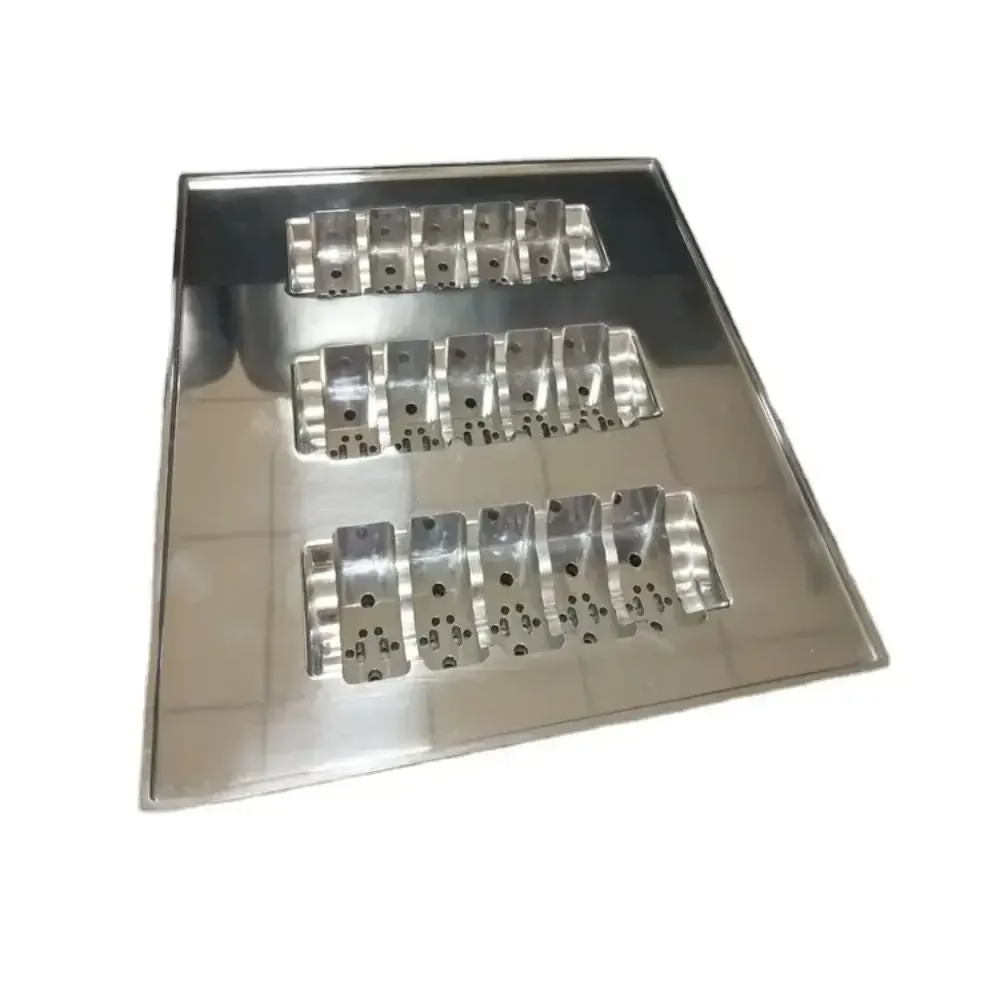
CNC virtuosos the art of steel starts at the cutting edge
Steel does not care how good the drawing looks. It responds to cutting speed, feed per tooth, and how rigidly the tool is held. A 12 mm carbide end mill in 1018 at 120 m/min surface speed behaves nothing like the same tool in 17-4PH at 60 m/min. The first cuts freely. The second work-hardens the moment the tool rubs instead of shears.
That is the whole game. Every parameter choice either keeps the tool shearing cleanly or lets it rub. Rubbing generates heat, heat softens the edge, and the edge fails. Operators who understand this run steel faster than the handbook suggests, because they keep the chip load heavy enough to carry heat away with the chip.
Three numbers decide most steel jobs: surface speed in m/min, feed per tooth in mm, and radial depth of cut as a percentage of tool diameter. Get these right and the rest is bookkeeping. Get them wrong and no amount of spindle power saves the part.
- 1Shear, do not rubIf the tool burns instead of cutting, the feed is too light.
- 2Chip carries heatHeavy chip load pulls heat out of the cut zone.
- 3Rigidity comes firstShort tool holders beat long ones on deep pockets.
How carbon content changes the cut
Low-carbon steel like 1018 machines like a dream. It is soft, gummy, and forms a continuous chip that coils off the tool. Surface finishes come out near Ra 1.6 μm with a sharp cutter and no special coolant strategy. It also deforms easily, so thin walls on a 1018 part need light finishing passes.
Medium-carbon 1045 and alloy steels such as 4130 and 4140 sit in the middle. They hold shape better and take a better polish, but they work-harden if the tool dwells. A 4140 part with a deep pocket wants a constant engagement toolpath, not a series of full-width passes that leave the cutter rubbing at the corners.
Stainless is a different animal. Grades 303 and 304 are austenitic, meaning they harden under the cutting edge rather than ahead of it. Tools must stay sharp and feeds must stay aggressive. Grade 17-4PH in the H900 condition is harder still and often needs carbide with a coating and a rigid setup to hold ±0.005 mm.
- 11018 and A36Soft, gummy, easy to finish. Watch thin-wall deflection.
- 24140 and 4340Hardenable, strong, needs constant-engagement paths.
- 3303 and 304Austenitic. Keep the edge sharp and the feed heavy.
- 417-4PH and 440CHard and abrasive. Rigid setup, coated carbide, light finish passes.
Why a fifth axis changes the toolpath, not just the setup
A 3-axis mill can reach three faces of a part. Everything else needs a second setup, a new vise position, and a fresh chance to introduce alignment error. Each re-clamp costs time and adds stack-up that eats into a ±0.005 mm tolerance budget.
A simultaneous 5-axis center tilts the tool and rotates the part at the same time. The cutter can reach undercuts, deep cavities, and organic profiles from an angle that keeps the tool engaged instead of rubbing. That single change often decides whether a part is manufacturable at all.
The practical payoff is fewer operations. A part that took four setups on a 3-axis machine may run in one on a 5-axis center. Fewer setups mean less handling, tighter true position between features, and a better finish because the tool approaches each surface at its best angle.
- 1Undercuts and deep cavitiesReachable in one setup with a tilted tool.
- 2Organic profilesContinuous tool engagement gives a smoother surface.
- 3True position between featuresOne setup removes re-clamp stack-up.
When steel machining is the wrong answer
Steel is heavy, slow to cut, and expensive per kilogram. If the part is a bracket that carries no load, aluminium 6061 will do the job at a fraction of the cycle time. Choosing steel for stiffness you will never use is a common and costly mistake.
Thin-walled steel parts are another boundary. Below roughly 1.5 mm wall thickness on a 100 mm steel part, chatter becomes the limiting factor, not the machine. The fix is usually a redesign: add a rib, change the material, or split the part.
Very deep holes are a third limit. A hole 10× deeper than its diameter in 4140 needs peck drilling with frequent retracts, and straightness drifts. Gun drilling solves it, but that is a different process with different lead times. Know where standard CNC stops paying off.
- 1Unloaded bracketsAluminium 6061 is faster and lighter.
- 2Walls under 1.5 mmChatter, not power, becomes the limit.
- 3Holes over 10× diameterConsider gun drilling instead.
Steel grade selection by part requirement
Pick the grade from the requirement, not the other way around.
| Grade | Typical use | Machinability | Best fit when |
|---|---|---|---|
| 1018 | Fixtures, shafts | Excellent | Cost and speed matter most |
| 1045 | Gears, axles | Good | Need more strength than 1018 |
| 4130 | Aerospace tubing | Moderate | High strength, weldable |
| 4140 | Cranks, tooling | Moderate | Tough, hardenable parts |
| 4340 | Heavy-duty shafts | Fair | Shock loading and high stress |
| 303 | Screw machine parts | Very good | Free-machining stainless needed |
| 304 / 316L | Food and medical | Fair | Corrosion resistance is critical |
| 17-4PH | Valve bodies | Difficult | High strength plus corrosion resistance |
The verdict on steel CNC work
Choose 3-axis milling for flat, open parts where one or two setups finish the job. Choose simultaneous 5-axis only when the geometry has undercuts, deep cavities, or features that must hold true position to each other. The extra axis earns its keep through fewer setups, not through speed.
Steel machining questions engineers ask
What tolerance can steel CNC hold in production?
On a rigid setup with temperature control, we hold ±0.005 mm on critical features. That is the working tolerance, not a best-case number.
Looser tolerances cost less. If a feature only needs ±0.05 mm, say so on the drawing and the process gets simpler.
Does 5-axis machining cost more than 3-axis?
The hourly rate is higher, but the part often needs fewer setups and less fixturing. For complex geometry the total cost frequently comes out lower.
For a simple flat plate, 3-axis wins on price every time. The geometry decides.
Which steel grades are easiest to machine?
1018 and 303 stainless are the friendliest. Both cut cleanly at high surface speed and give good finishes without special tooling.
4140 and 17-4PH need constant-engagement toolpaths and coated carbide, which adds cycle time.
Can you machine hardened steel?
Yes, up to the hardness the tooling allows. Pre-hardened 4140 and 17-4PH in H900 are common requests.
For very hard material, we sometimes machine in the annealed state and finish after heat treatment. The drawing should state which condition applies.
What surface finish is realistic on steel?
As-machined steel lands around Ra 1.6–3.2 μm. With a finishing pass and the right tool, Ra 0.8–1.6 μm is routine.
Finer than Ra 0.8 μm usually means a secondary operation such as polishing or lapping.
How do you keep steel parts from moving during machining?
Rough, stress-relieve, then finish. That sequence removes most of the internal stress before the final cuts.
For thin sections we use light finishing passes and support the part with custom soft jaws or a fixture plate.
Send us your steel part drawing
Upload a STEP file and get a quotation with free DFM feedback within 12 hours. No minimum order quantity, from a single prototype to a 10,000+ part run.
12-hour quote100% inspectionNDA on request
More from the shop floor
We publish setup notes, tooling trials and inspection data from the factory floor.











