
Does NYC Have Any 5 Axis CNC Machines?
Yes, but the useful answer is narrower than a directory listing. This page explains how simultaneous 5-axis work is actually sourced in the New York metro area, where local capacity stops, and how to judge a shop before you send a STEP file.
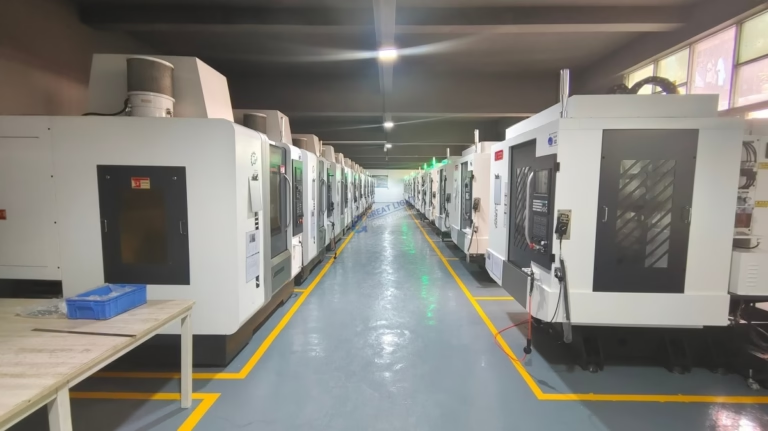
What Counts as a 5 Axis CNC Machine
The phrase gets used loosely. A true 5-axis machining center moves the tool or the part along three linear axes (X, Y, Z) plus two rotary axes (usually A and C). When all five move at the same time, the control keeps the tool tip normal to a curved surface. That is simultaneous 5-axis work.
A 3+2 machine also has five axes, but it indexes the rotary table to a fixed angle, locks it, then cuts in three axes. For a part with holes on five faces, 3+2 removes four setups and is often the cheaper route. It cannot follow a continuous swept surface the way simultaneous motion can.
There is a third category that matters for sourcing decisions: a 4-axis mill with a rotary table. It cuts around one axis and is widely available. If your part only needs features around a single rotary axis, you do not need a 5-axis shop at all, and paying for one wastes money.
So when you ask whether NYC has any 5 axis CNC machines, the real question is whether the shop has simultaneous capability, how much envelope the rotary axes cover, and whether the quoting engineer can read your model. Machine count alone tells you very little.
Where the 5 Axis Capacity Actually Sits
The New York metro area does have 5-axis capacity. It is concentrated, not spread evenly. Shops cluster in Long Island City, Maspeth, Bethpage, Carlstadt, Newark, and the Route 1 corridor toward Trenton. Most of these are job shops running 3-axis mills with one or two 5-axis centers bought for a specific contract.
Machine size varies more than machine count. A compact 5-axis cell with a 500 × 500 × 450 mm envelope covers most brackets, housings, and implant components. A large gantry machine with 4,000 mm of travel is rare anywhere in the region, and shops that own one schedule it tightly.
Real estate is the underlying constraint. A 5-axis cell needs floor space, a temperature-stable room, and a spindle that draws serious power. In Manhattan and inner Brooklyn, rent per square meter pushes precision machining out. What stays is prototyping, tooling repair, and small-lot work.
That leaves engineers in the city with three practical options: a local shop for tight-tolerance small parts, a regional shop within a two-hour drive, or an overseas partner for production volumes. The right choice depends on part size, tolerance, and how fast you need the first article.
Which Parts Need Simultaneous Motion
Simultaneous 5-axis earns its cost when the geometry forces it. Impellers, blisks, turbine blades, and compressor rotors have twisted surfaces that no 3-axis approach can reach without leaving witness lines. Medical bone plates and dental abutments often need undercuts on several faces.
Aerospace structural brackets are a different case. They have pockets and holes on multiple faces, but each feature is prismatic. A 3+2 setup handles them at a fraction of the programming cost, and the surface finish on flat walls is usually better because the tool stays rigid.
The tell is whether the tool has to stay normal to a surface while traveling along a curve. If yes, you need simultaneous motion. If the tool can stop, index, and cut a flat feature, you do not. Engineers who skip this check pay for capability they never use.
Tool access is the second test. Deep cavities with a high wall-to-depth ratio may need a long, slender tool, which deflects and chatters. Five-axis motion lets a shorter tool reach the same floor by tilting the part. That alone can decide the process.
Tolerance, Finish, and What Shops Can Hold
Rotary axes add error. Every additional axis stacks its own backlash, thermal drift, and calibration error onto the linear axes. A shop that holds ±0.005 mm on a 3-axis part will not automatically hold the same band on a simultaneous 5-axis part, especially on a part 400 mm across.
A realistic split looks like this. Prismatic features on a 3+2 setup can hold ±0.005 mm. Simultaneous contoured surfaces usually land in the ±0.01 to ±0.02 mm band unless the shop has invested in thermal compensation and probing. Ask which band applies to which feature.
Surface finish follows the same logic. As-machined aluminum typically lands at Ra 1.6–3.2 μm. With a fine step-over and a balanced tool holder, contoured surfaces reach Ra 0.8–1.6 μm. Mirror finishes below Ra 0.2–0.8 μm come from polishing, not from the cutter alone.
Setups matter as much as the machine. A part held in a soft jaw on a 5-axis trunnion can shift when the rotary table indexes. Shops that probe the datum after each index catch that drift. Shops that trust the fixture do not, and the error shows up in the CMM report.
How to Screen a Shop Before You Send Files
Start with the drawing, not the website. Mark every feature that needs rotary motion and note the tolerance on each. A shop that quotes the whole part at one tolerance band has not read it carefully. A shop that splits the quote by feature has.
Ask what CAM system they program with and whether they post-process in-house. Simultaneous 5-axis toolpaths need a verified post-processor and often a machine simulation pass. If the shop outsources programming, lead time grows and the first article is more likely to need rework.
Ask about probing and in-process verification. A shop running unattended 5-axis work should probe the datum after indexing and log the results. Without that, a night shift can produce a full pallet of scrap before anyone notices a drift.
Finally, ask about material. Aluminum and brass are forgiving on a 5-axis cell. Titanium Ti-6Al-4V and Inconel generate heat, work-harden, and eat tool life. A shop with titanium experience will talk about feed rates, coolant pressure, and tool coatings without prompting. One that only lists aluminum may still do good work, but expect a learning curve on the first order.
5 Axis Machining Options for NYC Buyers
Match part geometry and volume to the right supply route.
| Option | Best for | Typical lead time | Watch out for |
|---|---|---|---|
| Local NYC job shop | Small parts, tight tolerance, fast iteration | Days to 2 weeks | Limited simultaneous 5-axis capacity |
| Regional shop, 2-hour drive | Mid-size parts, aerospace and medical | 1-3 weeks | Travel time for reviews and fixturing |
| Overseas partner, DFM included | Production runs, complex geometry, 4,000 mm parts | 3-5 days after production start | Shipping and customs on the critical path |
| 3+2 on a local 5-axis mill | Prismatic parts with features on many faces | Days | Not a substitute for contoured surfacing |
| 4-axis mill with rotary table | Parts with features around one axis | Days | No undercut or twisted-surface access |
The Short Answer
If your part is small, prismatic, and needed this week, use a 3+2 shop in the metro area. If it has twisted surfaces, tight tolerance across many features, or a run of hundreds of pieces, source simultaneous 5-axis capacity outside the city and let the DFM review pay for the freight.
Frequently Asked Questions
Does New York City itself have 5-axis machine shops?
Yes, but the count is small and the machines tend to be compact. Most shops inside the five boroughs run 3-axis and 4-axis equipment with one 5-axis cell reserved for specific contracts.
If you need a large envelope or simultaneous contouring on a big part, look at Long Island, New Jersey, or a partner outside the region.
What is the difference between 5-axis and 3+2 machining?
3+2 indexes the rotary table to a fixed angle, locks it, and cuts with three linear axes. Simultaneous 5-axis moves all five axes at once so the tool stays normal to a curved surface.
For prismatic parts, 3+2 is faster to program and often more rigid. Reserve simultaneous motion for contoured or undercut geometry.
How tight a tolerance can 5-axis machining hold?
Prismatic features on a 3+2 setup can hold ±0.005 mm on a well-maintained machine. Simultaneous contoured surfaces usually land between ±0.01 mm and ±0.02 mm.
The spread comes from stacked rotary error, thermal drift, and fixture movement during indexing. Ask the shop which band applies to which feature.
Which materials are hard on a 5-axis machine?
Titanium Ti-6Al-4V, Inconel, and hardened tool steel are the demanding ones. They work-harden, run hot, and shorten tool life, so feed rates and coolant pressure matter more than on aluminum.
Aluminum 6061, 7075, brass C36000, and stainless 17-4PH are routine. Confirm the shop has cut your alloy before, not just something similar.
How do I protect my design when sending files to a shop?
Ask for a non-disclosure agreement before you upload anything, and confirm how files are stored and who can open them. A shop with an ISO 27001 information security system has documented controls in place.
Send a simplified model for the first quote if the full geometry is sensitive, then release the detailed STEP file once the NDA is signed.
Can a 5-axis shop handle both prototypes and production?
Many can, but check the quoting path. A shop set up for one-off prototypes may quote a 500-piece run by multiplying the prototype price, which is not how production economics work.
Look for a partner with no minimum order quantity that also runs lights-out production cells. That combination covers the first article and the volume order.
Send Your 5-Axis Part for Review
Upload a STEP file and get a quotation plus free DFM analysis within 12 hours. No minimum order quantity, from one prototype to a 10,000+ part run.
12-hour quote100% inspectionNDA on request
More 5-Axis Notes
We publish setup notes, tooling trials and inspection data from the factory floor.











