
What Does CNC Machines Do?
A CNC machine reads a CAD file and removes material with a controlled cutter until the part matches the drawing. This page explains the motion, the cutting mechanics, and the limits you should check before sending a design to a machine shop.
In this article
- 1
- 2
- 3
- 4
- 5
- 6
What Does CNC Machines Do to a Block of Metal
A CNC machine does one job: it removes material until a solid block matches a digital model. Nothing is poured or squeezed into shape. The starting stock is a billet, bar, plate or casting, and the cutter takes away everything that is not the part.
The instruction set is a program built from CAD geometry. CAM software converts surfaces and holes into toolpaths, then post-processes them into G-code: coordinates, feed rates, spindle speeds and tool changes. The controller executes those lines without an operator turning handwheels.
Because motion is driven by ball screws and servo motors rather than human hands, the same program produces the same geometry on the next blank. That repeatability is the real product. One machined part proves the process; the hundredth part is where the value shows up.
The operator still matters. They load stock, set work offsets, touch off tools, watch chip evacuation, and adjust offsets when a tool wears. The machine repeats motion, not judgment.
- 1Subtractive, not additiveMaterial is cut away, so internal features need tool access.
- 2Programmed, not hand-guidedG-code drives the axes; the operator sets up and monitors.
- 3Repeatable geometrySame program, same offsets, same result part after part.
How the Axes and the Cutting Tool Work Together
Every CNC machine has linear axes. A 3-axis mill moves the table or the spindle along X, Y and Z while the tool spins. The cutter is usually an end mill, drill or face mill, and it can only reach the part from the direction the spindle points. Undercuts and side pockets are cut with dedicated tools or a second setup.
A 4-axis machine adds rotation, normally about X (the A axis). The part is clamped in a rotary table or indexer, so several faces can be machined in one program. A Ø400 mm rotary table covers most brackets, housings and shafts that need features on multiple sides.
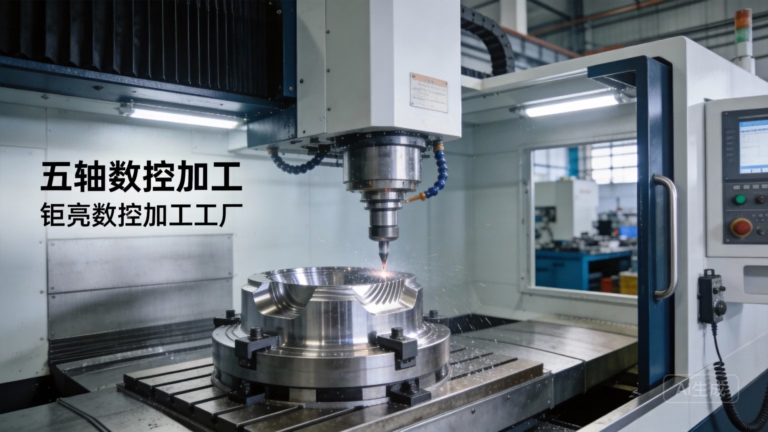
A 5-axis machine adds a second rotary axis, tilting the tool or the workpiece. The cutter can approach steep walls and deep pockets at a better angle, keeping a short, stiff tool. Impellers, turbine blades, medical implants and complex automotive housings fall into this group.
More axes are not automatically better. A flat plate with holes costs less on a 3-axis machine. Five-axis work earns its rate when the geometry cannot be reached otherwise, or when fewer setups remove stacking error.
- 13-axisFlat and prismatic parts, pockets, holes, faces.
- 24-axisCylindrical parts and multi-face features on one setup.
- 35-axisContoured surfaces, deep cavities, tight tool access.
Turning Centers Spin the Work Instead of the Tool
A CNC lathe rotates the workpiece and feeds a fixed tool into it. That single difference makes turning the fast route for anything round: shafts, pins, bushings, nozzles, spacers and threaded fasteners. Diameters and tapers come out concentric because the part spins on one centerline.
Modern turning centers are not just lathes. Live tooling adds rotating cutters, and a second spindle can pick up the part and finish the back side. A mill-turn center can drill cross holes, mill flats and cut the part off in one program, which removes a second op and the re-fixturing error that comes with it.
Turning has its own limits. Square corners, deep narrow slots and sharp internal pockets belong on a mill. Long slender shafts deflect under cutting force, so shops use steady rests, lower depth of cut, or a between-centers setup.
Threads are a good example of process choice. A turned thread is cut in a few passes on the same centerline as the diameter. A milled thread needs interpolation and costs more cycle time on most parts.
- 1Best shapesCylinders, cones, tapers, threads, grooves, face features.
- 2Live toolingCross holes and flats without a second machine.
- 3Watch outSlender shafts deflect; support them or reduce depth of cut.
Tolerance, Surface Finish and What Actually Drives Cost
Tolerance is the allowed size band on a dimension. General machining holds around ±0.005 mm on critical features when the setup is rigid and the material behaves. That number is not a default for every callout on the drawing. Tightening a non-functional dimension adds inspection time and scrap risk without improving the part.
Surface finish is measured in Ra, the average roughness of the surface. As-machined faces typically land at Ra 1.6–3.2 μm, a good turned or milled finish sits at Ra 0.8–1.6 μm, and fine work reaches Ra 0.2–0.8 μm. Finer finishes need slower feeds, smaller stepovers and sometimes a separate finishing pass or a secondary process.
Cost follows setup count more than cycle time on short runs. Every new orientation means another fixture, another set of offsets and another chance to stack error. Designing features so they can be reached from two or three directions usually saves more money than shaving a minute off the cycle.
Thin walls, deep holes and hard materials push back. A wall under 1 mm in aluminium will chatter unless the toolpath is adjusted. Inconel and hardened tool steel cut slowly and wear tools, so they cost more per cubic centimeter removed.
- 1Hold tight only where it mattersMark functional dimensions, leave the rest general.
- 2Finish is a process choiceRa 0.8–1.6 μm is a normal machined spec, not a polish.
- 3Setups drive priceFewer orientations usually beat faster cutting.
Which Materials Suit CNC Cutting and Which Do Not
Aluminium is the default for prototypes and most brackets. Grades like 6061, 7075 and 6082 cut fast, hold tolerance well and take anodizing cleanly. Stainless 303 and 304 machine reasonably; 316L and 17-4PH are tougher but common in medical and marine work.
Steel grades such as 1018, 1045 and 4140 are routine for shafts and structural parts. Titanium Ti-6Al-4V and Inconel cut slowly and generate heat, so they need sharp tooling, lower surface speed and more coolant. Shops quote them higher for a reason.
Plastics behave differently. POM and PEEK hold dimensions well, while ABS and PP soften and smear if the feed is too aggressive. Carbon fibre eats tool edges fast and needs dust control.
CNC is a poor fit for a few cases. Very thin sheet is faster on a laser or punch. Large hollow shells with uniform wall are usually die cast or molded. If a part needs thousands of identical units in one shape, casting or molding wins on unit cost.
- 1Easy6061 aluminium, brass, 303 stainless, POM.
- 2HarderTi-6Al-4V, Inconel, 17-4PH, hardened tool steel.
- 3Wrong processThin sheet, uniform hollow shells, very high volumes.
Matching the Machine to the Part
Use one row per part family. Pick the machine that reaches the features in the fewest setups.
| Part type | Machine | Typical setup count | Watch out for |
|---|---|---|---|
| Flat plate with holes | 3-axis mill | 1 | Thin plates bow when clamped |
| Bracket with side features | 4-axis mill | 1 | Rotary table clearance |
| Impeller or blade | 5-axis mill | 1 | Tool reach and chatter |
| Shaft or bushing | CNC lathe | 1 | Deflection on long slender parts |
| Housing with cross holes | Mill-turn center | 1 | Live tooling reach limits |
| Medical implant | 5-axis mill | 1–2 | Surface finish and burrs |
| Prototype enclosure | 3-axis mill | 2 | Corner radii need small tools |
Pick the Process From the Geometry
If features can be reached from two or three directions, a 3-axis or 4-axis setup is the cheaper route. If the part has contoured surfaces, deep cavities or needs a single setup to hold position, go 5-axis or mill-turn.
Common Questions
Does a CNC machine add material or remove it?
Standard CNC milling and turning are subtractive. The machine starts with solid stock and cuts material away until the shape matches the model.
A few machines combine metal deposition with milling, but that is a separate process family. For most parts, plan for a billet, bar or casting as the starting point.
How close can a CNC machine hold a dimension?
On rigid setups with stable material, ±0.005 mm is achievable on critical features. That figure applies to the features you actually mark, not to every dimension on the drawing.
Holes, bores and mating surfaces are the usual places to hold tight. Cosmetic faces and clearance holes rarely need it, and tightening them raises inspection cost.
Can one machine mill and turn the same part?
Yes. A mill-turn center has a rotating spindle and live tooling, so it can turn a diameter, then drill or mill cross features without releasing the part.
The gain is position accuracy between features and one less setup. The limit is tooling reach and the size of the part that fits the chuck and turret.
What file format does a CNC machine need?
The controller runs G-code. The shop generates it from a 3D model, usually STEP or IGES, or from a 2D drawing for simpler turned parts.
A clean model saves programming time. Missing radii, open surfaces and overlapping solids all have to be repaired before toolpaths can be built, and that delays the quote and the cut.
Why does a prototype cost more per part than a production run?
Prototype cost covers programming, fixtures, setup and inspection spread over a few pieces. Production runs spread those same fixed costs across many more parts.
The cutting time per part does not change much. What changes is how much non-cutting work each part has to carry.
When should a part not be CNC machined?
Very thin sheet, uniform hollow shells and very high unit volumes usually belong to laser cutting, die casting or molding. CNC is flexible, not cheap at volume.
If the geometry is simple and the quantity is large, ask for a cost comparison before committing to machining.
Send a Drawing, Get a Machining Plan
Upload your model and we return a quote plus DFM notes within 12 hours, with the machine, tolerance and finish we would run.
12-hour quote±0.005 mm100% inspectionNDA on request
More CNC Process Notes
We publish setup notes, tooling trials and inspection data from the factory floor.











