GreatLight CNC Machining Factory logo
CNC Machining
Rapid Prototyping
Materials
Industries
News
About GL

Get Instant Quote

Long-Part CNC Machining

Expert Casting Mess in Long Mast Machining

A 12 ft extruded tube arrives with paint thickness, out-of-round OD and lapping to control. We machine masts on dual-spindle lathes, broach six tight notches in one pass, and pack them standing up so nothing bends in transit.

4,000 mm max length±0.005 mm6-notch broaching3–5 day shipping
CNC Lathe Technical Specifications Terminology
4,000 mmMaximum processing size
±0.005 mmAchievable tolerance
127High-precision CNC machines
3–5 daysTypical shipping window
Where long parts go wrong

Does your long tube job keep slipping?

Most failures on masts and poles are not machining errors. They start upstream, in the extrusion and the paint line.

01

OD and ID drift after paint

The extruder holds bare tube size, then coating adds 60–120 µm per side. If the print calls bare-metal diameter, the finished mast lands undersize and the joint will not seat. Diameters must be quoted on the painted condition.

02

Lapping makes a rough tube

When the extrusion die drags material, the surface tears and laps over itself. Turning it clean can remove more wall than planned. We flag lapped zones before the first cut so the wall stock is accounted for.

03

Notch-to-notch inconsistency

Six notches clocked around one end are usually cut one at a time. Indexing error stacks up, and the motor bracket only fits on some masts. That is scrap on a part that already carries hours of turning.

04

Bent parts in transit

Horizontal trays hold about 5 masts and only 20–30 per box. Parts rest on each other, and a 12 ft tube takes a set. You pay for straightening or eat a rework batch before assembly even starts.

The fix

Treat the tube as a system, not a single turning job

Extrusion, machining, notching, finishing and packing are quoted together so the tolerances still hold at the last step.

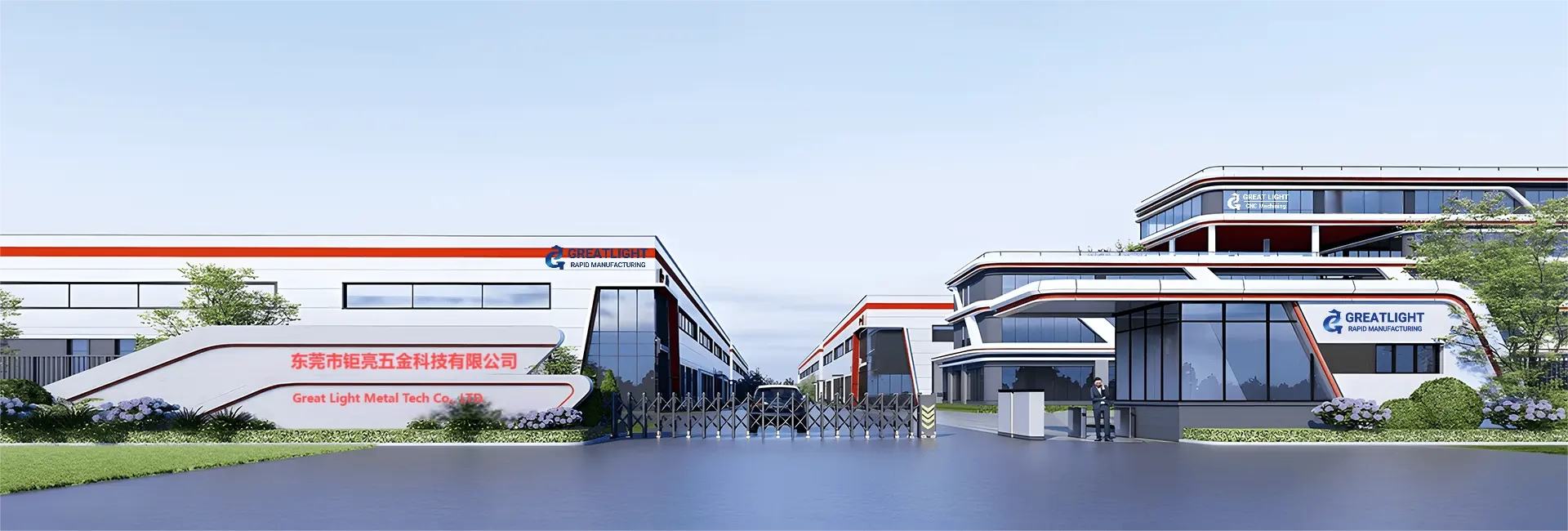
GreatLight Metal new factory building
Step 1 — extrusion control

Lock the tube size on the painted condition

The mast starts as a long aluminum extrusion. We work the die dimensions against the coating thickness so the outer diameter and inner diameter land inside print after paint, not before. Wall thickness stays even around the circumference, which is what keeps the mast straight once it is turned.

Lapping is caught at the extruder, not at the lathe. We inspect for torn and folded surface, mark those zones, and adjust the first-pass depth so the lap comes off without breaking into the wall.

  • 1
    Paint allowance built inOD and ID quoted on the coated part, not the bare tube.
  • 2
    Even wallWall variation checked around the full circumference.
  • 3
    Lap mappingRough zones marked before the first turning pass.
oplus_262178
Step 2 — turning and notching

Dual spindle, dual turret, then one broaching pass

We cut these on a dual spindle, dual turret lathe with live tooling and an automatic cartridge feeder. One side machines an end while the other side waits; the part transfers between spindles without being re-chucked by hand. That removes the concentricity error you get when a 12 ft tube is set up twice.

The six notches that clock the pivoting bracket are the hard part. We built a custom broaching tool that cuts all six in a single stroke instead of indexing around the tube. Notch position repeats from part to part, cycle time drops, and the operator is not measuring six features by hand on every mast.

  • 1
    Live toolingMilling and drilling done on the lathe, no second fixture.
  • 2
    One-stroke broachingSix notches cut in a single pass for repeatable clocking.
  • 3
    Transfer without re-chuckBoth ends machined on one setup from the same bar.

Get Instant Quote

Pick the right process

When long-tube turning is the answer, and when it is not

The deciding factor is usually aspect ratio and whether the tube is round after extrusion.

Part conditionRecommended routeWhy
Straight tube, L/D under 20Standard CNC turningChucking is rigid, no steady rest needed
12 ft tube, thin wallDual spindle lathe + steadySupports the middle, controls deflection
Six clocked notches on one endCustom broaching toolSingle stroke, repeatable angular position
Heavily lapped or torn surfaceRe-extrude before machiningTurning out the lap eats wall thickness
Tube bends in packingVertical grid packagingNo load on the barrel, no permanent set
Complex hollow shape, high volumeMetal die castingNear-net form when geometry allows it
Low-volume hollow prototypeVacuum castingFast shell parts before hard tooling
What we run

Services behind a long-part program

One shop for the turning, the notching, the finish and the box.

01

5 Axis CNC Machining

16 simultaneous 5-axis centers handle angled ports, brackets and features that would need three fixtures on a 3-axis mill.

02

CNC Milling & Turning

Mill-turn and dual spindle lathes cover shafts, masts and housings up to 4,000 mm long with live tooling.

03

Rapid Prototyping

First articles in days so the notch clocking and wall thickness are proven before a production run.

04

Metal Die Casting

For hollow housings and brackets where near-net shape beats machining from solid at volume.

05

Vacuum Casting

Silicone-tooled parts for fit checks and low-volume enclosures without hard tooling cost.

06

Part Surface Finishing

Anodizing, plating, powder coating and polishing in house, with coating thickness controlled at the print.

Scope

Capacity and inspection scope

ItemRangeNotes
Maximum part length4,000 mmLong-tube turning with steady support
Tolerance±0.005 mm±0.0002 in on qualified features
Surface finishRa 0.2–3.2 μmRa 0.8–1.6 μm typical as machined
MaterialsAluminum 6061, 6063, 6082, 7075Also stainless, steel, copper, titanium
Order quantity1 to 10,000+No minimum order quantity
Inspection100% before shipmentMaterial, in-process and final checks
ReportsOn requestDimensional data with the shipment
Quote turnaround12 hoursIncludes free DFM analysis
Why GreatLight

Numbers we can stand behind

Founded in 2011, three wholly-owned plants, 150 technicians.

15Y

15 years in production

Long enough to have seen extrusion dies drift, coating lines change, and prints get revised mid-run.

±0.005 mm

Tolerance held on long parts

Achievable on qualified features when the setup and the steady support match the aspect ratio.

127

CNC machines on the floor

16 simultaneous 5-axis centers, 16 mill-turn centers, plus 4-axis and 3-axis capacity.

99.99%

Qualification rate

Backed by 100% inspection before shipment and in-process monitoring.

12 h

Quote and DFM analysis

We tell you what will not hold before you commit tooling to it.

<2%

Historical late-delivery rate

Not a guarantee. It is the record we plan capacity around.

7,600 m²Manufacturing space
3Wholly-owned plants
150Technicians
ISO 9001 / IATF 16949Quality systems in place
What the work looks like

Long parts, the requirements, and what we deliver

die-casting-technology

Antenna mast tube

12 ft extrusion, turned on dual spindle, six broached notches.

  • 4,000 mm length
  • ±0.005 mm
  • 6 notches
vacuum-casting-services1

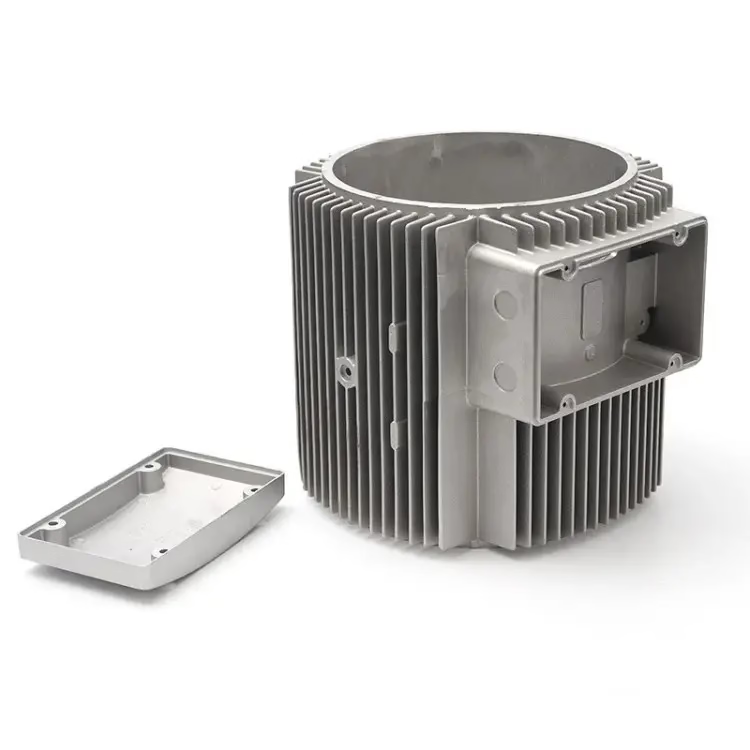
Hollow housing

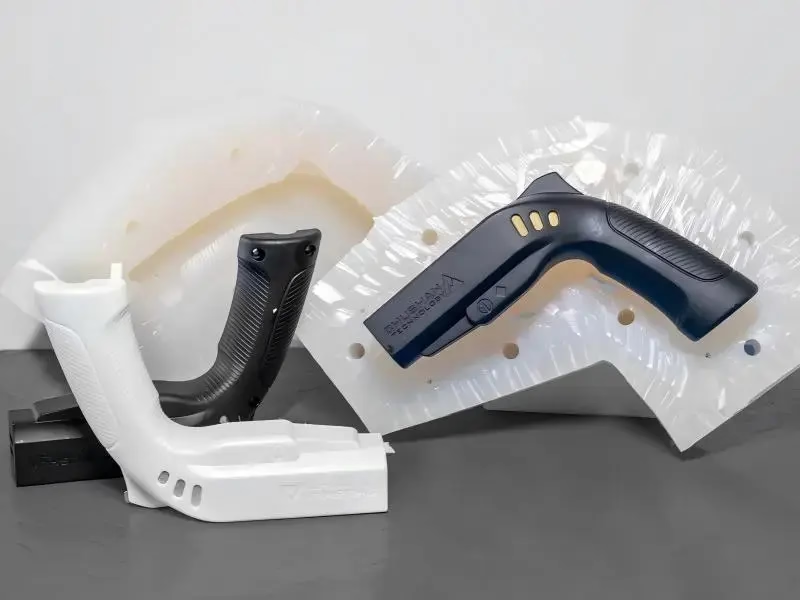
Near-net form where a machined solid would waste material.

  • Thin wall
  • Near-net shape
  • Low mass
CNC Machining Services Comparison 2026 Fictiv vs Xometry vs GreatLight

Rotating joint parts

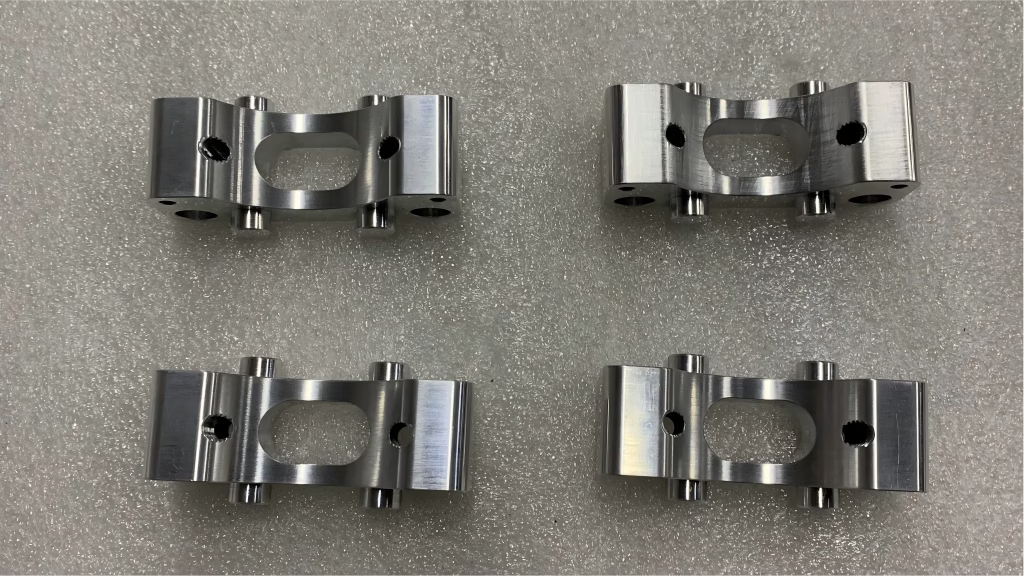
Clocking features that decide whether the bracket fits.

  • Repeatable angle
  • Live tooling
  • 100% inspected
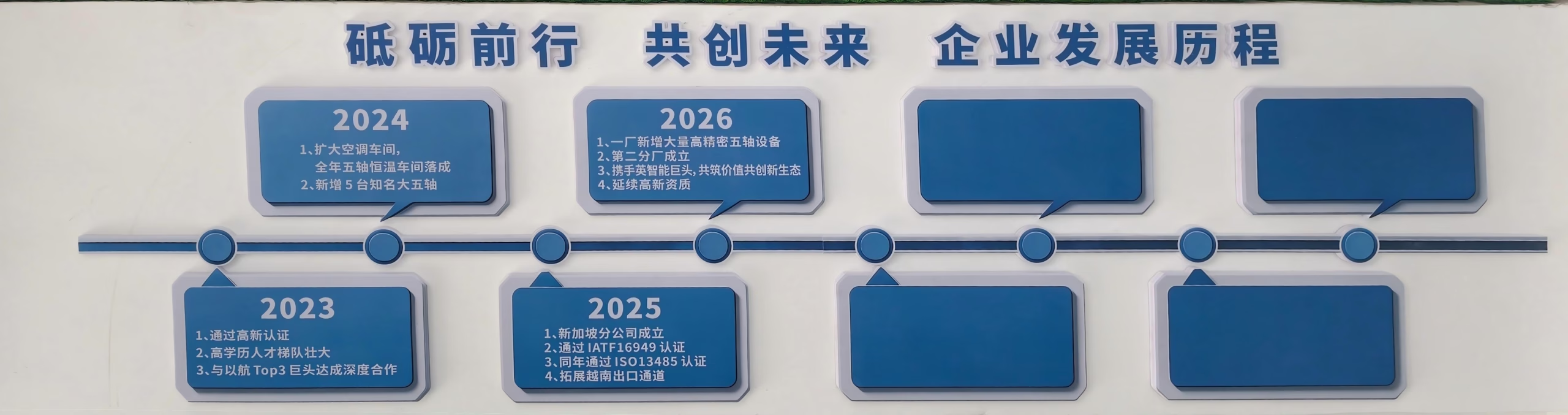
Forge ahead with determination and create the future together.

Anodized finish

Coating thickness held against the print, not guessed.

  • Anodizing
  • Ra 0.8–1.6 μm
  • Thickness control
FAQs

Questions engineers ask before sending a long-part RFQ

What causes an expert casting mess on long extruded tube?

The mess is usually three problems stacked together: the extrusion die laps material and tears the surface, the paint line adds thickness that was not in the bare-tube dimension, and the part gets re-chucked for the second end. Each one is manageable alone. Together they produce masts that will not seat.

We quote diameters on the painted condition, mark lapped zones before turning, and machine both ends from one setup wherever the geometry allows.

How do you hold tolerance on a 12 ft part?

Length is not the problem. Deflection is. A tube that long will bow under tool pressure if it is only held at the ends, so the middle is supported and the cutting load is kept low with live tooling.

On qualified features we work to ±0.005 mm (±0.0002 in). Features that sit far from a support point are reviewed in DFM before we quote the tolerance.

Why broach the notches instead of milling them?

Milling six clocked notches means six indexes, and each index adds error. On a motor bracket that only fits one way, stacked error turns into a rejected part.

A single-stroke broaching tool cuts all six at once. Position repeats part to part, cycle time drops, and the operator is not measuring six features on every piece.

Which materials do you machine for tube and mast work?

Aluminum is the common choice: 6061, 6061-T6, 6063, 6082 and 7075. We also run stainless 303, 304, 316 and 17-4PH, plus 4130 and 4140 steel when the stiffness requirement is higher.

Titanium TA1, TA2 and TC4 (Ti-6Al-4V) and Inconel are available for higher-temperature or higher-load parts.

How do you keep long parts from bending in the box?

Horizontal trays let tubes rest on each other, and a long tube takes a permanent set under its own weight. We changed to a vertical grid so each mast stands on its end and touches nothing.

That arrangement also raises the count per box, which lowers freight cost per part without adding fixtures.

Can you start from a drawing only, with no CAD model?

Yes. A dimensioned drawing with the critical features, material, finish and coating callout is enough to quote and to build the DFM notes.

If you have a model, send it with the drawing. If the tolerances conflict with the geometry, we will flag it in the 12-hour quote response.

What are the lead times and order quantities?

Quotation and free DFM analysis come back within 12 hours. Production can start within 24 hours of approval, and parts typically ship in 3–5 days.

There is no minimum order quantity. One prototype or a 10,000-piece run use the same quoting process.

How is our design protected?

Uploads are handled as confidential, and we sign an NDA on request before drawings are shared. We hold ISO 27001:2022 for information security.

Quality systems in place include ISO 9001:2015, IATF 16949:2016 and ISO 13485:2016.

Send the long part. We will tell you what will hold.

Upload the drawing and get a quote with free DFM analysis inside 12 hours. No minimum order quantity, 100% inspection before shipment.

12-hour quote100% inspectionNo MOQNDA on request

Trusted by engineers and manufacturers worldwide

Tesla Ford Motor Company BYD Auto Denso Magna International Boeing Airbus Medtronic KUKA FANUC