
High Initial CNC Machining Services: What to Check Before You Release a PO
This page is for design engineers and procurement staff who are about to place a first order, a prototype run or a low-volume batch. Read it and you will be able to judge a supplier on tolerance capability, lead time, MOQ, certification and quoting behavior before money changes hands.
In this article
- 1
- 2
- 3
- 4
- 5
- 6
- 7
- 8
Five things to settle before the first PO
High initial CNC machining services vs. a low-cost first quote
Use this to compare what two suppliers actually commit to on an initial order.
| Check | Low-cost quote | High initial service | Why it matters to you |
|---|---|---|---|
| DFM feedback | None, or 1 line | Written analysis in 12 hours | Catches features that cannot be machined |
| Tolerance claim | Blanket ±0.1 mm | Feature list, down to ±0.005 mm | Sets your inspection plan |
| Production start | Unstated | Within 24 hours of PO | Protects your build schedule |
| Finishing | TBD or subcontracted | Named process and inspection | Prevents rework after plating |
| MOQ | Often 50–100 pcs | None, 1 to 10,000+ | Keeps first-run cost honest |
| Inspection | Sample check | 100% before shipment | Reduces incoming reject rate |
| Certificates | ISO 9001 only | ISO 9001, IATF 16949, ISO 13485, ISO 27001 | Gate for regulated industries |
| Documentation | Invoice only | Inspection reports on request | Needed for design history files |
Pick the supplier whose quote answers questions you have not asked yet
For a first order, choose on DFM depth, per-feature tolerance and finishing control, not on the lowest unit price. Send your STEP file and we will return a quote with free DFM analysis within 12 hours.
What high initial CNC machining services actually means
The phrase describes the front end of a project rather than a machine type. It covers the first inquiry, the DFM review, material sourcing, the first article, and the low-volume batch that follows. The cutting is the simple part. The decisions made before cutting are what decide whether the part fits on the first try.
A cheap first quote usually prices only machine time. It leaves out the engineering questions: can this wall thickness hold during clamping, does this thread sit too close to a radius, will the anodize build change a Ø6 H7 bore. Those questions come back as change orders or scrapped parts.
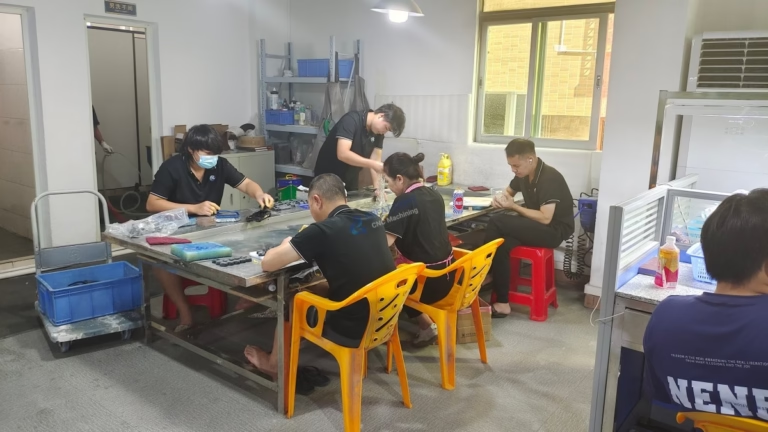
GreatLight has run this phase since 2011 across 3 wholly-owned plants and 7,600 m² of floor space, with 150 technicians and 127 high-precision CNC machines. The work is not exotic. It is the routine discipline of reading a drawing properly before the spindle turns.
So when we talk about high initial CNC machining services, we mean a supplier that treats the first order as the foundation of a longer relationship. That changes how they quote, how fast they respond, and how much they tell you before you ask.
- 1Front end, not a machine classIt covers inquiry, DFM, first article and low-volume batch.
- 2The quote tells you the mindsetMachine time only, or machine time plus engineering.
- 3First order sets the patternA weak prototype phase is expensive to correct later.
Tolerance, lead time and MOQ: the three hard numbers
Tolerance first. Our general capability is ±0.005 mm (±0.0002 in) on critical features, with surface finish from Ra 0.2–0.8 μm on ground or polished faces and Ra 0.8–1.6 μm on standard milled faces. As-machined surfaces sit at Ra 1.6–3.2 μm. Ask a supplier to name which features reach the tight number. If every feature is claimed at ±0.005 mm, the quote is not credible.
Lead time second. Quotation and free DFM analysis come back within 12 hours. Production can start within 24 hours of the PO. Parts ship in 3–5 days for typical prototype quantities. Those are stage figures, not a promise of a single delivery date, and you should ask for the same breakdown from any shop you compare.
MOQ third. There is no minimum order quantity here — one prototype or a 10,000+ part run both go through the same process. That matters because a shop that forces 100 pieces on a design you will revise next month is charging you for inventory, not for machining.
The three numbers interact. A tight tolerance on a long, thin part drives fixture cost, which drives lead time. A small MOQ with a tight tolerance means the shop absorbs setup cost and expects it back on volume. Read them together, never one at a time.
- 1Ask per feature±0.005 mm on critical bores and datum faces, looser elsewhere.
- 2Stage the scheduleQuote 12 h, start 24 h, ship 3–5 days.
- 3No MOQOne piece to 10,000+ on the same route.
Certification and quoting behavior decide the long run
Certification is a filter, not a badge. ISO 9001:2015 is the baseline. IATF 16949:2016 is what automotive and EV programs expect. ISO 13485:2016 covers medical devices. ISO 27001:2022 matters when your CAD files are the asset being protected. Ask which plant holds which certificate, because a group certificate does not automatically cover the site that will cut your part.
Quoting behavior is the softer signal. A useful quote lists material grade, stock size, machine, tolerance per feature, finish, inspection method and lead time. A quote that is one line and a price is a placeholder, and the real number arrives later as a change order.
Confidentiality belongs here too. Uploads are secure and confidential, and an NDA is available on request. If your drawings carry export-controlled geometry or an unreleased product name, settle that before sending files, not after.
One more check: does the supplier tell you when a design is a bad fit for CNC? A part with deep internal channels, a 0.4 mm wall or a texture that only molding can produce should be redirected. Honest redirection costs you nothing and saves a month.
- 1Site-level certificatesConfirm the plant, not just the group.
- 2Quote detailMaterial, machine, tolerance, finish, inspection, lead time.
- 3NDA before filesSecure uploads; NDA on request.
- 4Bad-fit honestyA supplier who says no early is useful.
Material and finish choices that affect the first order
Material drives the process more than the drawing does. Aluminum 6061-T6 and 7075 machine fast and hold tight tolerances; 7075 is stronger but more prone to distortion on thin sections. Stainless 303 and 304 cut cleanly, while 316L and 17-4PH (SUS630) need slower feeds and sharper tooling. Titanium TC4 (Ti-6Al-4V) and Inconel are for load and heat cases, and they cost time as well as money.
For a first article, aluminum is the safe route. It machines in one setup on a 5-axis center, anodizes predictably, and lets you check fit before committing to steel. Switch to 4140, 4340 or 17-4PH once the geometry is frozen.
Finishing is where initial orders most often slip. Anodizing, electroless nickel, zinc, silver and gold plating, powder coating, black oxide, bead blasting, polishing and laser marking all sit downstream of machining. Confirm which steps are in-house, which are subcontracted, and who performs final inspection after them.
Laser marking has a practical limit: minimum character height 1.5 mm. If your part number or traceability code is smaller than that, it will not read reliably. Move the mark to a flat face or enlarge it during DFM.
- 1Aluminum first6061-T6 for first articles, 7075 when strength matters.
- 2Stainless and titaniumSlower cutting, more tool wear, higher cost.
- 3Finish after machiningAnodize and plating change dimensions slightly.
- 4Marking limit1.5 mm minimum character height.
Common mistakes buyers make on a first order
The first mistake is sending a PDF and expecting a usable quote. STEP or IGES plus a 2D drawing with datums, tolerances and finish callouts gets you a real number in 12 hours. A PDF alone gets you a guess.
The second is choosing on unit price. On a 5-piece prototype run, setup and programming dominate the cost. A shop that quotes 30 percent less is either skipping inspection or planning to recover the difference on the next order.
The third is leaving finishing undefined. A part quoted as machined and later sent for hardcoat anodize can grow a few micrometres and lose a press fit. Define the finish in the RFQ and let the supplier hold the pre-plate dimension.
The fourth is ignoring the inspection report. We inspect 100 percent before shipment and provide reports on request. If your quality system needs first article inspection data, say so in the RFQ so the CMM time is included in the quote.
- 1Send STEP plus 2DDatums, tolerances and finish callouts included.
- 2Do not buy on unit priceSetup dominates small runs.
- 3Define the finishPre-plate dimensions must be held.
- 4Request inspection dataAsk early, not after delivery.
How to run a first order, step by step
The same sequence applies whether you need one prototype or a 500-piece pilot run.
- 1Send a complete data packageSTEP or IGES for geometry, 2D drawing for datums, tolerances, threads and finish. State the material grade and quantity. Missing callouts are the top reason quotes come back slow.
- 2Read the DFM before the priceFree DFM analysis returns within 12 hours. Check for thin walls under 0.8 mm, deep pockets beyond 4× tool diameter, and threads closer than 1 mm to a radius.
- 3Confirm tolerance per featureMark critical features at ±0.005 mm and leave the rest at general tolerance. Blanket tight tolerances on non-functional faces raise cost with no benefit.
- 4Fix the finish and post-processingChoose anodize type, plating or coating in the RFQ. For hardcoat anodize, allow 20–50 μm build and specify the pre-plate dimension.
- 5Approve the first articleInspect datum features, bore sizes and any press fits before releasing the batch. Catch a dimension shift here and you avoid scrapping the run.
- 6Schedule the pilot batchProduction can start within 24 hours of PO approval; typical parts ship in 3–5 days. Build a 3–5 day buffer into your own assembly plan.
- 7Lock the process for volumeOnce the design is frozen, keep the same material, finish and inspection plan. Changing any one of the three restarts the qualification.
Questions engineers ask before the first order
How tight a tolerance can you hold on a first article?
General capability is ±0.005 mm (±0.0002 in) on critical features, with surface finish down to Ra 0.2–0.8 μm on ground faces.
Send the drawing and we will tell you which features reach that number and which should stay at general tolerance. A per-feature answer is more useful than a single blanket figure.
What is the smallest quantity you will run?
There is no minimum order quantity. We run from one prototype to 10,000+ part runs.
Small quantities carry more setup cost per part, so the unit price at five pieces will always be higher than at five hundred. That is normal and we will show the breakdown.
How fast can you quote and ship?
Quotation and free DFM analysis come back within 12 hours. Production can start within 24 hours of the PO, and parts ship in 3–5 days for typical prototype quantities.
Complex parts with several finishing steps take longer. We will flag that in the quote rather than after the order.
Which certifications cover the plant that will machine my parts?
We hold ISO 9001:2015, IATF 16949:2016, ISO 13485:2016 and ISO 27001:2022 across our operations.
Tell us your industry and we will confirm which site and which certificate apply to your project.
Can you handle heat treatment and plating as part of the order?
Yes. Anodizing, electroless nickel, zinc, silver and gold plating, powder coating, black oxide, bead blasting and polishing are all available.
We inspect 100 percent before shipment, including parts that pass through a finishing step, so the final dimension is checked after coating.
How do you protect our drawings and design data?
Uploads are secure and confidential, and an NDA is available on request before any file transfer.
Our ISO 27001:2022 scope covers information security, which is relevant if you are sending unreleased product geometry.
Ready to start your first CNC order?
Upload your drawings for a quote and free DFM analysis within 12 hours. No MOQ, 100 percent inspection before shipment.
12-hour quote100% inspectionNo MOQNDA on request
More from the shop floor
We publish setup notes, tooling trials and inspection data from the factory floor.











