
How to Choose the Material of Machine Tools
This guide is for machine builders and engineers specifying beds, columns, bases, and slides. It walks through six proven steps to choose the material of machine tools, from duty cycle and damping to castability and cost per hour. You will finish with a shortlist and a set of questions to send your foundry or machine shop.
In this article
- 1
- 2
- 3
- 4
- 5
- 6
- 7
- 8
Key takeaways
Match the material to the machine's duty cycle
Start with how the machine will actually run, not with a material data sheet. A surface grinder holding Ra 0.4 μm for 10 hours a day sees continuous excitation from the grinding wheel. A woodworking router cutting soft material in 2 hour batches sees almost none. The same bed design will behave very differently in those two machines.
Write down three numbers before you open a catalogue: cutting hours per day, highest spindle speed, and the worst chatter frequency you have measured on a similar machine. Those three values tell you which damping range you need. If you cannot measure chatter, ask the spindle supplier for the dominant excitation frequency at top speed.
Then decide the acceptable tool tip movement under load. For a finishing machine, 5 μm is often the working limit. For a roughing machine, 20 μm may be fine. This number becomes your acceptance criterion when you compare candidate materials.
- 1Continuous cuttingFavor high-damping iron or polymer concrete.
- 2Intermittent cuttingWelded steel or aluminum may be enough.
- 3High speed spindleDamping matters more than static stiffness.
Compare damping and stiffness for each candidate
Stiffness alone does not stop chatter. Damping does. Grey cast iron such as HT250 or G2 grade iron typically shows a damping ratio around 0.001 to 0.003, while mild steel sits near 0.0002 to 0.0005. That gap is why most grinding and milling beds are still cast iron.
Steel welded fabrications win when you need a large travel in a short lead time. A 4,000 mm steel weldment can be cut, welded, and stress relieved faster than a pattern can be made. The trade off is that you must add mass or fill the structure with epoxy granite to recover the lost damping.
Aluminum is rarely the right answer for a bed. Its elastic modulus is about one third that of steel, so a stiff aluminum bed becomes very heavy. Use aluminum for covers, guards, and moving gantries where inertia matters more than damping.
- 1Cast ironBest balance of damping, stiffness, and cost for beds.
- 2Steel weldmentGood for long travels and fast delivery, needs stress relief.
- 3Polymer concreteVery high damping, needs steel inserts for mounting.
Check thermal drift against your tolerance budget
Every material moves when it warms up. The coefficient of thermal expansion for steel is about 11.7 × 10⁻⁶ /°C, for cast iron about 10.5 × 10⁻⁶ /°C, and for aluminum about 23 × 10⁻⁶ /°C. A 1,000 mm bed with a 2 °C gradient will shift the tool tip roughly 21 μm if it is cast iron.
That number is often larger than the machine's stated accuracy. So the material choice has to be paired with a thermal plan: coolant flow through the bed, symmetric rib layout, and temperature sensors near the spindle. If you cannot control the gradient, choose a lower expansion material or shorten the thermal path.
Granite and polymer concrete help here because their expansion is lower and their thermal mass is higher. They warm up slowly, which gives the control loop time to react. That is why precision grinders and CMMs often use them.
Confirm the material can actually be cast and machined
A perfect material on paper is useless if the foundry cannot pour it without porosity. Minimum wall thickness for grey iron is usually 6 to 8 mm. Below that, the metal freezes before it fills the section. Sharp inside corners create hot spots and shrink voids, so design radii of at least 3 mm.
Draft angle matters too. Sand cast iron needs 1 to 2 degrees of draft on vertical faces. If your design has zero draft, the pattern cannot be pulled and you will pay for a lost foam or investment casting process instead.
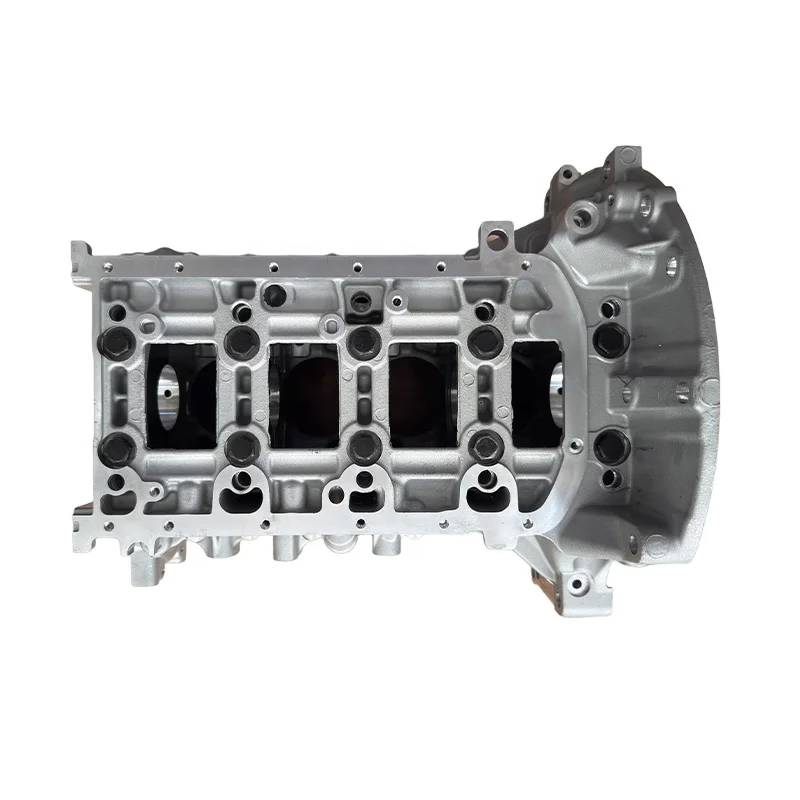
After casting, the part must be machined. Cast iron machines well, but it needs a stress relief cycle before finish boring. Skip that step and the bed will move 10 to 30 μm over the first few months. For steel weldments, stress relief is even more critical. We run raw material checks and in process monitoring on every machine tool casting we machine, and final inspection reports are available on request.
- 1Wall thicknessKeep grey iron above 6 mm to avoid cold shuts.
- 2Corner radiiUse 3 mm minimum to reduce shrink porosity.
- 3Stress reliefRequired before finish machining on beds and columns.
Price the material over the machine's working life
Price per kilogram is a poor guide. A cast iron bed may cost more to pour than a steel weldment, but it often needs less epoxy filling and less remedial work after assembly. Look at total cost over the expected cutting hours.
Include these items: pattern or fixture cost, machining time, stress relief, surface treatment, and the cost of scrapping a part after final inspection. A single scrapped 800 kg bed can wipe out the savings from a cheaper alloy.
Then look at downtime. If a bed drifts out of tolerance after 2,000 hours, the machine is out of service. A material that holds its geometry for 20,000 hours is usually worth a higher purchase price. We see this pattern across the industrial machinery and robotics programs we support.
Step by step: choosing the material
- 1Record the duty cycleLog cutting hours per day, spindle speed range, and worst chatter frequency. Aim for at least 40 hours of data before deciding.
- 2Set the tool tip movement budgetFinishing machines: 5 μm. General milling: 10 to 15 μm. Roughing: up to 20 μm. Write this number down.
- 3Shortlist three materialsTypical shortlist: grey cast iron, steel weldment, polymer concrete. Add granite only if thermal drift is the dominant risk.
- 4Check damping and expansionCompare damping ratio and CTE at your working temperature range. Reject any option that exceeds the budget in step 2 by more than 30%.
- 5Run a castability reviewCheck wall thickness above 6 mm, corner radii above 3 mm, and draft above 1 degree. Adjust the design before quoting.
- 6Request a stress relief planAsk the supplier for the cycle time, temperature, and cooling rate. Rough machine, relieve, then finish machine.
- 7Compare cost per 10,000 hoursAdd pattern cost, machining, treatment, and expected scrap. Choose the lowest figure, not the lowest quote.
- 8Verify the supplierAsk for material certificates, in process inspection records, and a sample of a similar bed. Check dimensional reports before releasing the batch.
Material comparison for machine tool structures
Values are typical ranges for guidance only. Confirm with your foundry and metrology data.
| Material | Best for | Watch out for | Relative cost |
|---|---|---|---|
| Grey cast iron | Beds, columns, grinding bases | Needs stress relief before finish boring | Medium |
| Steel weldment | Long travels, fast delivery | Low damping, must add mass or filling | Medium |
| Polymer concrete | High damping, thermal stability | Steel inserts needed for mounting | High |
| Granite | Precision grinding, metrology frames | Brittle, limited mounting options | High |
| Aluminum | Covers, guards, moving gantries | Low modulus, poor damping for beds | Low to medium |
The short answer
Pick the material that keeps tool tip movement inside your budget for the full working life, not the one with the lowest price per kilogram. For most beds and columns, that means grey cast iron with a documented stress relief cycle.
Frequently asked questions
Is cast iron always better than steel for a machine bed?
No. Cast iron wins on damping and thermal stability, which matters for grinding and precision milling. Steel wins when the bed is very long, the lead time is short, or the design is still changing.
If you pick steel, plan for stress relief and add mass or epoxy granite filling to recover damping.
How thick should the walls be on a cast iron bed?
Keep the minimum wall at 6 to 8 mm for grey iron. Thinner sections tend to freeze before the mold fills, which leaves cold shuts and porosity.
Thicker walls add mass and damping, but they also add weight and cost. Use ribs to raise stiffness without thick walls.
Do I need stress relief after casting?
Yes for any bed or column that will be finish machined to tight tolerances. Without it, residual stresses release over weeks and move the geometry.
A typical sequence is rough machine, stress relieve, then finish machine. Ask for the cycle temperature and cooling rate in writing.
Can polymer concrete replace cast iron?
It can for high damping applications such as grinding and metrology frames. The damping is higher and the thermal expansion is lower than iron.
The trade off is mounting. Polymer concrete needs cast in steel inserts for bolts and linear rails, and the supplier list is shorter.
How do I compare quotes from different foundries?
Compare the same drawing revision, the same material grade, and the same inspection scope. Ask whether stress relief and pattern cost are included.
Then compare cost per expected cutting hour, not the total price. A cheaper bed that drifts after 2,000 hours is the expensive option.
What tolerances can be held on a machined machine tool casting?
We hold ±0.005 mm on critical features and Ra 0.8 to 1.6 μm on mounting faces. Surface finish down to Ra 0.2 to 0.8 μm is available where the design calls for it.
Every part is inspected before shipment, and dimensional reports can be provided on request.
Send us your bed or column drawing
We review machine tool castings for castability, machining sequence, and stress relief, then quote from one prototype to full production runs.
12-hour quote100% inspectionNo minimum order quantity
More machining guides
We publish setup notes, tooling trials and inspection data from the factory floor.











