
Is a Sonic Welder a CNC Machine?
A sonic welder joins parts with 20–40 kHz vibration. A CNC machine cuts material with a rotating tool under program control. They share a cabinet, a servo, and a controller, which is why the question keeps coming up. This page separates the two by motion, force, and tolerance so you can pick the right process for a real part.
What Each Machine Actually Does
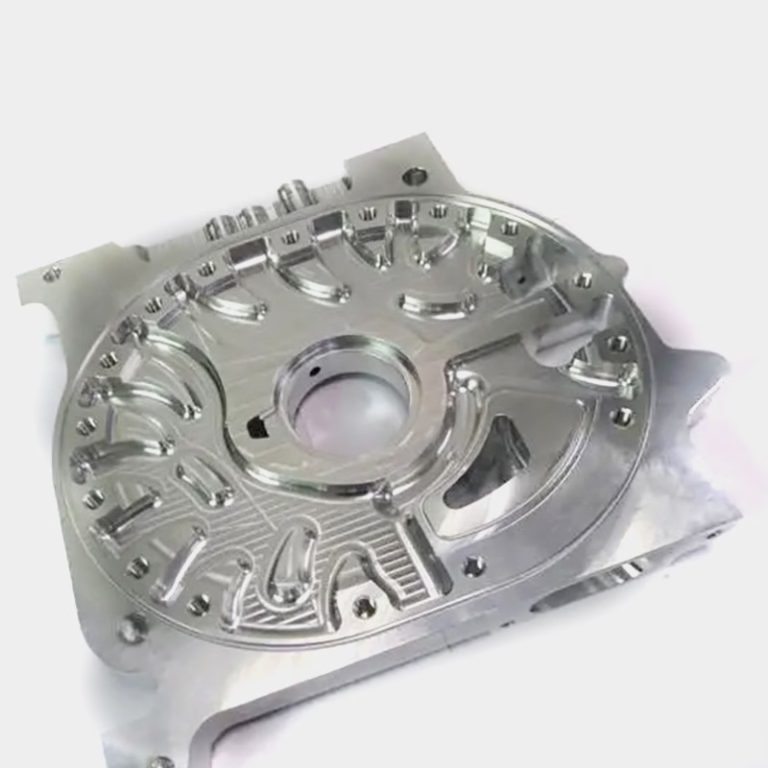
A CNC machine removes material. A spindle turns a cutter, ball screws drive the axes, and the control follows a program of coordinates. The workpiece gets smaller and the finished geometry is defined by tool paths. Tolerance, surface finish, and feature position all come from that motion.
A sonic welder, also called an ultrasonic welder, does not remove anything. It presses two plastic parts together and shakes one of them at 20–40 kHz for 0.1–1.0 s. Friction at the joint face melts a small energy director, and the melt solidifies into a weld. The horn only travels a few tenths of a millimeter.
So the honest answer to the sonic welder a cnc machine question is no. They look similar on the factory floor, but the physics are different. One machine is judged by the shape it leaves behind. The other is judged by whether the joint holds.
That distinction matters for quoting, for fixture design, and for inspection. If you need a bore held to ±0.005 mm, welding cannot get you there. If you need two ABS halves joined without a screw, a CNC machine cannot do it either.
The two processes also differ in how they are programmed. A CNC program is a list of coordinates and feed rates. An ultrasonic welder is set by amplitude, pressure, hold time, and trigger force. There is no tool path to edit.
Four Tests That Separate the Two Processes
Test one is motion. A CNC axis moves 4,000 mm on our largest machine and repeats to ±0.005 mm. An ultrasonic horn moves less than 1 mm, and it does so at high frequency with almost no positional feedback.
Test two is force direction. A milling cutter pushes sideways and lifts the part unless it is clamped. An ultrasonic welder pushes straight down, then vibrates laterally across the joint face. The part is held by the anvil, not by a vise.
Test three is the output. A CNC machine produces chips, coolant mist, and a new surface. A sonic welder produces a flash bead, a weld line, and sometimes a witness mark from the horn. Nothing is removed.
Test four is repeatability. A CNC shop measures the part. A welding line measures weld strength, flash height, and leak rate. Different instruments, different acceptance criteria.
If a machine passes all four tests as a cutting machine, it is a CNC machine. An ultrasonic welder fails the first test immediately.
Where a Sonic Welder Stops Working
Ultrasonic welding needs a thermoplastic. Amorphous resins such as ABS and PC weld well. Semi-crystalline resins such as PA and POM need higher amplitude and a sharper energy director, and the weld window narrows.
Filled and glass-reinforced grades are harder. Glass fibers do not melt, so they sit in the joint and block melt flow. A 30% glass-filled PA part often needs a different joint design or a switch to a snap fit plus adhesive.
Thermosets, most metals, and ceramics cannot be ultrasonically welded. Metal can be ultrasonically spot welded in thin foils, but that is a different machine and a different process.
Geometry sets the ceiling too. A tall, thin wall absorbs vibration before it reaches the joint. A part with a long unsupported flange will flex and weld unevenly. In those cases a CNC-machined rib or a thicker boss helps more than a stronger weld.
Wall thickness below 1.5 mm and joint faces smaller than about 2 mm make the process fragile. Above 4 mm, the horn may not deliver enough amplitude to the joint face at all.
What This Means for Your Drawing
A sonic welder cannot hold a tolerance. It has no scale feedback on the joint. If a drawing calls out ±0.05 mm on a welded assembly, that callout will not be met by welding alone.
The usual fix is a machined datum. Weld the housing first, then machine the critical bores, faces, or slots in a second op. The weld provides the shape. The CNC machine provides the accuracy.
That two-step route is common in electronics enclosures, pump housings, and medical device shells. The welded body is rough, and the machined features are tight.
Cost follows the same split. Welding is fast, usually a few seconds per part and cheap per unit. CNC machining carries setup time and tool wear, so it rewards a batch and punishes a one-off.
If the part is a metal component with tight tolerances, skip the welding question entirely. Send the drawing to a machine shop. If it is a plastic shell that needs to be sealed and cannot be screwed, welding is the right answer and machining is not.
How the Two Cells Look Different
A CNC cell has a machine enclosure, a tool magazine, a coolant system, and a chip conveyor. An operator loads a blank, closes the door, and the program runs. Cycle times are measured in minutes.
A welding cell has a press frame, a converter, a booster, and a horn. The part sits in a nest. Cycle times are measured in seconds. Operators check weld depth and flash height, not dimensions.
Maintenance differs too. A CNC machine is judged by spindle runout, ball screw backlash, and tool life. A welder is judged by horn wear, amplitude drift, and converter temperature.
Both cells can sit in the same plant and feed the same assembly line. One makes the parts. The other joins them. Calling both of them CNC machines hides that split and leads to wrong fixtures, wrong inspection plans, and wrong quotes.
Deciding Which Process You Need
Ask what the part must do. If the answer is carry load, seal fluid, or hold a bearing, you need a machined feature. If the answer is hold two plastic halves together, you need a weld.
Then ask what the tolerance is. Anything tighter than ±0.05 mm on a plastic part usually pushes you toward machining, or toward a machined insert inside a welded body.
Finally, ask about volume. Welding scales with tooling for the horn and nest. Machining scales with cycle time and tool life. At low volume, machining wins on setup. At high volume in plastic, welding usually wins on unit cost.
Send us the drawing and the material. We will tell you which route fits and where the tolerance has to come from. That answer takes less time than building the wrong fixture.
Sonic Welder vs. CNC Machine
Use this table before you write a process sheet.
| Item | Sonic welder | CNC machine |
|---|---|---|
| Material action | Joins, no removal | Cuts, material removed |
| Typical materials | ABS, PC, PA, PP | Aluminium, steel, titanium, plastics |
| Axis travel | Under 1 mm, high frequency | Up to 4,000 mm |
| Positional tolerance | Not a positioning process | ±0.005 mm achievable |
| Program input | Amplitude, pressure, hold time | Coordinates, feeds, speeds |
| Output to check | Weld strength, flash, leak | Dimensions, finish, position |
| Fixturing | Anvil and horn nest | Vise, soft jaws, vacuum plate |
| Best fit | Plastic housings, seals, clips | Metal and plastic precision parts |
Which Process Fits Which Part
Match the part to the process before you quote.
| Part type | Recommended process | Why |
|---|---|---|
| ABS enclosure, snap-fit joint | Ultrasonic welding | Thermoplastic, fast cycle, sealed joint |
| Aluminium housing, bearing bore | CNC machining | Tight bore, metal, ±0.005 mm |
| Glass-filled PA manifold | Machining or redesign | Fibers block melt flow at the joint |
| PC shell with machined face | Weld, then machine | Weld gives shape, CNC gives datum |
| Stainless bracket, thin wall | CNC machining | Metal does not ultrasonically weld |
| PP filter housing, high volume | Ultrasonic welding | Low unit cost, seconds per part |
The Short Answer
A sonic welder is not a CNC machine. If your part needs a held tolerance or a machined datum, send it to a CNC shop. If it needs two plastic halves joined without fasteners, welding is the right call and machining is not.
Common Questions
Can a sonic welder be controlled by G-code?
No. G-code describes tool position over time. A welder is controlled by amplitude, pressure, hold time, and trigger force. Some welders log those values digitally, but there is no tool path to program.
If you see a screen with coordinates on a welding press, it is usually a motion controller for the downstroke, not a cutting path.
Is ultrasonic welding a subtractive or additive process?
Neither, in the usual sense. It does not remove material and it does not add material. It changes the state of the material at the joint face, melting and re-solidifying it.
That is why welding is grouped with joining processes such as laser welding and adhesive bonding, not with machining or 3D printing.
Can I weld metal with an ultrasonic machine?
Only thin foils and some wire bonds, using a dedicated metal welding setup. Bulk metal parts do not weld this way.
For metal assemblies, the practical routes are CNC machining, laser welding, or brazing. Each has its own tolerance and inspection rules.
Why do CNC shops sometimes own welding equipment?
Because a finished assembly may need both. A machined metal insert is often overmolded or ultrasonically staked into a plastic housing.
The shop machines the insert, the customer or the molder does the joining. Some shops keep a welder for staking and insert installation.
Does ultrasonic welding affect part dimensions?
Yes, slightly. The joint collapses by the height of the energy director, often 0.2–0.5 mm. Flash forms outside the joint line.
If overall height matters, design the pre-weld stack 0.2–0.5 mm taller and specify a weld-depth stop on the press.
What tolerance can a welded plastic assembly hold?
Typically ±0.1 mm on overall height with a controlled weld stop, and looser on lateral position. That is far from CNC machining at ±0.005 mm.
When a welded assembly needs a tight feature, machine that feature after welding in a second operation.
Send the Drawing, Get a Process Answer
Upload your part and we will tell you whether it needs a CNC machine, a welder, or both, with a DFM note and a quote.
12-hour quote100% inspection
More Process Notes
We publish setup notes, tooling trials and inspection data from the factory floor.











