
Is Glowforge a CNC Machine?
Short answer: no. A Glowforge is a laser cutter, and a CNC machine cuts with a spinning tool that touches the part. This page breaks down how each one removes material, what tolerance each can hold, and which jobs belong on which machine. Written for engineers and buyers who need to route a part to the right process.
In this article
- 1
- 2
- 3
- 4
- 5
- 6
- 7
- 8
Key takeaways
Is Glowforge a CNC Machine? The Short Answer
No. A Glowforge is a laser cutter and engraver. It is computer-controlled, and it does remove material, so the confusion is understandable. But it removes material by focusing a beam of light onto the surface until the material burns, melts, or vaporizes away. Nothing touches the part.
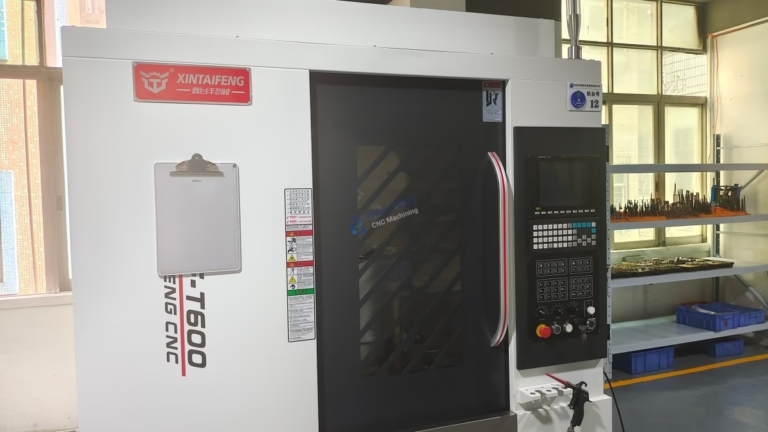
CNC stands for computer numerical control. In a machine shop, a CNC machine is a mill, lathe, router, or mill-turn center that drives a physical cutting tool along programmed axes. The tool contacts the workpiece and shears chips off it. The cutting force is real, measurable, and it has to be absorbed by the part and the fixture.
That single difference, heat versus force, drives everything else on this page. It sets the tolerance a machine can hold, the materials it can touch, the geometry it can produce, and the surface finish it leaves behind.
So if someone asks is Glowforge a CNC machine, the accurate answer is that it belongs to a different category of fabrication equipment. It is a digital fabrication tool. It is not a CNC machining center.
- 1GlowforgeCO2 laser cutter, 2D profiles, non-contact thermal removal
- 2CNC millRotating cutter, 3D geometry, contact mechanical removal
- 3Shared traitBoth follow a computer-generated toolpath
How Laser Cutting Removes Material
A laser cutter works by concentrating energy. A CO2 tube or diode array produces a beam, mirrors and a lens focus it to a spot a few tenths of a millimeter wide, and the concentrated energy raises the local temperature of the material until it fails. Wood and paper char and burn. Acrylic melts and vaporizes. Some thin metals can be cut with enough power and an assist gas.
The kerf, meaning the width of the cut, is set by the beam diameter and the way the material reacts to heat. On a typical laser cutter the kerf lands in the 0.1–0.5 mm range and it can vary between materials and even between passes. The edge is not cut cleanly in the machining sense. It has a heat-affected zone where the material structure changed.
Depth control is limited. The beam is focused at one plane. You can raise or lower the focus to cut deeper or shallower, and you can run multiple passes, but you cannot steer the cut around a 3D contour the way a ball-nose end mill does. A laser produces a through-profile, not a sculpted surface.
This is why laser cutting is fast and cheap for flat parts and close to useless for a part with pockets, tapers, threads, or a three-dimensional curve.
- 1Thermal removalMaterial is burned, melted, or vaporized, not sheared
- 2Narrow kerfRoughly 0.1–0.5 mm depending on material and focus
- 3Heat-affected zoneEdge chemistry changes; hardness and color can shift
How a CNC Machine Removes Material
A CNC machine spins a cutting tool and moves it along programmed axes. On a three-axis mill the tool moves in X, Y, and Z while the workpiece stays put. A four-axis machine adds rotation about one axis. A simultaneous five-axis machine tilts and rotates the tool or the table so the cutter can reach a compound angle in one setup.
The tool shears material into chips. That means the process has to manage cutting force, heat in the cut, chip evacuation, and tool wear. Rigid setups and correct feeds and speeds keep the cut stable. A light finishing pass with a sharp cutter leaves a predictable surface. At GreatLight we hold ±0.005 mm and reach Ra 0.2–0.8 μm on finishing operations when the geometry allows it.
Because the tool is a solid body with a defined shape, the machine can produce far more than a profile. End mills cut pockets and slots. Ball-nose tools cut curved surfaces. Drills and taps create holes and threads. A mill-turn center cuts a turned diameter and a milled flat on the same part without re-fixturing.
The price of that capability is setup time and fixturing. A CNC job needs workholding, a tool list, and a program that has been proven out. For a flat acrylic panel, that overhead is hard to justify. For a 7075 aluminium bracket with a pocket and two dowel holes, it is the only way to hit the drawing.
- 1Mechanical removalA rotating cutter shears chips from the workpiece
- 2Full 3D capabilityPockets, tapers, radii, threads, contoured surfaces
- 3Repeatable precision±0.005 mm is a routine shop tolerance, not a lab number
- 4Setup costWorkholding and toolpath prove-out are part of the job
Where the Two Processes Cross Over
There is one narrow band where the two processes look similar. A thin acrylic panel with a simple outline can be cut on a laser in minutes and on a CNC router in a similar time. A shallow engraved logo can be lasered or engraved with a small end mill. In those cases, pick on the basis of edge finish and unit volume, not on precision.
Move to aluminium and the gap opens fast. A fiber laser can cut thin aluminium sheet, but it leaves a dross edge and a heat-affected zone, and it cannot cut a pocket to depth. A CNC mill cuts the same sheet, plus a 6 mm pocket, plus a tapped hole, and holds position across a 10,000-part run.
Move to thickness and the laser drops out entirely. A 20 mm steel plate is a CNC or waterjet job. A laser will not cut it cleanly at that thickness on a Glowforge-class machine.
The practical rule: if the part is flat, non-metallic, and needs a through-profile with generous tolerance, laser is a good fit. If the part is metal, has depth, needs threads, or must hold a tight tolerance, it is a CNC job.
- 1Flat non-metal, loose toleranceLaser is usually faster and cheaper
- 2Metal with any depthCNC, without exception
- 3Tight tolerance on metalCNC only; laser cannot hold it
Why Precision Parts Almost Always Land on CNC
A laser cutter is a design tool. It is excellent for form and fit checks, classroom work, signage, packaging mockups, and low-volume craft production. There is nothing wrong with that. It is simply a different job than producing a functional metal component.
A functional metal component has to survive a load, fit a mating part, and hold its dimensions through plating or anodizing. That means the drawing will carry a tolerance, a surface finish callout, and often a material condition. Meeting those calls for a controlled cutting process with a known tool geometry and a measured result.
At GreatLight we run 127 high-precision CNC machines across 3 wholly-owned plants covering 7,600 m², with 16 simultaneous 5-axis machining centers and 16 mill-turn centers. Maximum processing size is 4,000 mm, so a single setup can carry work from a Ø400 mm rotary table part up to a long structural component.
Inspection is 100% before shipment, with raw material checks, in-process monitoring, and a final report on request. That is the part a laser cutter cannot offer: a documented dimensional result against a drawing.
- 1Rapid prototypingCNC prototype parts without hard tooling
- 2Bridge productionMachined parts that hold until a casting or molding tool is ready
- 3Materials on hand6061-T6, 7075, 17-4PH, Ti-6Al-4V, PEEK, and more
How to Decide Which Machine a Part Belongs On
Work through these in order. The first hard stop decides the process.
- 1Check the materialAluminium, stainless, titanium, copper, or tool steel means CNC. Acrylic, plywood, leather, or paper opens the laser option.
- 2Check the tolerance on the drawingAnything tighter than ±0.1 mm on a metal feature rules out laser. ±0.005 mm is standard CNC work.
- 3Check for depth featuresPockets, counterbores, tapers, threads, or 3D contours require a rotating cutter. A laser cannot produce them.
- 4Check the quantity and repeatabilityLaser kerf drifts with lens condition and material batch. A CNC program repeats from part one to part 10,000.
- 5Check the edge requirementIf the edge must be machined, deburred, or anodized, laser-cut edges need extra prep on metal.
- 6Check the assembly contextIf the part mates with a machined housing, cut it the same way so the tolerance stack stays consistent.
Laser Cutter vs CNC Machining: What Each Process Can Do
Values are typical shop ranges, not machine specifications.
| Factor | Laser cutter (Glowforge class) | CNC machining center |
|---|---|---|
| Material removal | Thermal: burn, melt, vaporize | Mechanical: shear chips with a cutter |
| Tool contact | None | Cutter contacts the workpiece |
| Typical tolerance | ±0.1–0.5 mm on profiles | ±0.005 mm |
| Depth control | Through-cut or shallow engrave | Full 3D with Z and rotary axes |
| Edge quality | Heat-affected, slightly tapered | Machined, Ra 0.8–1.6 μm typical |
| Metals | Thin sheet only, limited | Aluminium, steel, titanium, copper, Inconel |
| Best geometry | Flat 2D profiles and engraving | Pockets, threads, tapers, contoured 3D |
| Setup effort | Low: load file, focus, run | Higher: fixturing, tooling, prove-out |
The Verdict
If the part is flat, non-metallic, and tolerance is loose, a laser cutter is the right tool. If the part is metal, has depth, threads, or a drawing tolerance, choose CNC machining.
Frequently Asked Questions
Does Glowforge use G-code?
Glowforge runs its own cloud-based motion control and a proprietary file format, not standard G-code.
A CNC machine runs G-code, which is why a CNC program can be checked, edited, and post-processed by the shop.
Can a laser cutter replace a CNC machine for prototyping?
For flat acrylic or plywood form checks, yes. It is fast and needs no fixturing.
For a metal bracket with a pocket, a tapped hole, and a ±0.05 mm fit, no. The laser cannot produce those features.
Which process gives a better edge finish?
A CNC machined edge is cut by a defined tool and lands around Ra 0.8–1.6 μm as-machined, finer with a finishing pass.
A laser edge is a heat-affected surface with a slight taper and possible discoloration. On metal it usually needs secondary prep before coating.
Is laser cutting cheaper than CNC machining?
For thin flat parts in small quantities, laser is often cheaper because there is no fixturing or tooling.
Once the part needs metal, depth, or tight tolerance, the CNC setup cost is spread across the run and the comparison flips.
What is the largest part a shop like yours can machine?
Maximum processing size is 4,000 mm, with large travels of 4,000 × 400 × 150 mm.
Compact travels start at 500 × 310 × 200 mm for small, high-detail parts.
Do I need a minimum order quantity for CNC parts?
No. There is no minimum order quantity, from one prototype to 10,000+ part runs.
Quotation and free DFM analysis come back within 12 hours, and production can start within 24 hours.
Send Us the Drawing
Upload your CAD file and get a quotation with free DFM analysis inside 12 hours. Uploads are secure and confidential, and an NDA is available on request.
12-hour quote100% inspectionNo MOQ
More from GreatLight
We publish setup notes, tooling trials and inspection data from the factory floor.











