
Choosing Precision CNC Machining Services Companies
This guide is for engineers and sourcing teams comparing precision cnc machining services companies before sending a drawing out for quote. It covers the checks that separate a capable shop from a risky one: tolerance you can hold in production, certification you can audit, MOQ that fits a prototype, and a quote you can read.
In this article
- 1
- 2
- 3
- 4
- 5
- 6
- 7
- 8
- 9
Key takeaways
How to score precision cnc machining services companies
Use the same five rows for every supplier. A shop that fails two rows rarely recovers on price.
| Check | What to ask | Good answer | Red flag |
|---|---|---|---|
| Tolerance | Which machine holds ±0.005 mm? | 5-axis centers, stated travel | One number for all features |
| Certification | Which cert covers my part? | ISO 9001 plus sector cert | Certificate not downloadable |
| MOQ | Can you run one prototype? | No minimum order quantity | Setup fee hides the MOQ |
| Lead time | On-time rate last year? | Stated rate, under 2% late | 3–5 days, no data |
| Quote detail | Is inspection listed? | Line-item quote, report on request | Single lump-sum price |
Tolerance: what precision cnc machining services companies can actually hold
Every shop advertises tight numbers. The useful question is which machine produces your specific feature. A thin wall, a deep pocket and a Ø6 mm bore all behave differently, even on the same part. Ask the supplier to name the machine and the setup before you accept the tolerance on the drawing.
GreatLight runs 127 high-precision CNC machines, including 16 simultaneous 5-axis machining centers, 12 four-axis mills, 27 three-axis machines and 16 mill-turn centers. That spread matters. A 4,000 mm long part and a 500 × 310 × 200 mm housing need different travels, and a shop that only owns one size will push your job onto the wrong machine.
So what can you reasonably expect? ±0.005 mm (±0.0002 in) on critical features when the process is set up for it, with surface finish between Ra 0.2–0.8 μm after fine machining and Ra 1.6–3.2 μm as-machined. Those figures are achievable, not automatic. They depend on material, wall thickness and how many setups the part needs.
Watch for the shop that quotes ±0.005 mm on a 300 mm aluminum extrusion with a 1.5 mm wall. That is a setup problem, not a machine problem. A good supplier will tell you before you find out at first article.
Certifications and inspection: reading the paperwork
Certifications tell you what system the shop runs, not how good the parts are. ISO 9001:2015 is the baseline most buyers require. If your part goes into a vehicle, IATF 16949:2016 is the one your quality team will ask about. Medical device work usually points to ISO 13485:2016, and any customer sending proprietary drawings should care about ISO 27001:2022 for information security.
GreatLight holds all four. That is useful, but the certificate is only the entry ticket. The next question is what happens at the machine. GreatLight inspects 100% of parts before shipment, with raw material checks, in-process monitoring and final inspection, and inspection reports on request.
Ask for a sample report. If the supplier cannot show you what a first article inspection report looks like, you will be writing the format yourself later. Also ask who signs it. A report signed by the operator who ran the part is worth less than one signed by a separate inspection function.
One more thing: certification scope. A certificate that covers a trading office but not the factory floor is not the same document. Check the address on the certificate against the address that will make your parts.
MOQ, materials and the prototype-to-production gap
Minimum order quantity is where a lot of sourcing projects quietly stall. A shop that wants 500 pieces before it will quote is not a prototyping partner. GreatLight has no minimum order quantity, running from one prototype to 10,000+ part runs on the same process chain.
That matters because the second order is where tolerances drift. If the prototype shop and the production shop are different companies, you inherit a whole new set of process variables. Keeping both in one place removes a handoff.
Material range is the other half of this check. Ask about the exact grade, not just the family. Aluminum: 6061, 6061-T6, 2024, 5052, 5083, 6063, 6082, 7075, ADC12. Stainless: 303, 304, 316, 316L, 420, 430, 431, 440C, 17-4PH (SUS630). Steel: 1018, 1045, 4130, 4140, 4340, A36 and tool steel.
Titanium and superalloys are the usual bottleneck. TA1, TA2, TC4 (Ti-6Al-4V), Inconel and magnesium AZ31B / AZ91D are all machinable, but tool wear and thermal control change the cost structure. A supplier who quotes titanium at aluminum cycle times has not run much titanium.
Lead time, quoting and the engineering conversation
Lead time promises are cheap. Ask what the shop measures. GreatLight quotes and returns a free DFM analysis within 12 hours, can start production within 24 hours, and ships parts in 3–5 days, with historical late-delivery probability below 2%. Those are process commitments you can hold them to.
The DFM analysis is often the more valuable half. A supplier that flags a 0.5 mm corner radius as un-machinable before you cut metal saves you a redesign cycle. If nobody comments on your drawing, nobody has looked at it closely.
Communication is the quiet failure mode. Time zone gaps, a single account manager handling thirty projects, and no named engineer on the thread. When you send a drawing, you want a reply from someone who can say what tool they will use, not just what it costs.
Surface finishing belongs in this conversation too. Anodizing in clear, color, hardcoat or conductive, electroless nickel, zinc, silver and gold plating, powder coating, black oxide, bead blasting, tumbling, brushing and polishing, plus laser marking with a minimum character height of 1.5 mm. Finish choices change tolerance stack-up, so decide them before the first cut, not after.
Vertical integration and confidentiality
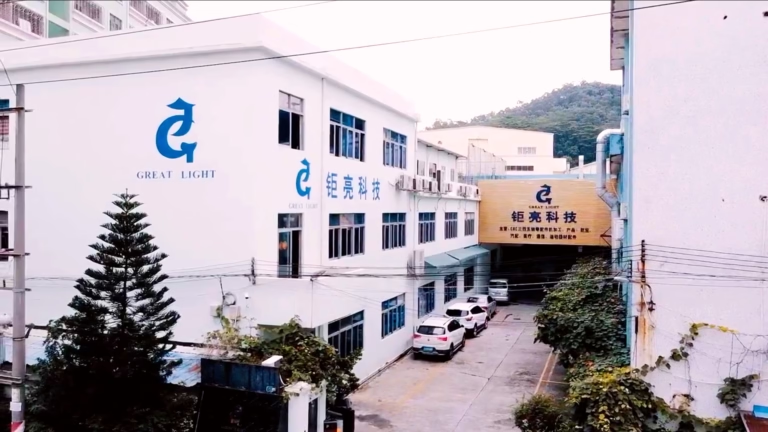
Vertical integration is a real cost lever, not a marketing phrase. When machining, finishing and inspection sit under one roof, the part does not sit in a truck between operations. GreatLight operates 3 wholly-owned plants across 7,600 m² with 150 technicians, plus a Singapore factory at No.3 Joo Koon Circle, Singapore 629032.
The Singapore site matters for buyers who need a non-China origin option or a closer shipping lane into Southeast Asia. Ask which plant will run your part and whether the same quality system covers it. Both sites fall under the same certifications.
Confidentiality is the last box most teams forget to tick. Uploads are handled as secure and confidential, and an NDA is available on request. If your drawing includes a proprietary geometry or a customer logo, get the NDA signed before the RFQ, not after the PO.
A practical test: send a redacted drawing first. See how the supplier handles revision control and whether they ask about the missing dimensions. Shops that ignore the gaps will also ignore your tolerance callouts.
Matching the supplier to your industry
Aerospace, automotive and EV, medical devices, robotics and automation, electronics, industrial machinery and new energy each carry different expectations. Aerospace buyers care about traceability and material certs. Automotive and EV programs care about IATF 16949 and PPAP-style documentation. Medical device teams care about ISO 13485 and clean handling.
Robotics and automation work usually means short runs, tight tolerances on joint interfaces, and frequent revisions. That favors a shop with rapid prototyping next to production machining. New energy programs often need larger housings and heat-management features, which is where the 4,000 × 400 × 150 mm travel envelope earns its keep.
You do not need a supplier that serves every sector. You need one whose process chain matches your part size, material and documentation load. A shop optimized for 20 mm connectors will struggle with a 3,000 mm frame, and the reverse is also true.
Pick two or three candidate precision cnc machining services companies that clear your sector requirements, then score them on the five rows above. Price comes last, because a cheap quote that fails first article costs more than a correct one.
How to run the supplier evaluation
Six steps, roughly one week if you send the same package to every candidate.
- 1Prepare one complete RFQ packageSend 3D STEP, 2D drawing with GD&T, material grade, finish spec, quantity for prototype and production, and target date. Identical packages make quotes comparable.
- 2Ask for the machine and setup planRequest the machine type, number of setups and workholding approach. A 5-axis part done in one setup should be quoted as such.
- 3Request certificate scope and an inspection report sampleCheck the certificate address matches the factory. Ask for a redacted FAIR or inspection report to see the format you will receive.
- 4Confirm MOQ and the prototype-to-production pathAsk explicitly whether the prototype and the 10,000-piece run use the same plant, machines and inspection plan.
- 5Compare quoted lead time against stated on-time dataA 3–5 day ship promise means little without a historical late rate. Ask what they measure and over what period.
- 6Sign the NDA before releasing final drawingsEspecially if the part carries proprietary geometry. Keep a revision log so you know which drawing each quote refers to.
Questions buyers ask before awarding the job
What tolerance can precision cnc machining services companies realistically hold?
±0.005 mm (±0.0002 in) is achievable on critical features when the machine, workholding and material suit the geometry. The number is not universal.
Thin walls, deep pockets and long parts need extra setup or stress relief. Ask for the process plan, not just the tolerance figure.
Do I need IATF 16949 or ISO 13485 if my part is not automotive or medical?
For general industrial and electronics work, ISO 9001:2015 is usually enough. IATF 16949:2016 applies when your customer's quality system requires it.
ISO 13485:2016 matters for medical device components, and ISO 27001:2022 is worth checking when you share sensitive CAD data.
Is a low MOQ a sign of a small or weak supplier?
Not necessarily. No minimum order quantity means the shop can absorb setup cost across a broader customer base.
What matters is whether the same plant and quality system run both the prototype and the production order.
How fast can a quote come back?
GreatLight returns a quotation and free DFM analysis within 12 hours, and production can start within 24 hours.
Turnaround depends on drawing completeness. A missing material grade or finish spec is the most common cause of a delayed quote.
What should be listed on a machining quote?
Unit price, material grade and source, machining operations, surface finish, inspection level, packaging and shipping terms.
A single lump-sum number makes it impossible to see where cost sits and where you can negotiate.
Can one supplier handle both prototypes and 10,000+ part runs?
Yes, if the process chain is in-house. GreatLight runs from one prototype to 10,000+ part runs with no minimum order quantity.
Ask how tooling and fixtures transition between the prototype and production phases.
Send your drawing and get a scoreable quote
Send STEP and 2D files and we return a quotation with a free DFM analysis within 12 hours. The quote is line-itemed, so you can compare it against the checks above.
12-hour quoteFree DFM analysisNo MOQ100% inspection
More from GreatLight
We publish setup notes, tooling trials and inspection data from the factory floor.











