
Precision CNC Machining Services Near Me: How to Vet a Supplier
This guide is for engineers and procurement staff choosing a precision cnc machining services near me partner for prototypes through 10,000+ part runs. It covers the checks that decide whether a shop can actually hold your tolerances, hit your dates and keep your drawing confidential, with the numbers we use at GreatLight.
In this article
- 1
- 2
- 3
- 4
- 5
- 6
- 7
- 8
Key takeaways
What to compare before you commit
Use this table to sort shortlisted shops by the criteria that actually change the outcome of your order.
| Criterion | What to ask | Good sign | Warning sign |
|---|---|---|---|
| Tolerance | Routine tolerance on a 100 mm steel part | States ±0.005 mm and explains how it is measured | Quotes best-case tolerance only |
| Quoting | Turnaround and DFM feedback | Quote and DFM analysis within 12 hours | Quote with no manufacturability notes |
| MOQ | Smallest order they accept | One prototype to 10,000+ parts, no MOQ | High setup fee below 500 parts |
| Certifications | Which standards are in scope | ISO 9001, IATF 16949, ISO 13485, ISO 27001 | Vague claims, no certificate numbers |
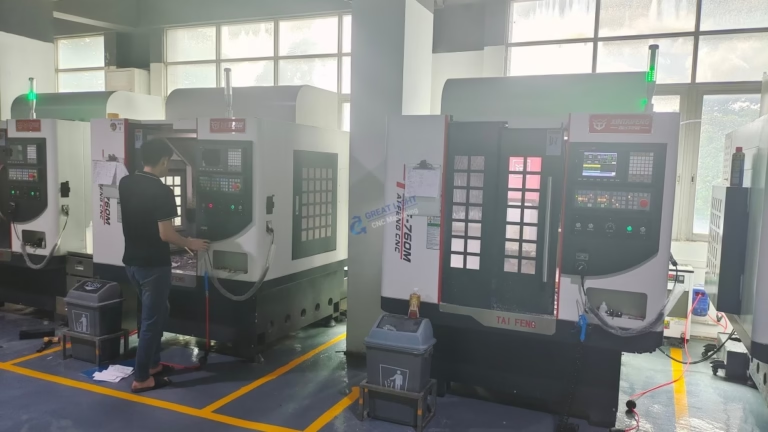
| Capacity | Machine mix and max part size | 16 five-axis centers, up to 4,000 mm | Single machine shop, no backup |
| Inspection | What is checked and reported | 100% inspection, reports on request | Sample inspection only |
| Confidentiality | NDA and file handling | NDA on request, secure uploads | Drawings sent by plain email |
| Finishing | In-house or outsourced | Anodizing, plating, blasting in one flow | Finishing adds weeks to the schedule |
Pick the shop that answers the tolerance question
If two quotes look similar, choose the supplier that explains how it holds ±0.005 mm, inspects 100% before shipment and signs your NDA first.
Match tolerance to the process, not to the brochure
Every shop prints a tolerance number. The useful question is which number it holds across a full batch, on your material, at your part size. A 20 mm aluminium bracket at ±0.005 mm is routine. The same callout on a 900 mm steel plate is a different job because thermal growth, fixture stiffness and tool wear all move the cut.
Before you send a drawing, decide which dimensions are functional and which are reference. Marking every dimension as critical forces the shop to inspect everything, which raises cost and slows the schedule without improving the part. GD&T with clear datums gives the machinist a datum to set up from and gives inspection a repeatable way to accept or reject.
Surface finish follows the same rule. Ra 0.8–1.6 μm is a normal machined finish for sealing faces and bearing bores. Ra 0.2–0.8 μm needs slower passes, sharper tooling and more inspection time. If your drawing calls Ra 0.2 μm on a non-contact surface, you are paying for a finish the part will never use.
Material changes everything. 6061 aluminium cuts clean and holds tight tolerance easily. 316L stainless work-hardens, so light passes and rigid setups matter. Inconel and titanium push tool wear up and feed rates down. A shop that quotes the same cycle time for all three has not looked at your drawing.
- 1Mark critical dimensionsKeep the critical list short and tie each one to a function.
- 2State the datumSetup and inspection both start from the datum you define.
- 3Match finish to useRa 1.6–3.2 μm for covers, Ra 0.8–1.6 μm for sealing faces.
Read the lead time in two parts: quote and production
A quote in 12 hours is useful because it includes free DFM analysis. That step catches thin walls, deep pockets and tolerances that cannot be reached in one setup. Fixing those before the first cut is cheaper than scrapping a batch. It does not mean parts appear the next morning.
Production speed depends on the machine the job lands on and how full the shop is. A shop with 127 high-precision CNC machines, including 16 simultaneous 5-axis centers and 16 mill-turn centers, can spread work instead of queuing it behind one spindle. For simple turned parts, production can start within 24 hours and parts ship in 3–5 days. Complex 5-axis work takes longer, and the quote should say so.
Ask what happens when a tool breaks or a first article fails. The answer tells you more than the headline lead time. A shop that inspects the first article, adjusts offsets and re-checks before running the batch will lose an hour and save a day.
Watch for lead times that ignore finishing. Anodizing, plating and powder coating add steps, sometimes at another site. If finishing is quoted separately with its own lead time, add the two before you promise a date to your customer.
- 1Quote clockQuote and free DFM analysis within 12 hours.
- 2Production clockStart within 24 hours; simple parts ship in 3–5 days.
- 3Finishing clockAdd coating and plating time on top of machining.
MOQ, certifications and file security
Minimum order quantity is a signal about who the shop is built for. A supplier with no MOQ can take a single prototype and then run 10,000+ parts on the same process and fixtures. That continuity matters: the prototype you approve and the production parts you receive come off the same setup logic.
Certifications matter only when your industry requires them. ISO 9001:2015 covers general quality management. IATF 16949:2016 applies to automotive and engine hardware. ISO 13485:2016 applies to medical devices. ISO 27001:2022 covers information security, which matters if your drawings are controlled. Ask to see the certificate scope, not just the logo.
Confidentiality is a practical question, not a legal one. Ask how files are stored, who can open them and whether the shop will sign an NDA before you upload. We sign NDAs on request and treat uploads as secure and confidential. If a supplier hesitates on that, look elsewhere.
Finally, check what the price includes. Tooling, fixtures, first article inspection, certificates of conformance and finishing are common line items that appear after the quote. A clear quote lists them up front.
- 1No MOQOne prototype to 10,000+ parts without changing process.
- 2Certificate scopeMatch the standard to your industry, not the logo.
- 3NDA on requestSign before files move, not after.
Machine mix decides which parts a shop can quote
The machine list is the clearest picture of what a shop can do. Three-axis machines handle flat plates, pockets and simple profiles. Four-axis mills add rotation for parts with features on multiple faces. Simultaneous 5-axis centers cut curved surfaces and undercuts in one setup, which removes fixtures and the error they introduce.
Part size sets the ceiling. Our largest travel is 4,000 × 400 × 150 mm, with medium travels of 750 × 1,150 × 550 mm and 600 × 600 × 600 mm, and compact travels of 500 × 500 × 450 mm and 500 × 310 × 200 mm. A Ø400 mm rotary table handles round and index work. If your part is outside those envelopes, the shop must split it or decline.
Mill-turn centers matter for parts that are both turned and milled. Doing both on one machine keeps concentricity between the bore and the milled features, which is hard to hold across two setups. For shaft-like parts with cross holes, that is often the deciding factor.
Ask for the machine that will run your job, not the machine list. A shop with 16 five-axis centers may still schedule your simple bracket on a 3-axis mill, and that is the right call. What you want to hear is why.
- 13-axisPlates, pockets, simple profiles.
- 25-axisCurved surfaces and multi-face features in one setup.
- 3Mill-turnConcentric bores plus milled features on one machine.
Common traps when buying machined parts
The first trap is a quote that arrives in minutes with no questions. A real quote for a 5-axis part involves reading the drawing, checking the envelope and choosing a setup. Speed without questions usually means the shop priced a generic part.
The second trap is comparing prices that cover different scopes. One quote includes material, machining and inspection; another adds finishing, tooling and certificates later. Normalize the scope before comparing numbers.
The third trap is ignoring the first article. If the shop runs the full batch before you approve the first part, you own the risk. Ask for first article approval on any new part, especially where tolerance is tight or the material is difficult.
The fourth trap is treating certification as decoration. A certificate that does not cover your process or your site proves nothing. Check the scope, the site address and the expiry date. Then check that the shop actually inspects to that standard.
- 1No questions, no confidenceA fast quote without DFM notes is a guess.
- 2Normalize the scopeCompare quotes that include the same line items.
- 3Approve the first articleNever let a batch run before first article sign-off.
Seven steps to qualify a supplier
- 1Send a complete drawing packageInclude 3D model, 2D drawing, material, finish, tolerance and quantity. Missing finish callouts are the most common cause of a slow quote.
- 2Request DFM feedback with the quoteAsk for manufacturability notes, not just a price. A 12-hour quote with DFM analysis tells you the shop read the drawing.
- 3Confirm the routine toleranceAsk which tolerance is held on every part of the batch, and how it is measured. ±0.005 mm is a reasonable daily target for small and medium metal parts.
- 4Check the machine envelope against your partSend the bounding box. If the part exceeds 4,000 mm in any direction, ask how they would split or fixture it.
- 5Ask about MOQ and setup chargesConfirm whether one piece is accepted and how setup is billed. A no-MOQ shop should not add a large setup fee at low quantity.
- 6Verify certification scopeAsk for the certificate and the scope statement. Match it to your industry: IATF 16949 for automotive, ISO 13485 for medical.
- 7Lock in inspection and NDA termsConfirm 100% inspection before shipment, reports on request, and sign the NDA before uploading controlled files.
Questions buyers ask before ordering
How do I check tolerance capability without sending a job?
Send a drawing of a part similar to yours and ask how they would hold the tightest callout. A useful answer names the machine, the fixture and the measurement method. If the reply is only a number with no method, treat it as a marketing claim.
You can also ask for the inspection report format used on a previous similar part. The format shows which dimensions are measured and with what instrument.
What is a realistic lead time for a first prototype?
For simple machined parts, production can start within 24 hours after the quote is approved, and parts ship in 3–5 days. Complex 5-axis parts, difficult materials like Inconel, or parts that need anodizing take longer.
Add finishing time to the machining time. Plating and coating are separate steps and should appear as separate lead time lines in the quote.
Do I need to pay a setup fee for a single part?
It depends on the shop and the part. A supplier with no minimum order quantity accepts one piece, but the price per piece will be higher than at volume because programming and fixturing are spread over one unit.
Ask how setup is billed separately from machining. That makes it easy to see how the unit price drops when quantity rises.
Which certifications should I require?
Require only what your industry needs. ISO 9001:2015 is the baseline for general quality management. Add IATF 16949:2016 for automotive work, ISO 13485:2016 for medical devices and ISO 27001:2022 when information security is part of the contract.
Ask for the certificate scope and the site address. A certificate held by a different plant does not cover the parts you buy.
How are drawings kept confidential?
Ask how files are uploaded, stored and accessed, and who inside the shop can open them. We treat uploads as secure and confidential and sign an NDA on request before files are transferred.
Sign the NDA before the first upload, not after the quote. It is simpler to set the rule at the start.
What materials and finishes can be handled in one order?
We machine aluminium grades such as 6061, 7075 and 6082, stainless steels including 303, 304, 316L and 17-4PH, alloy steels, copper and brass, titanium TC4 and Inconel, plus plastics like POM, PEEK and PC.
Finishing covers anodizing, electroless nickel and other plating, powder coating, black oxide, bead blasting, tumbling, brushing and polishing, plus laser marking with a minimum character height of 1.5 mm.
Send your drawing and get a clear answer
We return a quote with free DFM analysis within 12 hours, from one prototype to 10,000+ parts.
12-hour quoteNo minimum order quantity100% inspectionNDA on request
More from GreatLight
We publish setup notes, tooling trials and inspection data from the factory floor.











