
Rational Application of Diamonds and Its Tools
Diamond is the hardest cutting material available, yet most diamond tools fail for reasons that have nothing to do with hardness. This page explains how to match grain size, bond, edge geometry, and coolant to the actual workpiece, and when a diamond tool is the wrong purchase.
Key takeaways
What Makes Diamond Different From Carbide
Diamond sits at the top of the hardness scale at roughly 10 on Mohs, and polycrystalline diamond (PCD) keeps most of that hardness in a sintered layer bonded to a carbide body. The practical result is an edge that stays sharp far longer than coated carbide when cutting aluminium, copper, brass, and most composites. Thermal conductivity is the second advantage. Diamond pulls heat out of the cutting zone instead of letting it build in the workpiece.
That same carbon chemistry is the limitation. Iron has a high affinity for carbon, so at cutting temperatures above roughly 700 °C the diamond surface graphitises and diffuses into the chip. Tool life collapses within seconds. This is why steel, stainless steel, cast iron, and most nickel alloys are cut with CBN or coated carbide, never with diamond.
So the first question is never which diamond grade. It is whether the workpiece contains iron or nickel in a form that will react at cutting temperature. If it does, stop and choose another tool material. If it does not, diamond becomes a serious candidate for long runs and tight finishes.
Hardness alone does not decide the outcome. Edge geometry, bond retention, and heat removal decide whether the tool survives the first hundred parts or the first hundred thousand.
- 1Good candidatesAluminium 6061 and 7075, copper C110, brass C36000, carbon fibre, and most plastics
- 2Bad candidatesSteel 1045, 4140, 17-4PH, Inconel, and any iron-bearing cast alloy
- 3SometimesMetal matrix composites and sintered carbide need a test cut before commitment
Grain Size, Bond, and Coolant Selection
Grain size sets the trade-off between edge sharpness and impact resistance. Fine grain, around 2–6 μm, produces a sharper edge and better surface finish, which suits finishing passes and thin-walled parts. Coarse grain, 20–40 μm, resists chipping on interrupted cuts and roughing where stock removal matters more than Ra.
Bond hardness controls how the grain releases. A hard bond holds grain longer and gives better form retention, but on a light or high-speed machine it can glaze and stop cutting. A softer bond releases dull grain sooner, keeping the wheel free-cutting at the cost of faster diameter loss. Match bond to machine rigidity and spindle power, not to a catalogue default.
Coolant is where most shops lose tools. Diamond grinding on carbide or PCD generates heat fast, and without flood or high-pressure mist the wheel loads within minutes. Use water-based coolant for grinding where the machine allows it, and keep flow directed at the contact zone rather than the whole wheel.
For turning and milling with PCD inserts, a minimum 20 bar through-tool coolant keeps chips clear of the edge and reduces built-up edge on aluminium. On plastics and composites, air blast plus extraction often beats liquid, because liquid traps swarf against the cutting edge.
- 1Fine grain 2–6 μmFinishing passes, Ra 0.2–0.8 μm targets, thin walls
- 2Medium grain 8–15 μmGeneral turning and milling of aluminium and copper alloys
- 3Coarse grain 20–40 μmInterrupted cuts, roughing, composites with hard fillers
Where Diamond Tools Pay Off in Production
Diamond earns its cost in three situations. Long production runs where tool changes stop the spindle. Tight finish requirements where a coated carbide edge would need a second operation. And abrasive non-ferrous materials that eat carbide edges in a single shift, such as carbon fibre laminates and filled engineering plastics.
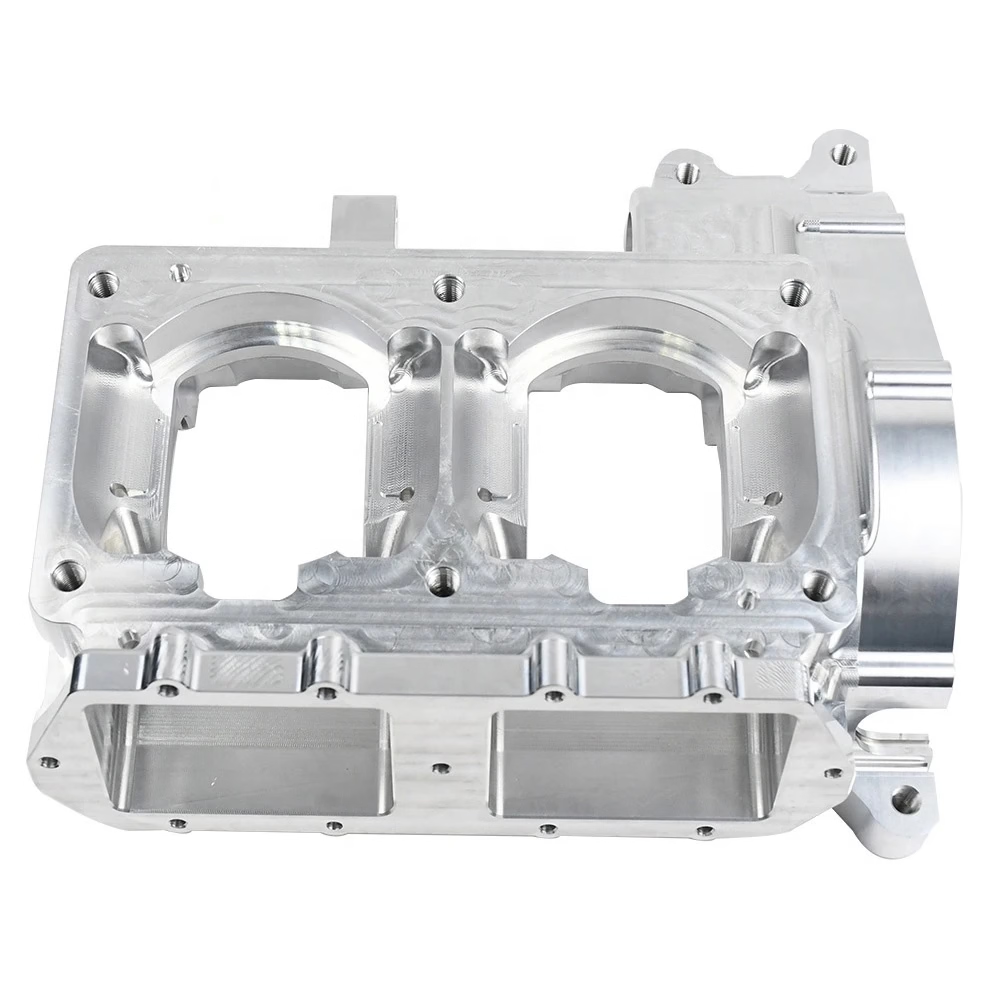
A typical example is an aluminium heat sink or manifold body with a lot of pocketing and a flatness callout inside 0.02 mm. A PCD end mill holds that geometry across thousands of parts because the edge does not round over the way carbide does. The same job on coated carbide may need four or five tool changes per shift.
Diamond also changes the inspection picture. Because the edge stays sharp, surface finish drifts less over a run, so first-article and final inspection stay close to each other. That stability is often worth more than the raw tool life number.
Where diamond does not pay off is short runs, one-off prototypes, and any job where the geometry changes between parts. Setup and tool cost cannot be recovered in fifty pieces, and a coated carbide tool will do the same job.
- 1Long runsThousands of identical parts where tool change downtime dominates cost
- 2Finish-critical facesFlatness inside 0.02 mm and Ra below 0.8 μm on non-ferrous parts
- 3Abrasive compositesCarbon fibre, glass-filled POM, and PEEK with hard fillers
- 4Not for prototypesOne-off parts and changing geometry rarely justify the tool cost
Machine and Fixture Requirements
Diamond tooling is unforgiving of vibration. A spindle with measurable runout, a weak fixture, or a long overhang will chip a PCD edge faster than any workpiece will. Before switching a job to diamond, check spindle runout, tool holder condition, and the stiffness of the workholding.
Rigid setups let you run higher surface speeds. Aluminium with PCD typically runs at 500–1,500 m/min, copper and brass lower, and composites lower still to control delamination. These are starting windows, not fixed rules. The correct value depends on spindle power, coolant delivery, and how much material each pass removes.
Tool holders matter as much as the insert. A worn collet or a damaged taper introduces runout that shows up as chatter marks and premature chipping. We check holder condition before a diamond job starts, because replacing an insert costs far more than replacing a collet.
Fixtures should support the part close to the cutting zone. Thin-walled aluminium parts deflect under diamond cutting forces just as they do under carbide, and the deflection shows up as wall thickness variation that no tool grade can fix.
- 1Check runout firstSpindle and holder runout above a few micrometres will chip a PCD edge
- 2Shorten overhangKeep the tool as short as the geometry allows to cut vibration
- 3Support thin wallsMove fixture contact close to the cutting zone on aluminium housings
Diamond, CBN, and Carbide Compared
Use this to screen a job before quoting a tool change.
| Tool material | Best workpiece | Typical finish | When it fails |
|---|---|---|---|
| PCD diamond | Aluminium, copper, brass, composites | Ra 0.2–0.8 μm | Iron or nickel in the workpiece |
| CVD diamond | Composites, graphite, hard plastics | Ra 0.4–1.6 μm | Heavy interrupted cuts |
| CBN | Hardened steel, Inconel, cast iron | Ra 0.8–1.6 μm | Soft non-ferrous alloys |
| Coated carbide | Steel, stainless, general work | Ra 1.6–3.2 μm | Abrasive composites, long runs |
| Uncoated carbide | Aluminium roughing, plastics | Ra 1.6–3.2 μm | High-speed finishing passes |
Which Tool to Choose
Cutting aluminium, copper, brass, or composites in volume with a finish callout inside Ra 0.8 μm? Use diamond. Cutting anything with iron or nickel in it, or running a handful of parts? Stay with coated carbide or CBN and put the money into fixtures instead.
Common questions
Can diamond tools cut stainless steel at low speed?
No, not reliably. The problem is chemical, not thermal. Carbon from the diamond diffuses into the iron in the workpiece once the contact zone reaches roughly 700 °C, and that happens even at moderate cutting speeds.
Tool life measured in seconds is normal. Use CBN for hardened steel and coated carbide for 304 or 316 stainless.
How do I know if a diamond wheel is glazing?
Look at the spark pattern and the sound. A glazed wheel goes quiet, throws few sparks, and the surface finish drops while the feed force climbs.
Dress the wheel with a silicon carbide or alumina stick, or reduce bond hardness if the problem repeats on every job.
What coolant works best with PCD inserts?
Water-based flood coolant for grinding, and high-pressure through-tool coolant at 20 bar or more for turning and milling.
On plastics and carbon fibre, air blast with extraction often gives a cleaner edge than liquid coolant because swarf does not stick to the tool.
Is PCD worth it for a 200-part run?
Usually not. Setup, tool cost, and the trial cut needed to dial in speeds and feeds only pay back over longer runs.
Below roughly a thousand identical parts, coated carbide almost always wins on total cost per part.
Does diamond tooling change the tolerance we can hold?
It changes how long you can hold it. The edge stays sharp through the run, so thermal and wear drift stay small and the last part looks like the first.
On our 5-axis centres we hold ±0.005 mm on non-ferrous parts with 100% inspection before shipment.
Can you machine diamond-tooled parts from prototypes through production?
Yes. There is no minimum order quantity, so the same process can start with one prototype and scale to 10,000+ part runs.
Quotation and free DFM analysis come back within 12 hours, and production can start within 24 hours.
Send Us the Drawing, We Will Tell You If Diamond Fits
Upload a drawing or STEP file and we will confirm whether diamond tooling is the right call, or recommend a cheaper route that holds the same tolerance.
12-hour quote100% inspectionNo minimum order quantity
More from the shop floor
We publish setup notes, tooling trials and inspection data from the factory floor.











