
Reliable CNC Machining Service: What to Check Before You Order
['A reliable CNC machining service is not defined by a brochure. It is defined by tolerance you can hold, inspection you can audit and a lead time you can plan around.', 'This guide is for design engineers and purchasing staff choosing a machining partner. Read it and you can tell which supplier claims are worth checking, and which ones to walk away from.']
In this article
- 1
- 2
- 3
- 4
- 5
- 6
- 7
- 8
Key takeaways
What separates a reliable CNC machining service from a cheap one
Use this table as a screening sheet before you send an RFQ.
| Check | Weak answer | Strong answer | Why it matters |
|---|---|---|---|
| Tolerance | "We hold tight tolerance" | ±0.005 mm on named machines | Decides fit on bearing and mating faces |
| Inspection | Final check only | Raw material, in-process, final | Catches drift before parts ship |
| Lead time | "Fast turnaround" | Quote in 12 h, ship in 3–5 days | You can plan assembly and launch |
| MOQ | 500 pieces minimum | From one prototype to 10,000+ | Lets you validate before tooling spend |
| Certification | ISO 9001 only | IATF 16949, ISO 13485, ISO 27001 | Matches your audit and traceability needs |
| Shop size | One machine, one shift | 127 machines, 3 plants | Absorbs demand spikes and breakdowns |
| Communication | Quote only, no feedback | Free DFM analysis with quote | Cost and risk drop before cutting starts |
Warning signs in a supplier quote
Any single line here is worth a follow-up question. Two or more together usually means walk away.
| Signal | What it often means | What to ask instead |
|---|---|---|
| Tolerance with no machine named | Generic claim, no process plan | Which machine and what inspection method? |
| No DFM feedback on the quote | Job will be cut as drawn, errors included | Can you flag thin walls and tool reach? |
| Delivery date given as a single number | No buffer for material or rework | What is your ship window and late rate? |
| Certification listed but not scoped | Certificate may not cover your process | Which site and which scope does it cover? |
| Price far below the others | Missing operations or inspection | What is excluded: finish, report, freight? |
| No NDA offered | Drawings may be shared freely | Can we sign an NDA before upload? |
Pick the supplier you can audit, not the one with the lowest number
If the quote comes with DFM notes, a named machine, an inspection plan and a certification that matches your industry, the price is worth paying. If any of those are missing, the savings show up later as rework.
Tolerance and finish: the numbers behind a reliable CNC machining service
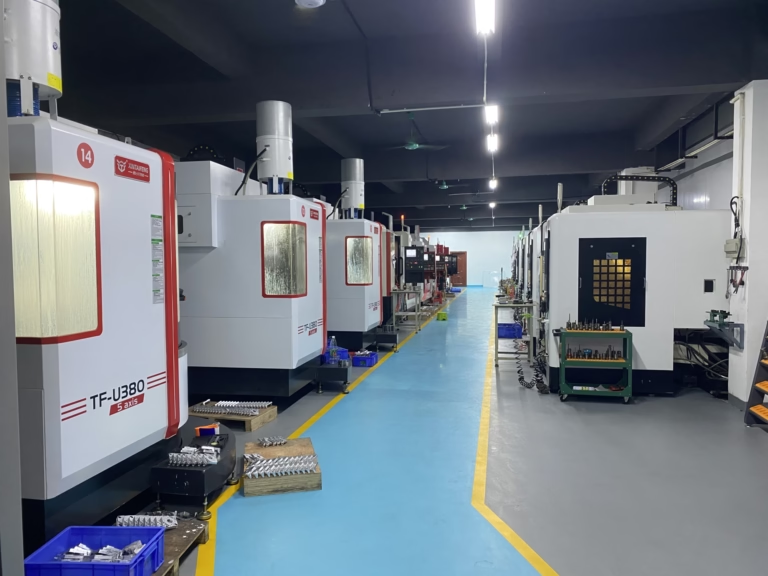
Every supplier will say they hold tight tolerance. The useful question is which machine and which measurement. At GreatLight, ±0.005 mm (±0.0002 in) is held on parts that fit the machine envelope, and the shop floor has 16 simultaneous 5-axis machining centers, 12 four-axis mills and 27 three-axis machines to route a job to the right spindle.
Tolerance and surface finish interact. A face that must seal needs Ra 0.2–0.8 μm, a general mating surface usually lands at Ra 0.8–1.6 μm, and an as-machined bracket at Ra 1.6–3.2 μm. If a drawing asks for both a 0.4 μm finish and a deep pocket, expect extra operations and a longer cycle. Say so early and the quote reflects reality.
Part size sets the limit. The largest travel here is 4,000 × 400 × 150 mm, with medium envelopes at 750 × 1,150 × 550 mm and 600 × 600 × 600 mm, and compact cells at 500 × 500 × 450 mm. A Ø400 mm rotary table handles round work in one setup instead of three.
Material choice changes the answer too. Aluminium 6061-T6 and 7075 cut cleanly and hold fine finish. Stainless 316L and 17-4PH work-harden, so light passes and rigid fixturing matter. Titanium TC4 (Ti-6Al-4V) and Inconel need slower speeds and more tool changes, which shows up as cost, not as a tolerance problem.
Inspection, traceability and certifications you can audit
A reliable CNC machining service inspects in three stages: raw material check on arrival, in-process monitoring while the job runs, and 100% inspection before shipment. Reports are available on request. If a supplier cannot tell you who measured the part and with what, the tolerance claim is marketing.
Certification should match the industry you sell into. ISO 9001:2015 covers general quality systems. IATF 16949:2016 is what automotive and EV programs expect. ISO 13485:2016 applies to medical devices. ISO 27001:2022 matters when you upload controlled drawings and want the information side covered as well as the metal.
Traceability is the practical test. Ask for a heat or lot number on the material certificate, and ask how a revision change is handled once a job is released. A shop that can answer in one email is usually a shop that has done this many times.
Confidentiality belongs in the same conversation. Uploads are treated as secure and confidential, and an NDA is available on request. For defense-adjacent or pre-launch consumer work, sign the NDA before the first drawing leaves your server.
Lead time, capacity and what a realistic schedule looks like
Quote speed tells you about the front office. Quotation and free DFM analysis come back within 12 hours, and production can start within 24 hours of approval. Parts ship in 3–5 days for typical runs. Those numbers are only useful if capacity exists behind them.
Capacity is the insurance policy. GreatLight runs 127 high-precision CNC machines across 3 wholly-owned plants totaling 7,600 m², with 150 technicians. That mix of 5-axis, 4-axis, 3-axis and 16 mill-turn centers means a broken spindle or a rush order does not stop your program.
For repeat work, ask how the shop handles a revision mid-run. The answer should be a hold point, a re-inspection and a clear note on which parts are to which revision. Vague answers here cause the expensive mistakes, not tolerance drift.
Historical late-delivery probability is below 2%. Treat that as context, not a guarantee. What you can control is the input: a clean drawing, a defined datum scheme, and a realistic surface finish callout.
Cost drivers and MOQ: where a low quote goes wrong
Price is driven by setup, not by material alone. One prototype and a 10,000-part run share the same programming and fixturing cost, so the per-part price falls as quantity rises. There is no minimum order quantity here, which lets you buy one piece, check the fit and then commit.
Five-axis work costs more per hour but can remove three setups. For a housing with features on five faces, that usually wins. For a flat plate with holes, a three-axis machine is cheaper and just as accurate. A supplier who quotes every job on the same machine is not optimizing for you.
Finishing adds cost that buyers forget. Anodizing, electroless nickel, powder coating and black oxide each add handling and a lead-time step. Laser marking needs a minimum character height of 1.5 mm to stay legible after coating.
Materials range from aluminium 6061, 2024 and 7075 through stainless 303, 304, 316L and 17-4PH to titanium, Inconel, copper alloys and engineering plastics such as POM, PEEK and carbon fibre. Exotic stock has its own lead time, and that is often the real schedule risk, not machining.
How to qualify a reliable CNC machining service in 7 steps
Run these in order. Stop early if step 2 or step 3 fails.
- 1Send a real drawing, not a descriptionInclude material, tolerance, surface finish callouts and datum scheme. A 2D PDF plus a STEP file is enough to quote. Missing datums are the most common cause of a wrong first article.
- 2Read the DFM feedback before the priceLook for notes on wall thickness below 0.8 mm, deep pockets beyond 4× diameter, or holes that need a second setup. Free DFM analysis within 12 hours is a reasonable benchmark.
- 3Ask which machine will run the partA part with features on five faces belongs on a 5-axis center. A flat bracket belongs on a 3-axis mill. The answer tells you whether the shop is routing for cost or just filling a spindle.
- 4Confirm the inspection plan in writingRaw material check, in-process monitoring, 100% inspection before shipment. Ask for the report format, such as first article plus key dimension list. Reports on request should be stated up front.
- 5Match certifications to your industryAutomotive and EV: IATF 16949:2016. Medical: ISO 13485:2016. Controlled data: ISO 27001:2022. General: ISO 9001:2015. Ask which plant holds the certificate.
- 6Test with a small order firstNo minimum order quantity means you can buy one to five pieces, measure them yourself, and check finish, burrs and marking before releasing a production run.
- 7Agree the revision and change processWrite down who approves a drawing change, how in-process parts are handled, and what happens to a released job if a revision lands mid-run. Do this before the second order, not after.
Questions engineers ask before ordering
What tolerance can a reliable CNC machining service actually hold?
±0.005 mm (±0.0002 in) is achievable on parts that fit the machine envelope, with the right fixture and a stable thermal environment. Very small features, thin walls below 0.8 mm, and deep pockets reduce what is realistic.
Tell the supplier which dimensions are functional. A drawing that puts the same tight tolerance on every face raises cost without improving the assembly.
How fast can I get a quote and parts?
Quotation and free DFM analysis come back within 12 hours. Production can start within 24 hours of approval, and parts ship in 3–5 days for typical runs.
Exotic materials, plating and anodizing add their own lead time. Ask about those steps separately rather than assuming one number covers everything.
Is there a minimum order quantity?
No. Orders run from one prototype to 10,000+ part runs. That is deliberate: it lets you validate a design before committing to a larger batch.
Per-part cost still falls with quantity because programming and fixturing are spread over more parts. The first piece is the most expensive piece.
Which certifications should I look for?
ISO 9001:2015 is the general baseline. IATF 16949:2016 fits automotive and EV programs, ISO 13485:2016 fits medical devices, and ISO 27001:2022 covers information security when you upload controlled drawings.
Ask which site holds the certificate and what scope it covers. A certificate for one process does not automatically apply to another.
How do you protect my drawings and design data?
Uploads are treated as secure and confidential, and an NDA is available on request. Sign it before the first drawing is uploaded if the program is sensitive.
Keep the same standard for every supplier in the chain. Data handling is usually the weakest link, not the machining.
What surface finishes and materials are available?
Finishes include anodizing in clear, colour, hardcoat and conductive types, electroless nickel, zinc, silver and gold plating, powder coating, black oxide, bead blasting, tumbling, brushing, polishing, and laser marking with a 1.5 mm minimum character height.
Materials cover aluminium 6061, 2024, 7075 and ADC12, stainless 303 to 17-4PH, alloy and tool steels, copper and brass, titanium, Inconel, magnesium, and plastics such as POM, PEEK and carbon fibre.
Send your drawing and get a real answer in 12 hours
Upload a STEP file and a 2D drawing. You get a quotation, DFM feedback and a realistic ship window, with no minimum order quantity.
12-hour quote and DFM100% inspection before shipmentNDA available on request
More from the shop floor
We publish setup notes, tooling trials and inspection data from the factory floor.











