
Metal 3D Printing Robot Torso Frame
This guide is for engineers and purchasing teams sourcing a metal 3d printing robot torso frame service. It covers the checks that separate a printable drawing from a frame that survives hip-cycle loading, cable routing and a 40-part build. Read the seven checks, then compare suppliers on the same numbers.
In this article
- 1
- 2
- 3
- 4
- 5
- 6
- 7
- 8
- 9
- 10
Key takeaways
Metal 3D printing robot torso frame: process options
Use this to pick the route before you pick the supplier.
| Route | Best for | Watch out for |
|---|---|---|
| SLM / DMLS | Lattices, internal channels, thin ribs | Residual stress, support scars on downfaces |
| CNC from billet | Solid joints, tight bores, low volume | Deep pockets, long cycle time |
| Die casting | Thin-wall shells above 10,000 parts | Tooling cost, no internal lattices |
| Print + 5-axis hybrid | Loaded frames with machined bores | Two setups, needs one supplier |
| Sheet metal weldment | Flat panels, large envelopes | Weld distortion, fewer organic shapes |
| Vacuum casting | Early fit checks, non-structural | Not for load-bearing frames |
What to put side by side when you compare suppliers
Fill this in for each quote so the decision is not made on price alone.
| Item | What to ask | Why it matters |
|---|---|---|
| Density target | Figure and measurement method | Pores start fatigue cracks |
| Heat treat | Route and where it sits in the flow | Distortion control on thin ribs |
| Machined tolerance | Value on bores and faces | Bearing and motor fits |
| Surface finish | Ra range per surface | Sealing, wear, appearance |
| Certification scope | Which processes are covered | Audit and customer approval |
| Quote inclusions | What the price covers | Build-only quotes mislead |
| Lead time basis | Start point and ship point | Planning, not a promise |
Pick the supplier who owns both the print and the cut
For a load-bearing torso frame, the deciding factor is not the printer. It is whether one team controls orientation, stress relief, interface machining and final inspection.
Where a metal 3d printing robot torso frame wins
A torso frame carries the shoulder mounts, the hip actuators, the battery box and the cable runs between them. Casting and billet machining can do that, but they force you to design around draft angles, tool reach and wall thickness rules. Powder-bed printing removes those limits. You can put a lattice where stiffness is needed and leave open channels where cables need to pass.
That freedom has a cost. Every overhang past about 45° needs support, and support leaves a rough footprint. Every thick section cools slower than the thin web next to it, which pulls the part. A metal 3d printing robot torso frame is only as good as the build orientation and the stress-relief step chosen for it.
So the first question to a supplier is not about machine brand. It is: what orientation do you plan, where will you put supports, and how do you relieve stress before you cut the part off the plate?
- 1Good fitFrames with internal cable routing, lattice webs, or 20+ discrete bracket locations merged into one body.
- 2Poor fitA flat 300 × 300 mm plate with four holes. Billet machining or sheet metal will be cheaper and faster.
Alloy choice for a metal 3d printing robot torso frame
AlSi10Mg is the default for robot frames. It prints cleanly, machines well, and gives a good stiffness-to-weight ratio. For a walking robot, that low density matters more than ultimate strength, because the torso sits at the top of the mass stack and drives the hip torque.
Ti-6Al-4V (TC4) gives roughly double the specific strength and much better fatigue life. It also costs more per kilogram, prints slower, and is harder to machine at the interfaces. Use it when the frame is genuinely load-limited, not as a default upgrade.
Stainless 316L and 17-4 PH show up where corrosion or EMI shielding matters. 316L is the easier print. 17-4 PH can be heat treated to higher strength, but the heat treat adds a step and a distortion risk that must be planned.
- 1AlSi10MgGeneral torso frames, actuator housings, weight-critical structures.
- 2TC4 (Ti-6Al-4V)High-cycle fatigue joints, thin highly loaded ribs.
- 3316L / 17-4 PHCorrosive environments, shielding, higher-strength pins.
Density, fatigue and the numbers to ask for
As-built SLM parts run roughly 99.5% dense, with small gas pores and lack-of-fusion defects. For a robot frame that sees millions of gait cycles, those defects are crack starters. The fix is not a better machine. The fix is a documented process: parameter set, powder condition, and a HIP or vacuum stress-relief cycle suited to the alloy.
Ask the supplier for the relative density figure they target, the heat-treat or HIP route, and the hardness or tensile result from the run. A supplier who cannot name those numbers is selling a shape, not a structural part.
Fatigue is where this shows up. A frame that passes a static load test can still crack at a rib root after 200,000 cycles. If the torso is safety-relevant, budget for a fatigue coupon built alongside the real part.
- 1Relative densityAsk for the target figure and how it is measured.
- 2Heat treat routeStress relief before cut-off is not optional on thin frames.
- 3Witness couponSame build, same orientation, tested separately.
Post-processing is half the job
A printed frame straight off the plate is not a finished part. Supports must come off without gouging the surface. Critical bores need to be machined, because as-built SLM holds roughly ±0.1 mm at best and that is not a bearing fit.
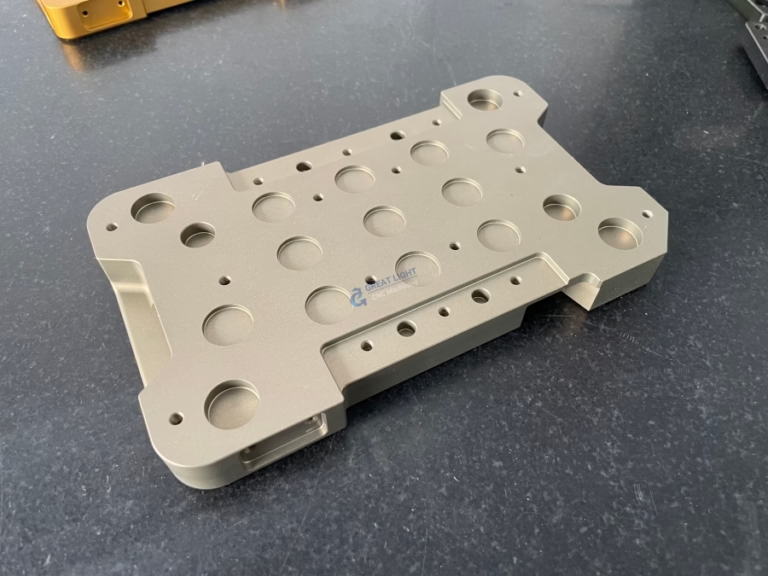
GreatLight runs a hybrid route: print the organic body, then clamp it in a 5-axis center and cut the motor mounts, bearing bores and dowel holes. Machined tolerance is ±0.005 mm, with finishes from Ra 1.6–3.2 μm as-machined down to Ra 0.2–0.8 μm where a bore needs it.
Finishing follows the application. Anodizing for wear and color, bead blasting to clean the print texture, laser marking for part traceability at a minimum character height of 1.5 mm. Each step adds handling and lead time, so agree the full chain before the build starts.
- 1Support removalManual plus CNC cleanup. Watch downfacing surfaces.
- 2Interface machiningBores, faces and dowel holes cut after heat treat.
- 3Surface finishBead blast, anodize, hardcoat, laser mark as needed.
Supplier checklist before you send a PO
Most failures on robot torso frames are not printing failures. They are handoff failures: the printer blames the drawing, the machine shop blames the print, and the customer owns the scrap. One supplier with both powder-bed printing and 5-axis machining removes that gap.
GreatLight has 127 high-precision CNC machines across 3 wholly-owned plants, including 16 simultaneous 5-axis centers, in 7,600 m² of floor space in Dongguan plus a Singapore factory. That matters for a torso frame because the printed blank comes back into the same building for machining and inspection.
Certifications to verify: ISO 9001:2015, IATF 16949:2016, ISO 13485:2016 and ISO 27001:2022. Ask for the certificate scope, not just the logo. If your frame touches a medical or automotive program, the scope has to cover the process you are buying.
- 1One supplier, both processesPrinting and 5-axis machining under one quality system.
- 2Inspection on requestRaw material check, in-process monitoring, final inspection.
- 3NDA before drawingsUploads are confidential and an NDA is available on request.
Lead time, volume and how quotes are built
Quotation and free DFM analysis come back within 12 hours. Production can start within 24 hours of approval, and parts normally ship in 3–5 days. Historical late-delivery probability is below 2%. Treat those as planning numbers, not a contractual date.
There is no minimum order quantity. One prototype frame and a 10,000+ part run go through the same quote form, which helps when you are still proving the design at 5 units before committing to a fixture.
Compare quotes on scope, not on the headline number. A build-only price that excludes stress relief, support removal, interface machining and inspection is not comparable to one that includes them. Ask for the inclusions in writing.
- 112 hoursQuote plus DFM feedback on your model.
- 224 hoursProduction start after you approve.
- 33–5 daysTypical shipping window for machined parts.
Seven steps from drawing to shipped frame
Each step lists the parameters we would agree with you before the build.
- 11. DFM reviewWe check overhang angles above 45°, minimum feature size, trapped powder volumes and wall thickness. Feedback within 12 hours.
- 22. Orientation and supportsPick the build direction so critical faces are up and supports land on non-critical surfaces. Record the choice on the drawing.
- 33. Print the blankSLM or DMLS with a qualified parameter set for AlSi10Mg, TC4, 316L or 17-4 PH. Powder batch logged per build.
- 44. Stress relief or HIPThermal cycle before cut-off, sized to the alloy and section thickness. Skip this and thin ribs will move.
- 55. Support removal and cleanupManual and CNC removal. Do not let anyone grind a bearing face to hide a support scar.
- 66. 5-axis interface machiningMotor mounts, bearing bores and dowel holes cut to ±0.005 mm. Finishes from Ra 1.6–3.2 μm or finer where specified.
- 77. Finish and inspectAnodize, bead blast, plating or laser marking as agreed. 100% inspection before shipment, reports on request.
Questions engineers ask before ordering
Can I send a STEP file and get a frame back without changing the design?
Usually yes, but expect DFM notes. Thick-to-thin transitions, unsupported overhangs and trapped powder pockets are the three things that most often need a small edit.
We return the DFM analysis with the quote, within 12 hours, so you can decide before anything is built.
Is as-built SLM accurate enough for bearing seats?
No. As-built powder-bed printing is a roughing process at the interfaces. Bores and faces that carry a fit should be machined after heat treat.
With 5-axis machining we hold ±0.005 mm on those features and can reach Ra 0.2–0.8 μm where a bore needs it.
Do you have a minimum order quantity for printed frames?
No minimum order quantity. We build from one prototype up to 10,000+ part runs on the same process and quality system.
For a single frame, expect the quote to lean on setup and programming more than on material.
How do you protect the design before we place an order?
Uploads are secure and confidential, and we can sign an NDA before you send drawings.
If your program requires it, we can restrict the files to the engineering team only and log every access.
Which alloy should we pick for a walking robot torso?
Start with AlSi10Mg if weight and cost drive the decision. It prints well and machines cleanly.
Move to TC4 (Ti-6Al-4V) only when fatigue life or specific strength is the binding constraint, because it adds cost and machining time at every interface.
Can you machine a frame that another shop printed?
Yes, if we can inspect the blank first. Print orientation and heat treat history affect how it will move under cutting.
Send the print report with the part and we will tell you what tolerance is realistic on the interfaces.
Send the frame model, get a quote and DFM in 12 hours
Upload the STEP file and we will come back with process route, alloy recommendation, machining plan and price. NDA available on request.
12-hour quoteNo MOQ100% inspection
More from GreatLight
We publish setup notes, tooling trials and inspection data from the factory floor.











