
How to Choose a Rapid Prototype Company for CNC Machining
This guide is for design engineers and sourcing managers picking a supplier for the first cut of a new part. We cover the seven checks that separate a rapid prototype company that can hit your drawing from one that only says it can, plus the tolerance, lead time, and quote details worth confirming before you release a purchase order.
In this article
- 1
- 2
- 3
- 4
- 5
- 6
- 7
- 8
- 9
Key takeaways
What to check before you send an RFQ
Use the middle column as your pass/fail line when you compare two rapid prototype company quotes side by side.
| Check | What good looks like | Why it matters |
|---|---|---|
| Tolerance | ±0.005 mm on critical features only | Blanket tight tolerance inflates price |
| Lead time | Quote + free DFM in 12 hours | Slow quoting delays tooling decisions |
| First article | Parts ship in 3–5 days | Prototype builds slip without a date |
| MOQ | No minimum, one piece up | A 50-piece floor kills early iterations |
| Certifications | ISO 9001, IATF 16949, ISO 13485 | Determines which industries you can serve |
| Confidentiality | Secure uploads, NDA on request | Unreleased designs leak without cover |
| Quote detail | Material, finish, tolerance, qty listed | A single number hides the real driver |
| Inspection | 100% check, reports on request | Catches setup drift before assembly |
The short version
Pick the shop that reads your drawing and tells you which callouts drive cost. Machine count and certificates are easy to list; a DFM read and a price break at four quantities are what actually tell you whether the supplier fits your part.
Does the rapid prototype company actually machine your geometry?
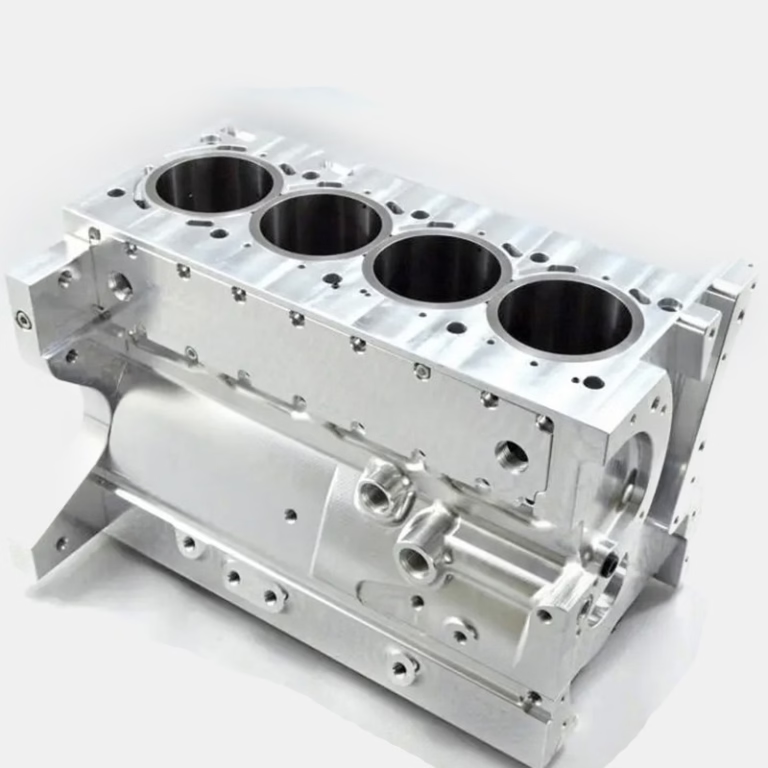
Most prototype parts are not simple blocks. They have pockets with deep corners, angled faces, thin ribs, or a bore that has to line up with a boss on the other side. Ask which machine would run your part and why. A shop with 16 simultaneous 5-axis machining centers can cut five faces in one setup, which holds position between features far better than moving a part across three fixtures.
Travel limits decide what is possible. A 4,000 × 400 × 150 mm envelope covers long rails and frame sections. Medium platforms at 750 × 1,150 × 550 mm and 600 × 600 × 600 mm handle most enclosure and manifold work. Compact machines at 500 × 500 × 450 mm and 500 × 310 × 200 mm are the right call for small, high-detail parts where rigidity matters more than size.
If a supplier answers with a machine count and nothing else, push back. The useful answer names the machine, the number of setups, and the axis count. That tells you whether your datum scheme survives the process.
- 15-axisComplex geometry, undercuts, five-sided features, one setup
- 24-axisCylindrical parts with cross holes or flats
- 33-axisPrismatic parts with features on one or two faces
Tolerance, surface finish, and what they cost
±0.005 mm (±0.0002 in) is the tight end of normal CNC work, and it is not free. Reaching it means a stable setup, sharp tooling, temperature control, and slower passes. Apply it to the features that mate with something else, and leave the rest at general machining tolerance.
Surface finish works the same way. Ra 1.6–3.2 μm is as-machined and usually fine for a bracket or a housing. Ra 0.8–1.6 μm needs a finishing pass. Ra 0.2–0.8 μm means a separate operation, sometimes hand polishing, and the price reflects it. If your drawing calls for Ra 0.4 μm on a face that gets covered by a gasket, you are paying for nothing.
A good rapid prototype company will read the drawing and tell you which callouts drive cost. A weak one quotes the whole thing at the tightest value it sees. That difference shows up as a 30–50% gap between two quotes for the same part.
- 1As-machinedRa 1.6–3.2 μm — covers most non-sealing faces
- 2Fine finishRa 0.8–1.6 μm — sealing faces, sliding surfaces
- 3PolishedRa 0.2–0.8 μm — optical, medical, or bearing fits
Lead time: what the timeline really includes
Quoting speed is the first signal. A shop that returns a quotation and free DFM analysis within 12 hours is set up to process incoming work, not to batch it once a week. From there, production can start within 24 hours of PO and material release, and parts ship in 3–5 days for standard prototype quantities.
That 3–5 day window assumes the material is in stock and the drawing is frozen. If your part needs 7075 aluminium or Ti-6Al-4V and the shop has to order it, add the mill lead time. If you are still changing the model, every revision restarts the setup. Freeze the geometry before you release the PO and the quoted date holds.
Ask what happens when a part fails final inspection. A shop that reworks in-house keeps the schedule. One that outsources finishing or heat treatment loses days to shipping both ways. Historical late-delivery probability below 2% is a reasonable benchmark to request, but only if the supplier can back it with their own records.
MOQ, unit cost, and prototype-to-production continuity
Prototypes exist to be iterated. If a supplier sets a minimum order quantity, every design change costs you a full batch. No minimum order quantity, from one prototype to 10,000+ part runs, is the right model at this stage. It also tells you the shop is not treating prototype work as an unwanted interruption to production.
Unit price on a single piece is not a useful number on its own. Ask for a price at 1, 25, 100, and 1,000 pieces. The curve shows where setup cost stops dominating and where material and cycle time take over. If the drop from 1 to 100 is small, the shop is probably charging mostly for material. If it is steep, you are paying for setup and programming.
The other question is whether the same shop can take the part into production. Moving from a machined prototype to a die-cast or vacuum-cast part means new tooling and a fresh tolerance stack. A supplier that offers machining, die casting, vacuum casting, and sheet metal under one roof can plan that transition instead of handing you a drawing and wishing you luck.
Certifications, materials, and finishing in one place
Certifications are a filter, not a badge. ISO 9001:2015 covers general quality systems. IATF 16949:2016 is what automotive and EV programs expect. ISO 13485:2016 applies to medical devices. ISO 27001:2022 covers information security, which matters when your uploads are unreleased designs. Match the certificate to your industry before you compare price.
Material range is the next filter. Aluminium 6061, 7075, and 6082 are common. Stainless 303, 304, 316L, and 17-4PH cover most corrosion and strength needs. Titanium TC4 (Ti-6Al-4V), Inconel, and magnesium AZ31B are available but slow to cut and priced accordingly. On the plastic side, POM and ABS machine easily, PEEK and carbon fibre do not.
Finishing is where schedules slip. Anodizing, electroless nickel, powder coating, bead blasting, and laser marking all add a step. Laser marking has a minimum character height of 1.5 mm, so a 0.8 mm part number will not reproduce. Confirm the finish sequence and who owns the outside process before you approve the quote.
- 1AnodizingClear, colour, hardcoat, conductive
- 2PlatingElectroless nickel, zinc, silver, gold
- 3MechanicalBead blasting, tumbling, brushing, polishing
Inspection, data handling, and the questions that expose a weak supplier
100% inspection before shipment, covering raw material check, in-process monitoring, and final inspection, is the baseline. Inspection reports on request should be normal, not an upsell. If a supplier only inspects the first and last part of a run, dimensional drift in the middle goes out the door with your parts.
Confidentiality is a real commercial risk at prototype stage. Uploads should be secure and confidential, and a non-disclosure agreement should be available on request without a negotiation. If a shop hesitates on an NDA for a prototype job, that is a signal about how they handle everything else.
Finally, ask two questions. What would you change in this design to make it cheaper? And what feature here is most likely to fail inspection? A shop that answers both with specifics has actually read your drawing. A shop that answers with generalities has read your email.
Step by step: how to vet a rapid prototype company
- 1Send the 3D model and a marked-up drawingInclude material, finish, quantity, and which dimensions are critical. A STEP file plus a PDF with GD&T callouts gets a faster, more accurate quote than a model alone.
- 2Request a DFM read with the quoteAsk for wall thickness, tool reach, and datum comments in writing. Free DFM analysis within 12 hours is a normal turnaround for a responsive shop.
- 3Compare tolerance callouts line by lineCheck whether the quote assumes ±0.005 mm on all features or only on the ones you marked. The difference is often the largest single line in the price.
- 4Ask for a price break at 1, 25, 100, and 1,000 piecesThis exposes setup cost versus material cost and shows whether the shop can scale with you.
- 5Confirm the finish and inspection planGet the sequence in writing: machining, deburr, finish, final inspection. Note that laser marking needs 1.5 mm minimum character height.
- 6Sign the NDA before you upload production filesSecure uploads and an NDA on request protect unreleased geometry. Do this before sending the full assembly, not after.
- 7Freeze the revision before releasing the POProduction can start within 24 hours, but every model change restarts setup. A frozen drawing is what makes the 3–5 day ship window hold.
Frequently asked questions
How tight a tolerance can a rapid prototype company hold on a first article?
±0.005 mm (±0.0002 in) is achievable on critical features with a stable setup and sharp tooling.
On a first article, expect to confirm the tight callouts with a dimensional report before the design is frozen. Features that are not marked critical are usually held at general machining tolerance, which keeps the price down.
Do I need to order more than one piece?
No. No minimum order quantity means you can order a single prototype, then 10, 100, or 10,000+ pieces once the design settles.
Early iterations are cheaper when the quantity is flexible, because a design change does not strand a batch of parts you no longer need.
Which materials are realistic for a CNC prototype?
Aluminium 6061, 6061-T6, 7075, and 6082 machine quickly and are the default for most prototypes. Stainless 303, 304, 316L, and 17-4PH cover corrosion and strength needs.
Titanium TC4 (Ti-6Al-4V), Inconel, and magnesium AZ31B are available but slower to cut. On the plastic side, POM, ABS, and PC are straightforward; PEEK and carbon fibre need more care and cost more.
How long does a CNC prototype take to ship?
Quotation and free DFM analysis come back within 12 hours. Production can start within 24 hours of PO and material release, and parts ship in 3–5 days for standard quantities.
Add time if the material is not in stock or the model is still changing. Material lead time and revision restarts are the two most common reasons a prototype date slips.
What certifications should I look for?
ISO 9001:2015 for general quality systems, IATF 16949:2016 for automotive and EV work, ISO 13485:2016 for medical devices, and ISO 27001:2022 for information security.
Pick the certificate that matches your industry and your customer's audit requirements. Extra certificates you will never be audited against do not add value to the part.
Can one supplier handle the prototype and the production run?
Yes, if the shop covers more than machining. A supplier that also runs die casting, vacuum casting, sheet metal fabrication, and surface finishing can plan the transition from a machined prototype to a production process.
That matters because each process change brings a new tolerance stack. Planning it early avoids a second round of design fixes later.
Send your model, get a quote and a DFM read
Upload your STEP file and drawing. We return a quotation and free DFM analysis within 12 hours, with no minimum order quantity and secure, confidential handling of your files.
12-hour quote + DFMNo MOQ100% inspectionNDA on request
More from the shop floor
We publish setup notes, tooling trials and inspection data from the factory floor.











