
Should I Consider Buying a CNC Machine From Alibaba?
A sourcing guide for engineers and shop owners weighing a machine purchase against outsourcing the parts. We cover what to verify before you wire money, where the real costs hide, and when a machining partner beats owning iron.
In this article
- 1
- 2
- 3
- 4
- 5
- 6
- 7
- 8
Key takeaways
Buying a machine vs. outsourcing the parts
Match the row to your situation. Values are typical for small and mid-size buyers.
| Factor | Buy from Alibaba | Outsource to a machining partner |
|---|---|---|
| Upfront cash | Machine, freight, duty, rigging, tooling in one hit | No capital outlay, pay per part |
| First part in hand | 8-16 weeks typical start to production | 3-5 days after drawing release |
| Tolerance control | Depends on your operator and metrology | ±0.005 mm, 100% inspection before shipment |
| Spare part lead time | 4-10 weeks from overseas supplier | Not your problem, partner owns uptime |
| Cost per part at 500 pcs | High, fixed cost spread thin | Usually lower than your own cost |
| Cost per part at 50,000 pcs | Lowest once the line is running well | Higher, margin sits with the supplier |
| Engineering support | You write the programs and fixtures | DFM analysis within 12 hours, free |
| Best fit | High volume, stable design, in-house CAM | Prototypes, revisions, mixed materials |
The short answer
Buy the machine only if volume is high, the design is frozen, and you have priced the landed cost, the spares list and the service terms. Otherwise, send us the drawing and we will quote the parts.
What the listing price leaves out
The number on a product page is the ex-works price of a crate. It is not what the machine costs you. Freight from a Chinese port to a US or EU inland address for a 3-axis mill runs thousands of dollars, and ocean rates move. Duty depends on the tariff code and your country of import, and it applies to the freight too in most jurisdictions.
Then there is the site. A machine tool needs a level foundation, three-phase power of the right voltage and amperage, and often a transformer. Rigging a 3,000 kg machine into a bay needs a forklift or crane and a rigging crew. If your floor is a second-story mezzanine, stop and check the load rating before anything else.
Tooling is a line item people forget. A vertical mill with a 40-taper spindle needs holders, collets, face mills, drills and a probe if you want setup time under control. That basket is often 5 to 15 percent of the machine price, and it ships separately.
Finally, budget for metrology. If you cannot measure a feature, you cannot claim you made it. A micrometer and a height gauge cover simple work. Position tolerance on a bolt pattern needs a CMM or at least a granite plate and a height gauge with a dial indicator. Buyers who skip this step find out at the customer's incoming inspection.
How to read a machine spec sheet without getting fooled
Positioning accuracy and repeatability are different numbers, and suppliers often quote whichever looks better. Repeatability of ±0.005 mm on a single axis tells you the machine can return to a point. It says nothing about whether the spindle is square to the table or whether thermal growth moves the column after four hours of cutting.
Ask for the test cut report. A real one shows the material grade, the tool, the cutting parameters, and the measured result with the instrument named. A one-line claim of ±0.01 mm with no method is a marketing number. A report that shows a 100 mm square pocket measured on a CMM with actual deviation values is evidence.
Travel matters less than stiffness for most parts. A 4,000 mm bed sounds impressive until you cut 4140 steel and watch the column flex. For hard materials, a smaller machine with a heavier casting and a box-way design usually holds tolerance better than a long-travel machine built for aluminium.
Spindle taper tells you the tooling ecosystem you are entering. BT30 is light and fast, good for aluminium and plastics. BT40 and CAT40 cover most general work. HSK and big-plus tapers cost more but hold better at high rpm. If the supplier cannot tell you the taper drawbar force, that is a warning sign about how the machine was built.
Screening the supplier before you commit
Check whether the company is a factory or a trading house. Both can be legitimate, but the risk profile differs. A trading house cannot show you the assembly line, cannot answer questions about casting sources, and often cannot supply a part that was discontinued two years ago. Ask for a live video walkthrough of the assembly floor with the machine running.
Ask for the serial number of the exact unit you will receive and a photo of its nameplate before shipment. This is the single cheapest protection against receiving a different machine than the one you inspected. A supplier who refuses is telling you something.
Payment terms carry information. A 30 percent deposit against a bill of lading copy is normal. A demand for 100 percent before production, from a supplier with no transaction history, is a red flag. Escrow through the platform is slow but it exists for a reason.
Ask who calibrates the machine before it ships, with what artifact, and whether the certificate travels with the crate. Laser interferometer compensation is standard on better machines. If the answer is that the operator checks it with a dial indicator, the machine was not calibrated, it was eyeballed.
Service, spares and the six-week spindle problem
A machine tool is a 10-year asset with wearing parts. Spindles, ball screws, linear guides, servo drives and the controller all fail eventually. The question is not whether, but how fast you get back to cutting. This is where a low-price supplier separates from a real one.
Ask for the spare parts price list up front. Spindle, ball screw set, servo drive, controller board, and the lead time for each. If the supplier cannot produce this list, you are buying a machine with an unknown repair cost. A spindle that costs 40 percent of the machine price and takes eight weeks to arrive changes the economics of the whole purchase.
Controller choice matters for service. A mainstream controller brand has independent repair shops and a global parts network. A proprietary controller from a small builder may work well for years, then become unserviceable when the builder changes models. Ask how long the controller model will be supported.
Training is the last cost. A machine arrives with a manual and a phone number. Learning to fixture, program and inspect takes months. Budget for a programmer's time, or pay for on-site training if the supplier offers it, and get the scope in writing before the machine ships.
When outsourcing the parts is the better call
If your annual volume is under a few thousand parts, or the design is still moving, owning a machine is usually the expensive path. Fixed costs do not care about your order book. A mill payment, a floor footprint, an operator salary and a tooling budget run every month whether you ship or not.
A machining partner spreads those costs across many customers and many materials. The partner already has the 5-axis centers, the metrology, the finishing lines and the certifications. You pay for the parts you need, when you need them, and the capital stays in your business.
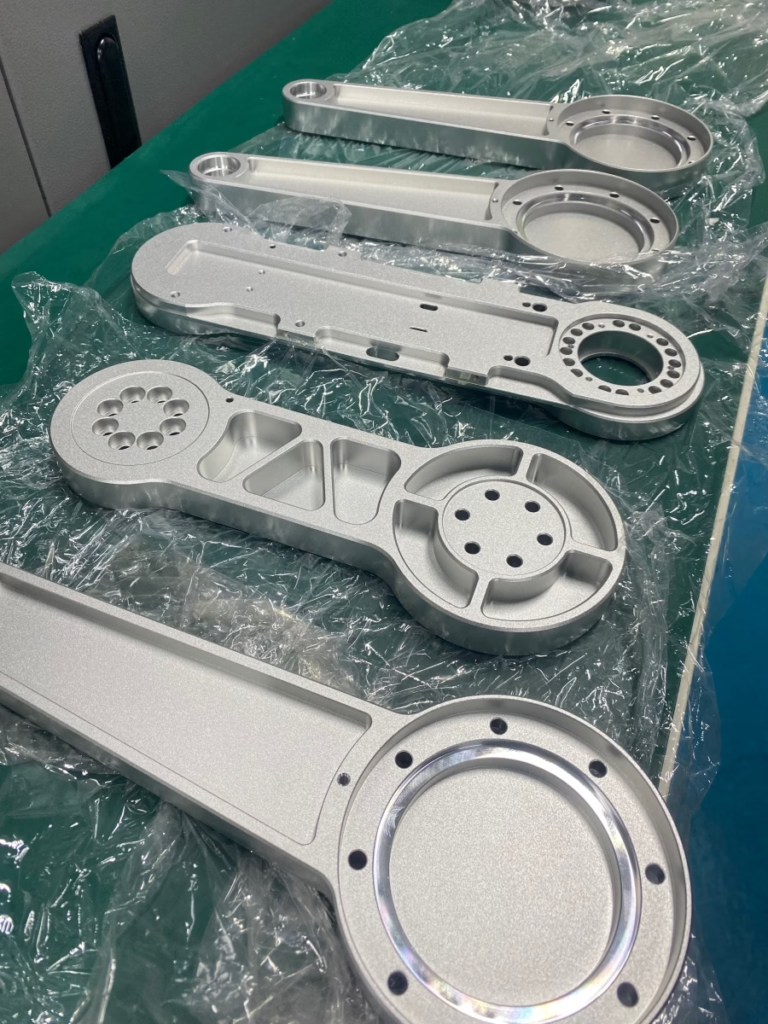
This is where GreatLight fits. We run 127 high-precision CNC machines across three plants in Dongguan and Singapore, including 16 simultaneous 5-axis machining centers and a maximum processing size of 4,000 mm. Tolerances hold at ±0.005 mm with finishes from Ra 0.2–0.8 μm on request.
We are certified to ISO 9001:2015, IATF 16949:2016, ISO 13485:2016 and ISO 27001:2022, and every part is inspected before shipment. Quotation and free DFM analysis come back within 12 hours, production can start within 24 hours, and parts ship in 3–5 days. There is no minimum order quantity, from one prototype to 10,000+ part runs.
If you are still set on owning a machine, that is a legitimate choice for high volume and stable designs. Just make the decision with the landed cost, the spares list and the service terms in front of you, not with the listing price.
Seven checks before you wire money
Work through these in order. Each one can stop the purchase.
- 1Get the landed cost in writingAsk the supplier for an itemized quote: machine, crating, freight to your port, insurance. Then get your own duty and inland transport quote. Compare the total against your budget, not the listing price.
- 2Request a test cut in your materialSend a drawing with a real tolerance callout. Ask for the part, the cutting parameters, and a measurement report naming the instrument used. Pay for the test part if you have to.
- 3Verify the supplier is the builderAsk for a live video walkthrough of the assembly floor with a machine under power. Get the business license and check the registered scope against what they claim to make.
- 4Lock the exact unit by serial numberBefore shipment, request a photo of the nameplate and serial number on the unit you are buying. Confirm it matches the unit that was tested and inspected.
- 5Demand the spare parts price listGet prices and lead times for spindle, ball screw set, linear guides, servo drives, and controller boards. If the list does not exist, treat the machine as unrepairable.
- 6Read the service and warranty clausesFind out who pays for parts, who pays for labor, and what the response time is. A warranty that requires shipping the machine back is not a warranty.
- 7Plan the install before the crate landsConfirm floor load rating, three-phase power, transformer sizing, rigging access, and who levels and calibrates the machine. Book the rigging crew before the ship arrives.
Questions buyers ask us
Is it safe to buy a CNC machine from Alibaba?
It can be, if you treat it as an import project rather than a shopping cart checkout. Verify the supplier is the manufacturer, get a test cut in your material, lock the unit by serial number, and use a payment method with some recourse.
The risk is not usually fraud. It is a machine that arrives with no spares list, a proprietary controller nobody can repair, and a service contact who stops answering after the warranty window closes.
How does outsourcing compare to buying my own machine?
Outsourcing wins when volume is low, the design is still changing, or you need several processes like milling, turning, finishing and inspection. You pay per part and keep the capital.
Owning wins when volume is high and stable, the part family is narrow, and you already have programming and metrology in house. Below roughly a few thousand parts a year, the fixed costs usually lose.
What is the maximum part size GreatLight can machine?
Our maximum processing size is 4,000 mm, with a large-travel envelope of 4,000 × 400 × 150 mm. Medium envelopes cover 750 × 1,150 × 550 mm and 600 × 600 × 600 mm.
For smaller work we run 500 × 500 × 450 mm and 500 × 310 × 200 mm envelopes, plus a Ø400 mm rotary table for parts that need multi-face access in one setup.
Do you handle surface finishing as well as machining?
Yes. Anodizing in clear, colour, hardcoat and conductive versions, electroless nickel, zinc, silver and gold plating, powder coating and black oxide.
We also run bead blasting, tumbling, brushing and polishing, plus laser marking and engraving with a minimum character height of 1.5 mm.
What tolerance and finish can you hold?
Tolerance is ±0.005 mm, or ±0.0002 in. Surface finish depends on the operation and material: Ra 0.2–0.8 μm for fine work, Ra 0.8–1.6 μm for high-finish surfaces, and Ra 1.6–3.2 μm as machined.
Every part is inspected before shipment, covering raw material check, in-process monitoring and final inspection. Inspection reports are available on request.
Which materials and industries do you work with?
Aluminium grades 6061 through 7075, stainless 303 to 17-4PH, alloy and tool steels, copper and brass, titanium including Ti-6Al-4V, Inconel, magnesium, and engineering plastics up to PEEK and carbon fibre.
We serve aerospace, automotive and EV, medical devices, robotics and automation, electronics, industrial machinery and new energy. Certifications include ISO 9001, IATF 16949, ISO 13485 and ISO 27001.
Send the drawing, get a quote and DFM feedback
Upload your files and we come back within 12 hours with pricing and a manufacturability review. No minimum order quantity, NDA on request.
12-hour quote100% inspectionNo MOQ
More from the shop floor
We publish setup notes, tooling trials and inspection data from the factory floor.











