
CNC Turning Service Maker: How to Choose One
Most turning quotes look the same on a spreadsheet. The difference shows up when you check spindle capacity, inspection records and how the shop handles a ±0.005 mm callout. This guide lists the five things engineers and buyers should verify before placing a purchase order, and the points where a low price usually hides a cost.
In this article
- 1
- 2
- 3
- 4
- 5
- 6
- 7
- 8
Key takeaways
Turning supplier comparison: what to weigh
Use this table to score two or three candidate shops on the same row set.
| Criterion | What good looks like | Red flag |
|---|---|---|
| Turning envelope | Live-tool lathes plus mill-turn centers up to 4,000 mm | Only bar feeders under Ø60 mm |
| Tolerance claim | ±0.005 mm stated with the size range it applies to | One number quoted for every part |
| Inspection | 100% inspection, reports on request | Sample check only, no records |
| Certificates | ISO 9001:2015 plus IATF 16949 or ISO 13485 as needed | Certificate shown but expired |
| Order size | No MOQ, one prototype to 10,000+ parts | Setup fee that blocks small runs |
| Quote speed | Price and DFM feedback within 12 hours | One week, no manufacturability notes |
| Confidentiality | NDA on request, secure file handling | Files passed around by email only |
The verdict
Pick the turning supplier that answers the technical questions first and the price second. Capacity, tolerance scope, inspection records and certificate scope tell you more than a 10% lower quote ever will.
Turning capacity: match the machine to the part
A CNC turning service maker is only as useful as the machines behind the quote. Turning covers a wide span: a Ø6 mm stainless pin and a 2 m hydraulic rod are not the same job, and they do not run on the same lathe. Before you compare prices, send a drawing and ask which machine the shop intends to use.
Bar-fed lathes with a Ø60 mm or smaller spindle handle the bulk of small turned parts. They are fast and cheap per piece, but the part must fit through the spindle bore. Once the diameter passes roughly Ø80 mm, the shop needs a chucking lathe or a mill-turn center. Parts with cross-holes, flats or slots usually need live tooling, otherwise they get a second op on a mill and the price doubles.
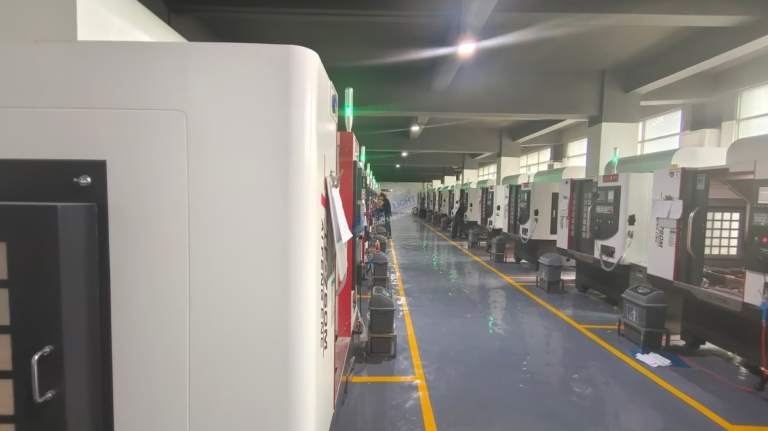
At GreatLight, turning runs alongside 16 mill-turn centers and 127 high-precision CNC machines in total, spread across three wholly-owned plants in Dongguan and Singapore. Maximum processing size is 4,000 mm, with travel options of 4,000 × 400 × 150 mm for long shafts and 500 × 500 × 450 mm for compact housings. A Ø400 mm rotary table covers parts that need indexed features.
The practical test: if the shop cannot tell you the spindle bore, the maximum turned diameter and whether it has live tooling, it has not looked at your drawing. Move on.
Tolerance and surface finish: read the fine print
±0.005 mm (about ±0.0002 in) is a normal working tolerance for turned parts in aluminum and brass. It is not normal on every feature of every material. Thermal growth, tool wear and chucking deflection all eat into the budget, and the smaller the part, the harder it is to hold.
Ask which dimensions carry the tight tolerance. A drawing with ±0.005 mm on a bearing seat and ±0.1 mm on a cosmetic shoulder is easy to make. A drawing with ±0.005 mm on a 400 mm unsupported shaft will get quoted high, or quoted low and then fail at inspection.
Surface finish follows the same logic. Ra 1.6–3.2 μm is standard as-machined turning. Ra 0.8–1.6 μm needs a slower feed and a fresh insert, which is a controlled process, not a lucky one. Ra 0.2–0.8 μm usually means a finishing pass, lapping or polishing after turning.
For sealing faces, O-ring grooves and hydraulic bores, specify finish and tolerance together. A groove that is dimensionally right but torn will still leak.
Materials and finishes that decide the process
Material choice changes the turning process more than most buyers expect. Free-machining grades run clean and fast: 6061-T6 aluminum, 303 stainless, C36000 brass. They hold tight tolerances with little fuss.
Other grades fight back. 316L stainless work-hardens at the cut, so feeds and speeds must stay aggressive or the insert rubs. Titanium TC4 (Ti-6Al-4V) and Inconel generate heat at the tool tip and need lower surface speed plus flood coolant. 7075 aluminum machines well but moves after stress relief, so thin walls need a roughing pass, a pause, then a finishing pass.
Plastics behave differently again. POM and PEEK hold good turned tolerances. ABS and PP deflect under chuck pressure, so the shop has to use soft jaws and light clamping. If your part is a thin-wall plastic tube, say so in the RFQ.
Finishes sit downstream of turning and can undo a good part. Anodizing adds 5–15 μm per surface and shifts tight diameters. Hardcoat anodizing adds more. If an anodized bore must stay within ±0.005 mm, mask it or machine undersize on purpose. Plating, bead blasting and laser marking all have their own allowances; laser marking needs a minimum character height of 1.5 mm to stay readable.
Lead time, MOQ and the quote itself
Quote speed tells you how the shop is organized. A useful reply is not just a number. It should include a manufacturability note, a proposed process route and a lead time you can plan around. At GreatLight, quotation and free DFM analysis come back within 12 hours, and production can start within 24 hours of approval. Parts ship in 3–5 days. Historical late-delivery probability sits below 2%.
MOQ is the other common trap. Some shops price a small run so high that the setup cost effectively forces you into 500 pieces. Others charge a setup fee and then treat the first article as a formality. A shop with no minimum order quantity can take one prototype and then scale to 10,000+ parts on the same process route, which saves a second qualification cycle later.
Read the quote line by line. Material, machining, finishing, inspection and freight should each appear. If finishing is missing and your drawing calls for anodizing, that cost arrives later.
For prototypes, ask whether the shop quotes the production process or a shortcut. A prototype made on a different route can pass dimensional checks and still not represent the parts you will receive in volume.
Certificates, inspection and confidentiality
Certificates are a filter, not a ranking. ISO 9001:2015 is the baseline for any serious CNC turning service maker. Add IATF 16949:2016 if the part goes into a vehicle, ISO 13485:2016 for medical devices, and ISO 27001:2022 if you are handing over sensitive design files.
Check what the certificate scope actually covers. A certificate for trading or assembly does not prove the shop machines and inspects in-house. Ask for the inspection routine: raw material check, in-process monitoring, final inspection before shipment. GreatLight inspects 100% of parts before shipment, with reports on request, and reports a qualification rate of 99.99%.
Measurement equipment matters as much as the certificate. A shop holding ±0.005 mm needs a CMM, a micrometer set and surface roughness testers on site, not sent out to a third party.
On confidentiality, ask early. Uploads should be handled as secure and confidential, and an NDA should be available on request before you send the CAD. If a supplier hesitates on this, that is your answer.
Step by step: how to vet a turning supplier
Run these steps in order. Most bad suppliers drop out by step 4.
- 1Send a real drawing, not a descriptionInclude 2D PDF with GD&T, 3D STEP, material grade and finish callout. Add the annual volume and whether the first order is a prototype.
- 2Ask for the machine and process routeExpect a named machine type, spindle bore, whether live tooling is used, and how many setups. A one-setup answer for a cross-drilled part is a warning.
- 3Confirm the tolerance applies to listed featuresAsk which dimensions hold ±0.005 mm and which are general. Request the general tolerance block if the drawing has one.
- 4Request an inspection planFirst article report, in-process checks, final inspection. For medical or automotive, ask for the specific records your auditor will want.
- 5Verify certificates and their scopeAsk for the certificate number and the scope statement. Match it to your industry: IATF 16949, ISO 13485, ISO 27001.
- 6Sign the NDA before releasing CADIf the design is sensitive, get the NDA in place first. Secure upload beats email attachments.
- 7Run a paid prototype before volumeOne part in the production process route, measured and reported, is cheaper than a scrapped batch of 2,000.
Turning supplier questions buyers ask
What is the smallest and largest part a turning shop can make?
It depends on the spindle and the bed. Bar-fed lathes typically top out around Ø60–80 mm, while chucking lathes and mill-turn centers handle much larger work. GreatLight runs up to a 4,000 mm maximum processing size with travel options from 500 × 500 × 450 mm up to 4,000 × 400 × 150 mm.
Send the envelope early. If the shop cannot state its maximum turned diameter, it is guessing.
Is ±0.005 mm realistic on a turned part?
Yes, on short, rigid features in aluminum, brass or free-machining stainless. It is harder on long unsupported shafts, thin walls and materials like Inconel or titanium.
Ask which features carry the tolerance. If the whole drawing is ±0.005 mm, expect either a high price or a quality problem.
Do I have to order a minimum quantity?
Not at every shop. Some suppliers have no minimum order quantity and run from one prototype to 10,000+ part runs. Others add setup charges that make small orders uneconomic.
If your program starts with a prototype, confirm that the prototype and the production run use the same process route.
Which certificates should a turning supplier hold?
ISO 9001:2015 is the baseline. Add IATF 16949:2016 for automotive, ISO 13485:2016 for medical devices, and ISO 27001:2022 if you need information security controls.
Check the scope on the certificate. A trading company can hold a certificate without machining anything in-house.
How long should a quote take?
A working quote with manufacturability feedback should come back within a business day. GreatLight returns quotation and free DFM analysis within 12 hours, with production able to start within 24 hours and parts shipping in 3–5 days.
A slow quote usually means a slow production control system behind it.
Can the shop handle finishing as well as turning?
Many do, and it saves freight and finger-pointing. GreatLight covers anodizing, plating, powder coating, black oxide, bead blasting, polishing and laser marking in one route.
If finishing is subcontracted, ask who owns the tolerance after coating and how a rejected batch is handled.
Send your turning drawing and get a real answer
Upload the STEP and PDF. You get a price, a DFM note and a lead time within 12 hours, from a shop that machines, inspects and finishes in-house.
12-hour quote100% inspectionNo MOQNDA on request
More from the shop floor
We publish setup notes, tooling trials and inspection data from the factory floor.











