
How to Vet Titanium Alloy CNC Machining Service Manufacturers
['Titanium cuts differently from aluminum or steel. Heat stays at the edge, the chip sticks, and a supplier without the right tooling and coolant strategy will burn through your tolerance and your schedule.', 'This guide is for engineers and sourcing leads comparing titanium alloy cnc machining service manufacturers. You will get a checklist of what actually decides whether a shop can hold ±0.005 mm in Ti-6Al-4V, plus the traps that show up after the purchase order is signed.']
In this article
- 1
- 2
- 3
- 4
- 5
- 6
- 7
- 8
Key takeaways
What separates capable titanium alloy cnc machining service manufacturers
Use this table to compare supplier answers side by side before you send an RFQ.
| Check | Weak answer | Strong answer |
|---|---|---|
| Grade knowledge | Quotes 'titanium' at one price | Asks for grade: TA2, TC4, Ti-6Al-4V |
| Tooling plan | Uses the same end mill as steel | Sharp uncoated carbide, positive rake |
| Coolant | Flood only | High-pressure through-spindle, 70+ bar |
| Tolerance | Claims ±0.05 mm as standard | States ±0.005 mm with inspection report |
| Heat control | No mention of alpha case | Controls cut temp, plans stress relief |
| Finishing | Sends parts out | In-house anodizing, blasting, polishing |
| Certification | ISO 9001 only | IATF 16949, ISO 13485, ISO 27001 as needed |
| Order size | Large minimums | No minimum order quantity, one to 10,000+ |
| Quote speed | Two weeks | Quotation and free DFM analysis within 12 hours |
Why titanium punishes the wrong process
Titanium keeps its strength at temperatures where aluminum has already softened. That sounds like an advantage until you try to cut it. Roughly 80% of the heat generated at the cutting edge stays in the tool instead of leaving with the chip, because titanium conducts heat poorly. The insert runs hotter than it would in steel at the same surface speed, and it wears faster.
The second problem is chemical. At elevated temperatures titanium is reactive. It can weld to the cutting edge, a failure mode known as galling. Once a built-up edge forms, the tool stops cutting cleanly and starts rubbing. Surface finish drops, dimensions drift, and the next part is scrap. Chips also tend to be thin and springy, so they can wrap around the tool and recut themselves.
The third issue is stiffness. Ti-6Al-4V has a high strength-to-weight ratio, so thin walls and long overhangs deflect under cutting force. A part that looks fine on the machine may be out of tolerance after the vise is released. This is where a shop's experience shows: they plan the fixturing and the toolpath around the deflection instead of chasing it with a file.
None of this makes titanium unmachinable. It makes the process choices narrower. Cutting speed, feed per tooth, radial engagement, coolant pressure, and tool geometry all have to sit in a tighter window than they do for 6061 or 304 stainless.
- 1Low conductivityHeat concentrates at the edge, so tool life depends on coolant and speed.
- 2Chemical reactivityGalling builds a welded edge that ruins finish and size.
- 3Springy chipsThin chips wrap and recut; chip evacuation needs attention.
- 4Deflection riskHigh strength plus thin walls means light passes and solid fixturing.
Machine and tooling capability to ask about
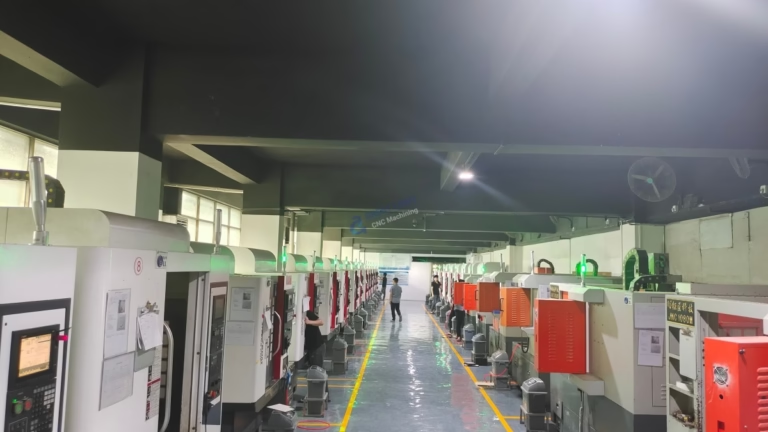
Ask which machine will run your part. For a simple bracket, a three-axis mill is enough. For a medical implant with compound angles or a turbine component with deep pockets, you want simultaneous five-axis motion, because fewer setups means fewer chances to lose datum. A shop with 16 simultaneous 5-axis machining centers can keep the part on one fixture and cut five faces without re-clamping.
Travel size sets the ceiling on part size. A typical compact machine covers 500 × 500 × 450 mm. Larger gantry-style machines reach 4,000 × 400 × 150 mm, which covers long structural parts. If your part is 900 mm long and the shop's largest machine is 600 mm, the quote is not real. Verify the work envelope against your drawing before anything else.
Tooling is the next filter. Titanium wants sharp, uncoated carbide with a positive rake angle and a strong edge. Coatings that work well on steel can react badly here. High-pressure through-spindle coolant, often 70 bar or more, is not a luxury. It breaks the chip, cools the edge, and flushes the pocket. A shop that lists flood coolant only is telling you something.
Finally, look at how they hold the part. Titanium's low modulus means a 2 mm wall will sing. Good shops use custom soft jaws, vacuum fixturing, or low-melt alloys to support thin sections. Ask for the fixture plan on any part with a wall thinner than 3 mm.
- 1Machine count127 high-precision CNC machines across 3 plants; 16 are simultaneous 5-axis.
- 2Work envelopeUp to 4,000 mm maximum processing size; compact machines down to 500 × 310 × 200 mm.
- 3Rotary tableØ400 mm rotary table for parts that need indexing around a bore.
- 4Coolant pressureHigh-pressure through-spindle coolant is the default for titanium, not an upgrade.
Tolerances, finishes, and inspection you can verify
Any shop can write ±0.005 mm on a website. The question is whether they can hold it on your drawing. Titanium's deflection and tool wear make tight tolerances harder to repeat than in aluminum, so the shop needs in-process probing or frequent manual checks. Ask what percentage of parts get inspected. A 100% inspection before shipment is the standard you want, with reports on request.
Surface finish is a second dimension. As-machined titanium sits around Ra 1.6–3.2 μm. With the right parameters and a finishing pass, Ra 0.8–1.6 μm is realistic. For sealing faces or bearing bores, Ra 0.2–0.8 μm is achievable but will add operations. Decide early which surfaces actually need the fine finish, because polishing every face of a titanium part is expensive.
Inspection equipment matters too. A shop that only owns calipers cannot verify a true position callout. Look for CMM capability, and for surface finish testers if your print specifies Ra. For medical or aerospace work, ask about material certification and traceability back to the mill.
One more point: titanium parts often need post-processing that changes dimensions slightly. Anodizing adds a thin oxide layer; stress relief may move the part. A capable supplier will plan the sequence so the final dimensions are taken after those steps, not before.
- 1Tolerance±0.005 mm (±0.0002 in) is achievable with the right process control.
- 2Finish rangeAs-machined Ra 1.6–3.2 μm; fine finish Ra 0.2–0.8 μm with extra ops.
- 3InspectionRaw material check, in-process monitoring, final inspection, reports on request.
- 4Qualification rate99.99% qualification rate is a useful benchmark when comparing shops.
Certifications, lead time, and order size
Certifications tell you which industries a shop already serves. ISO 9001:2015 covers general quality management. IATF 16949:2016 adds automotive-specific discipline around change control and traceability. ISO 13485:2016 is the medical device standard. ISO 27001:2022 covers information security, which matters if you are sending proprietary CAD files. Match the certificate to your end market, then ask to see the scope statement, not just the logo.
Lead time is where titanium differs from other materials. Tool wear slows production, and a shop that promises the same turnaround as aluminum may be overpromising. A realistic flow is quotation and free DFM analysis within 12 hours, production start within 24 hours, and parts shipping in 3–5 days for straightforward work. Complex five-axis parts with multiple finishing steps will take longer. Ask for the schedule by operation, not one number.
Order size flexibility matters for anyone in prototype or low-volume production. A supplier with no minimum order quantity lets you run one part to prove the design, then scale to 10,000+ without changing shops. If the supplier imposes a large minimum, your early iterations get expensive fast.
Finally, ask about confidentiality. Titanium parts often belong to aerospace or medical programs where the drawing itself is sensitive. Uploads should be secure and confidential, with an NDA available on request. That is a process question, not a legal formality.
- 1Quality certsISO 9001:2015, IATF 16949:2016, ISO 13485:2016, ISO 27001:2022.
- 2Quote speedQuotation and free DFM analysis within 12 hours.
- 3Production startProduction can start within 24 hours after approval.
- 4Order rangeNo minimum order quantity, from one prototype to 10,000+ part runs.
Finishing and post-processing in house
Titanium finishing is not cosmetic. Anodizing can be clear, colored, hardcoat, or conductive, and each type changes the surface in a different way. Hardcoat anodizing improves wear resistance on sliding surfaces. Conductive anodizing keeps the part electrically grounded, which matters for electronics housings. If your application is medical, anodizing also affects biocompatibility.
Bead blasting, tumbling, brushing, and polishing all produce different textures. Bead blasting gives a uniform matte surface and hides tool marks. Polishing gets you to a mirror finish but removes material, so it must be planned before final inspection. Laser marking and engraving need a minimum character height of about 1.5 mm to stay legible on titanium, so check your part number format.
The practical advantage of in-house finishing is schedule control. When anodizing and blasting happen under the same roof as machining, parts do not sit in transit for a week. The shop can also rework a dimension after finishing if needed, instead of scrapping the part.
Plating options like electroless nickel, zinc, silver, and gold are also available for titanium and its mating components. Each has a purpose: nickel for wear, silver for conductivity, gold for corrosion resistance in connectors. Ask which one the shop recommends for your environment.
- 1AnodizingClear, color, hardcoat, or conductive, depending on function.
- 2TexturingBead blasting, tumbling, brushing, polishing for different surface looks.
- 3MarkingLaser marking and engraving with minimum character height 1.5 mm.
- 4PlatingElectroless nickel, zinc, silver, gold for wear or conductivity.
Step by step: how to qualify a supplier
Run these steps before you commit a purchase order. Each one filters out a common failure mode.
- 1Send the drawing with the gradeState Ti-6Al-4V, TA2, or whatever you need. A shop that quotes a single titanium price without asking is not reading the print.
- 2Ask for the machine and fixture planRequest the specific machine model and work envelope. For thin walls under 3 mm, ask how they plan to support the part.
- 3Confirm coolant and toolingHigh-pressure through-spindle coolant at 70 bar or more, sharp uncoated carbide, positive rake. If they cannot name these, keep looking.
- 4Check tolerance and inspection methodAsk what tolerance they can hold on your specific features and whether a CMM will verify them. 100% inspection before shipment is the target.
- 5Match certifications to your marketAutomotive parts need IATF 16949. Medical parts need ISO 13485. Ask for the scope statement, not just the certificate number.
- 6Request a sample or first articleFor critical parts, run a first article and inspect it yourself. A sample center can show surface finish and edge quality before full production.
- 7Confirm lead time by operationGet a schedule that breaks out machining, finishing, and inspection. Watch for promises that ignore titanium's slower cutting speeds.
- 8Agree on confidentialityIf the design is sensitive, sign an NDA before sending CAD. Secure uploads and confidential handling should be standard.
Common questions
Can titanium alloy CNC machining service manufacturers hold ±0.005 mm?
Yes, but it depends on the feature and the setup. ±0.005 mm (±0.0002 in) is achievable on rigid parts with the right tooling and in-process probing. Thin walls, deep pockets, and long overhangs are harder because titanium deflects under cutting force.
Ask the shop to confirm the tolerance on your specific drawing, not in general. A supplier that answers with a flat yes without looking at the part is not giving you useful information.
What is the difference between machining CP titanium and Ti-6Al-4V?
Commercially pure grades like TA1 and TA2 are softer and more ductile. They cut more easily but tend to gall and form a built-up edge. Ti-6Al-4V (TC4) is stronger and harder, so it needs lower surface speeds and more rigid setups.
The choice usually comes from the application. CP titanium suits chemical and corrosion resistance. Ti-6Al-4V suits structural and medical implants where strength matters.
How does titanium affect lead time?
Titanium cuts more slowly than aluminum because the tool has to run at lower surface speed. Tool wear is also faster, so some jobs need insert changes mid-run. That means a titanium part will not match the turnaround of a simple aluminum bracket.
A realistic schedule for straightforward parts is quotation within 12 hours, production start within 24 hours, and shipping in 3–5 days. Complex parts with multiple finishing steps take longer.
Do I need a large order to get a quote?
No. Shops that serve prototyping and production work with no minimum order quantity. You can run a single part to validate the design, then scale to 10,000+ units with the same supplier.
This matters because titanium iterations are expensive. Being able to order one or two parts without a penalty keeps the design cycle moving.
Which certifications should I look for?
It depends on the end market. ISO 9001:2015 is the baseline for quality management. IATF 16949:2016 is standard for automotive. ISO 13485:2016 is required for medical devices. ISO 27001:2022 covers information security if you are sharing sensitive files.
Ask for the certification scope. A certificate for a different facility or process does not cover the work you are buying.
Can titanium parts be anodized after machining?
Yes. Anodizing can be clear, colored, hardcoat, or conductive. Hardcoat improves wear resistance; conductive keeps the part grounded. The oxide layer adds a small amount of thickness, so the machining dimensions should account for it.
Plan the finishing sequence before final inspection. If anodizing or stress relief happens after the last measurement, dimensions can shift.
Ready to compare titanium suppliers on real numbers?
Send your drawing and grade. We will return a quotation and a free DFM analysis within 12 hours, with the machine, tooling, and inspection plan spelled out.
12-hour quoteNo minimum order quantity100% inspection
More from the shop floor
We publish setup notes, tooling trials and inspection data from the factory floor.











