
Titanium CNC Machining Service: What to Check Before You Send an RFQ
This guide is for engineers and buyers sourcing a titanium CNC machining service for Ti-6Al-4V, commercially pure grades, and other hard alloys. It covers the checks that separate a shop machining titanium daily from one treating it like stainless steel. Read it and you can judge a quote in minutes, not weeks.
In this article
- 1
- 2
- 3
- 4
- 5
- 6
- 7
- 8
Key takeaways
Comparing titanium machining suppliers: what to weigh
Use this table to score two or three shops on the same criteria before you negotiate.
| Criterion | What good looks like | Warning sign |
|---|---|---|
| Alloy experience | Names TC4, TA1, TA2 and Inconel separately | Treats all titanium as one material |
| Machine rigidity | Heavy bases, linear guides, thermal compensation | Light router-class spindles |
| Toolpath strategy | Constant engagement, trochoidal roughing | Full-width slotting passes |
| Tolerance proof | ±0.005 mm with a written inspection plan | Tolerance quoted, method not stated |
| Lead time | Production start within 24 hours of PO | Vague multi-week windows |
| Order size | One prototype to 10,000+ parts, no MOQ | Minimum batch required |
| Certifications | ISO 9001, IATF 16949, ISO 13485, ISO 27001 | One generic certificate |
| Confidentiality | NDA available on request | No NDA process mentioned |
Pick the shop that talks about toolpaths, not just tolerances
A titanium CNC machining service earns its price in setup and tooling strategy. If the quote conversation stays on cycle time and ignores grade, rigidity, and inspection method, the savings will show up later as rework.
Why titanium punishes the wrong machine setup
Titanium keeps its strength at temperatures where aluminum has already gone soft. That sounds like an advantage until you cut it. The heat generated at the cutting edge has nowhere to go, because titanium conducts heat poorly. Instead of flowing into the chip and the workpiece, it stays in the tool. Tool life drops fast if the shop runs the same parameters it uses on 6061.
The second problem is work hardening. Titanium hardens in the shear zone during the cut. A light, rubbing pass does not remove material cleanly. It hardens the surface and makes the next pass harder. The fix is a controlled, consistent chip load, never a dwell. If a programmer lets the tool pause in the cut, the next revolution is cutting hardened metal.
The third issue is springback and chatter. Titanium has a lower modulus than steel, so thin walls deflect under cutting force. A rigid setup and a toolpath that keeps radial engagement constant solve most of this. Light finishing passes at the end, after the part has been roughed with material left for stress relief, keep the final dimensions stable.
- 1Low thermal conductivityHeat stays in the tool, so coolant delivery and edge geometry matter more than spindle RPM.
- 2Work hardeningNo rubbing passes. Keep the chip load high enough to cut under the hardened layer.
- 3DeflectionThin ribs and walls need support, sharp tools, and reduced radial engagement.
Which titanium grade fits your part
Grade 5 (Ti-6Al-4V, also written TC4) is the default for structural parts. It gives roughly twice the yield strength of commercially pure titanium and holds up at elevated temperature. It is also the grade most likely to chatter and the one where tool wear shows up fastest. Aerospace brackets, medical instruments, and high-load automotive parts usually land here.
Grade 2 (TA2) and Grade 1 (TA1) are commercially pure. They are softer, weld better, and resist corrosion in chemical and marine service. They machine more like a tough stainless steel. If your part does not need high strength, choosing Grade 2 instead of Grade 5 can cut cycle time and tool cost noticeably.
Do not assume a shop stocks what you drew. Titanium bar and plate in small quantities are often ordered per job. Ask whether the material is in stock or has to be sourced, because that single answer can move your delivery more than any machining parameter. We keep TC4, TA1, and TA2 in the material list and confirm availability at quote stage.
What a titanium-capable machine shop actually has
Rigidity is the foundation. Titanium cutting forces are high, and any flex in the machine frame turns into chatter and short tool life. Look for heavy machine bases, linear guides, and control systems that compensate for thermal growth over long cycles. A shop running titanium on a light machine will compensate by slowing down, which raises your cost and stretches lead time.
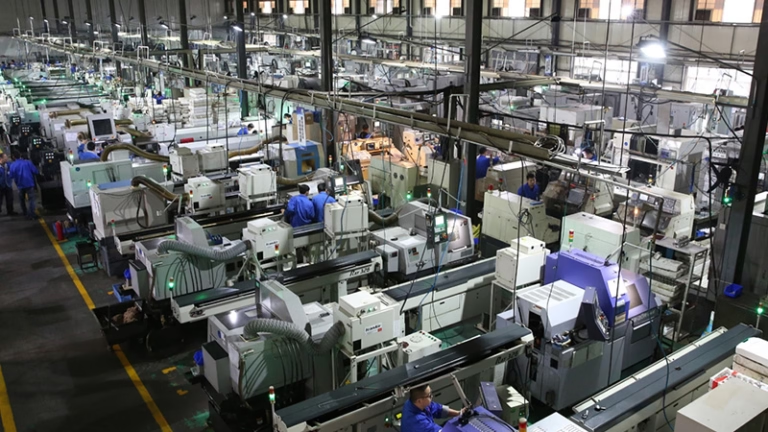
Five-axis capability matters for parts with compound angles, deep pockets, or features on multiple faces. Cutting in one setup avoids re-fixturing error and keeps datums consistent. We run 16 simultaneous 5-axis machining centers alongside 27 three-axis machines, 12 four-axis mills, and 16 mill-turn centers, which lets us route each part to the machine that fits it instead of forcing every job onto one spindle.
Tooling strategy shows up in the quote. Constant-engagement toolpaths, trochoidal roughing, and high-pressure coolant through the tool are the signs of a shop that cuts titanium often. If the quote assumes standard carbide and flood coolant, expect either a slow cycle or a high tool-replacement line item.
Tolerance, finish, and how they get verified
A tolerance number is only half the promise. The other half is the measurement plan. For titanium parts held to ±0.005 mm (±0.0002 in), ask what instrument is used, at what temperature, and whether the part is measured in the fixture or after it comes off the machine. Titanium moves after clamping is released, and a shop that measures only in the fixture may ship parts that fail at incoming inspection.
Surface finish is usually specified separately. As-machined titanium sits around Ra 1.6–3.2 μm. Where a sealing face or a sliding surface matters, the callout may be Ra 0.8–1.6 μm or finer, down to Ra 0.2–0.8 μm. Each step down adds finishing time. Put the finish requirement on the drawing, not in an email, so the quote covers it.
We inspect 100% of parts before shipment, with raw material checks, in-process monitoring, and a final inspection stage. Inspection reports are available on request. If your quality system needs first article inspection reports or material certificates, say so at the RFQ stage so they are built into the plan rather than added later.
Lead time, order size, and certification fit
Titanium sourcing adds a variable that aluminum does not have. Material lead time can dominate the schedule when a grade is not in stock. A shop that tells you the material status up front is easier to plan around. Our standard flow is quotation and free DFM analysis within 12 hours, production start within 24 hours of approval, and parts shipping in 3–5 days for typical jobs. Historical late-delivery probability is below 2%.
Order size should not be a barrier. Titanium prototypes and small runs are common in aerospace and medical work, where a design may change after the first build. We have no minimum order quantity and run from one prototype to 10,000+ part runs on the same process plan, so the first article and the production batch are made the same way.
Certification is a filter, not a badge. ISO 9001:2015 covers general quality management. IATF 16949:2016 is the one automotive and EV buyers look for. ISO 13485:2016 applies to medical devices. ISO 27001:2022 covers information security, which matters when you are sending controlled drawings. Check that the certificate scope actually covers the process you are buying, not just the company name.
Six steps to a titanium quote you can compare
Run these in order. Skipping step 1 is the most common reason two quotes come back 3× apart.
- 1Fix the grade and conditionState the alloy (TC4, TA1, TA2) and the stock form: bar, plate, or forging. Add the temper or heat treatment. A quote against the wrong grade is not comparable.
- 2Mark every critical featureCall out which dimensions carry ±0.005 mm and which are general tolerance. Shops price to the tightest callout on the drawing, so an unmarked tight feature inflates the whole quote.
- 3Separate finish from geometryPut surface finish callouts on the drawing. Note whether Ra 0.8–1.6 μm applies to one face or the whole part. Finishing is a distinct cost line.
- 4Send the 3D model and a 2D drawingThe model defines geometry, the drawing defines tolerance and finish. Missing either one forces the shop to guess and pad the price.
- 5Ask for DFM feedback with the priceGood shops flag thin walls, deep pockets, and features that need a second setup. Free DFM analysis inside the 12-hour quote window is normal for us, and it often removes cost before the first cut.
- 6Confirm material stock and inspection scopeAsk whether the grade is in stock, and whether you need material certs, first article reports, or full dimensional reports. These two answers set the real lead time.
Questions buyers ask before awarding a titanium job
How much slower is titanium than aluminum?
Cycle time depends on the feature, not just the material. Titanium cuts at lower surface speed and needs more careful chip evacuation, so a part that runs in 8 minutes in 6061 may run 3 to 5 times longer in Ti-6Al-4V.
Roughing dominates that difference. Finishing passes at low radial engagement are comparatively closer in time, so the gap narrows on parts with lots of small features and shallow cuts.
Can you machine thin-wall titanium parts without distortion?
Yes, with the right sequence. We rough with material left on the walls, let the part settle, then finish in light passes to control deflection. Support fixtures and sharp tooling reduce cutting force.
The limit is set by wall thickness relative to part size. Send the model and we will tell you at quote stage whether the wall ratio is workable or needs a design change.
What does ±0.005 mm mean in practice on titanium?
It means the shop controls thermal effects, fixturing, and tool wear tightly, and measures with equipment capable of resolving well below that band. It is achievable on critical features, not usually across every dimension of a large part.
Tell us which features need it. Applying tight tolerance selectively keeps the part affordable without weakening the design.
Do you need an NDA for titanium aerospace or medical drawings?
We can sign an NDA on request before you upload files. Uploads are handled as secure and confidential, and ISO 27001:2022 certification covers our information security process.
If your program has its own NDA template, send it with the RFQ and we will review it alongside the drawings.
What titanium grades do you machine?
We machine TA1, TA2, and TC4 (Ti-6Al-4V), plus Inconel and magnesium alloys such as AZ31B and AZ91D for parts that sit outside standard titanium work.
For grades outside this list, send the specification and we will confirm whether we can source and machine it before quoting.
How do I know the first article will match the production run?
The process plan, tooling, and machine routing are fixed after the first article is approved. Production runs follow the same setup, so the parts match what you signed off.
If a design change comes in later, we treat it as a new first article rather than adjusting the running program.
Send your titanium part for a DFM review
Upload the model and drawing and we will come back with a price, a material check, and DFM notes within 12 hours.
12-hour quoteNo minimum order quantity100% inspectionNDA on request
More titanium machining notes
We publish setup notes, tooling trials and inspection data from the factory floor.











