
Cheap Titanium CNC Machining: Where the Cost Actually Comes From
This page is for design engineers and buyers who need titanium parts at a workable price without losing tolerance or surface quality. We break down the cost drivers in Ti-6Al-4V and other grades, show which design and process choices remove real money, and explain how to judge whether a low quote is a genuine process advantage or a shortcut you pay for later.
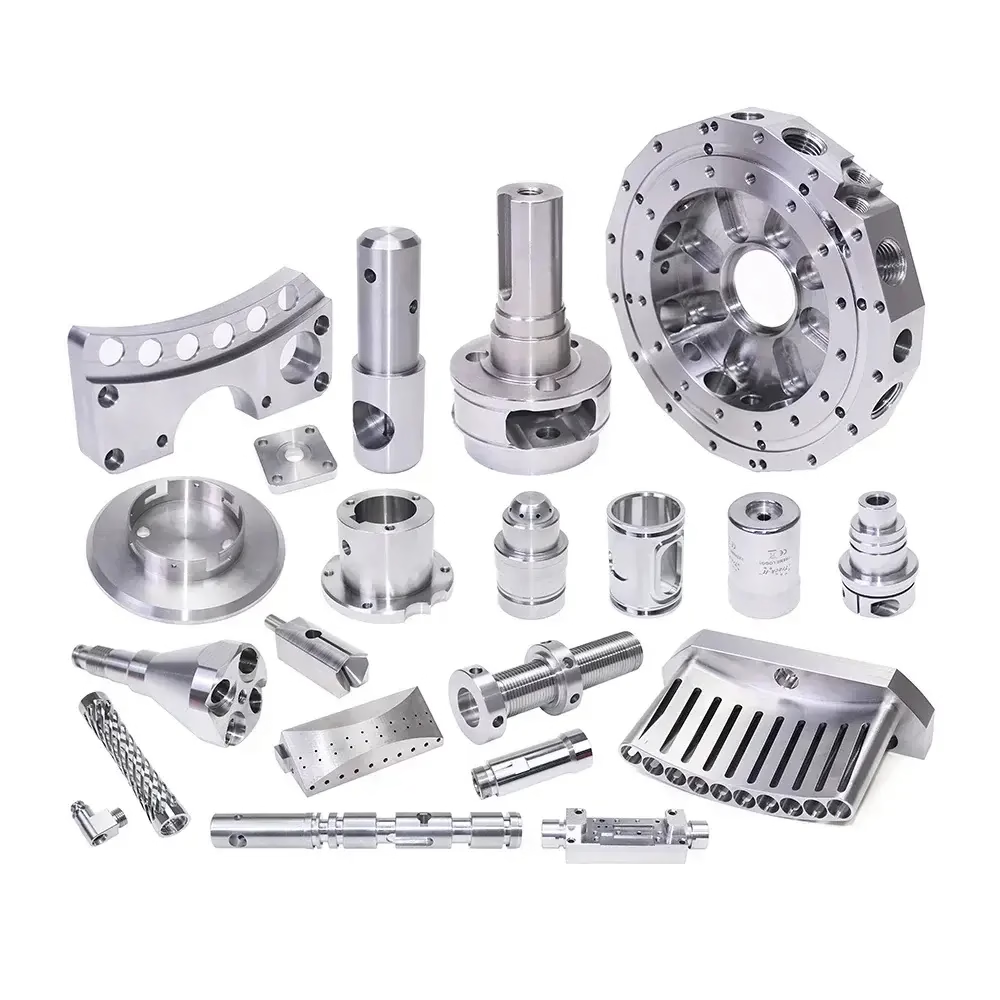
What "cheap" should mean in titanium
Low unit price and low total cost are not the same thing in titanium.
Why titanium costs more than aluminum at the spindle
Titanium is not difficult because it is hard. Grade 5 Ti-6Al-4V sits around 36 HRC, softer than many tool steels. The problem is heat. Thermal conductivity is roughly 7 W/m·K, about a fifteenth of 6061 aluminum. The heat a cutter makes at 60 m/min has nowhere to go except into the cutting edge, so edge temperature climbs fast and tool life drops from hours to minutes when the parameters are wrong.
Cutting speeds for titanium usually run 30 to 60 m/min with carbide tooling, and feed per tooth stays low because the material work-hardens at the surface. Slow the speed, keep the feed high enough to stay under the hardened layer, and use a lot of coolant. Do that and the cut is stable. Skip it and you burn through tools, which is where the money goes.
Titanium also springs back. Its elastic modulus is about 110 GPa, roughly half of steel, so thin walls and long slender parts deflect away from the cutter. A finishing pass that removes 0.2 mm on a 1.5 mm wall in aluminum is a chatter problem in titanium. Machinists compensate with lighter depths of cut, extra semi-finish passes, and more fixture support. Every one of those adds spindle time.
Raw stock is the other half of the bill. Titanium bar and plate cost several times more per kilogram than 6061 or 304 stainless, and a part that starts as a 120 × 120 × 60 mm billet removes 80 percent of that material as chips. Chips have almost no recovery value. Material removal ratio, not machining time alone, decides what a titanium part really costs.
- 1Heat stays in the edgeLow conductivity means coolant delivery and edge geometry matter more than spindle rpm.
- 2Work hardeningToo light a feed rubs the surface and hardens it, which kills the next pass.
- 3DeflectionThin walls need support, light depths of cut, and sometimes a stress-relief step.
- 4Buy-to-fly ratioOffal is expensive. Near-net stock or a different process can beat a cheaper hourly rate.
Where the money goes: titanium vs aluminum vs stainless
Same part envelope, three materials, three different cost profiles.
| Factor | Titanium Ti-6Al-4V | Aluminum 6061-T6 |
|---|---|---|
| Cutting speed | 30–60 m/min | 300–600 m/min |
| Tool life at speed | Minutes per edge | Hours per edge |
| Stock cost per kg | High | Low |
| Chip recovery value | Very low | Moderate |
| Typical cycle time | 3–6× aluminum | Baseline |
| Wall thickness limit | 1.0–1.5 mm practical | 0.8 mm practical |
Design choices that remove real cost
The single biggest lever is the shape you send us. A titanium bracket that keeps a constant wall of 3 mm machines in a fraction of the time of the same bracket with a 1.2 mm wall and a deep pocket. We are not asking you to add weight for no reason. We are asking which walls carry load and which ones are there because the CAD model looked cleaner that way.
Pockets are the second lever. A pocket whose depth is more than four times its width forces long, slender tools that must run at reduced parameters to avoid chatter. Widen the corner radii to at least one third of the pocket depth, or open the pocket floor with a drafted profile, and the same feature can be cut with a stiffer tool at a higher feed. Corner radii cost nothing functionally in most brackets.
Holes follow the same logic. Deep small-diameter holes in titanium are drilled in peck cycles with frequent retracts, and each retract is non-cutting time. If a hole does not need to be 6 mm at 60 mm deep, making it 10 mm or splitting it into a through hole from both sides can cut that feature's time in half. Specify tolerance only where it is needed, too. A hole called out at ±0.02 mm when the mating pin is a loose fit gets inspected, re-cut, and inspected again.
Tolerances and finish add cost quietly. Our standard titanium capability is ±0.005 mm, and a fine finish of Ra 0.2–0.8 μm is available, but both require slower finishing passes and more inspection. As-machined Ra 1.6–3.2 μm is fine for most structural brackets, housings, and fixtures. Reserve the tight tolerance and the mirror finish for sealing faces and bearing bores.
- 1Uniform wall thicknessKeep walls within a 2:1 ratio where possible so one set of parameters works.
- 2Pocket depth under 4× widthDeeper pockets need long tools and slow feeds.
- 3Corner radius ≥ 1/3 depthLarger radii let a stiffer cutter reach the floor.
- 4Tolerance where it mattersA general ±0.1 mm with three critical dims is cheaper to make and inspect.
Process optimization and how to order
Five-axis simultaneous machining changes the titanium math. On a 3-axis machine, a part with features on five faces needs multiple setups, and every setup is a chance for positional error plus an hour of fixturing. Cutting it in one five-axis setup removes that stack-up and often removes an operation entirely. We run 16 simultaneous 5-axis centers, 16 mill-turn centers, and 127 machines total, so the routing can be picked to fit the part rather than the other way around.
Roughing strategy matters as much. High-feed toolpaths with small radial engagement keep the heat load down and let the tool survive in titanium. Trochoidal roughing on deep pockets removes material in controlled arcs instead of a full-width cut. Both need CAM time up front, which is why a shop that quotes titanium in five minutes is usually quoting a generic toolpath that will cost you in cycle time.
Ordering strategy is the part most buyers control. One prototype and a 500-piece run have very different economics in titanium because setup, fixturing, and first-article inspection get spread over the batch. If you know the design is close to frozen, ordering the pilot batch and the production batch together usually beats two separate orders. There is no minimum order quantity here, from a single prototype to 10,000+ part runs, so you can start small and scale without re-quoting the setup.
Planning also means deciding what not to machine. A titanium part that has one complex internal channel and a simple outer envelope may be better as a machined body with a brazed or welded cover, or as a casting that is finish-machined only on the critical faces. We will say so during the DFM review if the drawing suggests it.
- 1One five-axis setupFewer setups means less stack-up error and less fixturing time.
- 2Trochoidal roughingControlled radial engagement keeps heat and tool wear manageable.
- 3Batch your pilot runSetup and first-article cost spread across more parts.
- 4Machine only what mattersCast or weld the simple geometry, machine the critical faces.
How to read a suspiciously low titanium quote
Five things to check before you accept the lowest number.
| What the quote says | What to ask | Likely issue |
|---|---|---|
| No DFM notes | Did anyone review the drawing? | Generic toolpaths, slow cycle |
| Tolerance not listed | Which dims are inspected? | Rework or scrap at your cost |
| No material cert | Which mill and heat lot? | Unknown grade, wrong properties |
| Unrealistic lead time | Is stock on hand? | Subcontracted or rushed |
| Finish not specified | What Ra will I receive? | Hand polish, inconsistent |
What a low price should not touch
There are three places where saving money in titanium turns into a loss. The first is material traceability. Grade 5 and Grade 2 look identical on the shelf and machine differently. If a shop cannot tell you the mill and heat lot of the stock, you cannot verify that the part meets the drawing's mechanical properties. We check incoming raw material and keep the records.
The second is inspection. Titanium parts often go into aerospace, medical, and EV structures where a single out-of-tolerance bore scraps the assembly. Our qualification rate is 99.99 percent, and that number comes from 100 percent inspection before shipment, not sampling. In-process monitoring catches a drifting dimension before the whole batch is cut. Inspection reports are available on request.
The third is certification. ISO 9001:2015, IATF 16949:2016, ISO 13485:2016, and ISO 27001:2022 are audited systems, not marketing lines. If your program requires one of them, a quote from a shop without the certificate is not a cheaper quote. It is a quote you cannot use.
Surface finishing is where cheap quotes get creative. Anodizing, bead blasting, and laser marking are separate operations with their own setup. Ask which finish is included in the line item and which one is billed later. Laser marking here has a minimum character height of 1.5 mm, which is worth knowing before you put a 0.8 mm part number on the drawing.
- 1Material certsAsk for the grade and heat lot on the stock.
- 2100% inspectionNot sampling. Reports available on request.
- 3Audited systemsISO 9001, IATF 16949, ISO 13485, ISO 27001.
- 4Finishing line itemsConfirm what the price includes before you compare.
Questions engineers ask about titanium pricing
Is Grade 5 titanium always more expensive to machine than Grade 2?
Usually yes. Ti-6Al-4V (Grade 5) is stronger and work-hardens more aggressively, so cutting speeds drop and tool life shortens. Grade 2 commercially pure titanium machines closer to a tough stainless. If your part is a cover, a spacer, or a corrosion barrier with light loads, Grade 2 can cut cost noticeably.
Can you hold ±0.005 mm in titanium on every feature?
We can hold ±0.005 mm on critical features with the right fixturing and thermal control. It is not practical to call out every dimension that tight, and doing so raises cost without adding function. Send the drawing and we will tell you which features need the tight callout and which can run at general tolerance.
Does a low quote mean the shop is skipping steps?
Not automatically. A shop with five-axis capacity, good CAM, and in-house finishing can genuinely quote lower because it removes setups and subcontracting. The warning signs are no DFM feedback, no tolerance list, and lead times shorter than the material can be sourced. Those are the quotes that come back as change orders.
What is the smallest quantity you will run in titanium?
There is no minimum order quantity. We quote from one prototype to 10,000+ part runs. Titanium prototypes are a normal request, and starting with one part lets you check fit and function before committing to a batch. The per-piece price drops as quantity rises because setup and inspection spread across more parts.
How do I keep a titanium part confidential?
Uploads are secure and confidential, and we sign an NDA on request. If your program has export-control or IP requirements, say so at the quote stage so the routing and documentation are set up correctly from the first operation.
What lead time should I expect?
Quotation and free DFM analysis come back within 12 hours. Production can start within 24 hours, and parts typically ship in 3–5 days. Titanium stock availability affects the start date, so tell us the grade and size early. Historical late-delivery probability is below 2 percent.
Send the drawing, get a real titanium number
Free DFM analysis and a quotation within 12 hours. No minimum order quantity, and your files stay confidential.
12-hour quote100% inspectionNo MOQ









