
Brass CNC Machining Service Prices: How to Read a Quote
Most brass quotes look similar until you compare the alloy, tolerance band, and inspection scope behind them. This guide is for engineers and buyers who need to judge whether a brass CNC machining service price is high, low, or simply quoting a different job. Read it before you send an RFQ.
In this article
- 1
- 2
- 3
- 4
- 5
- 6
- 7
- 8
Key takeaways
What actually moves a brass CNC machining service price
Use this table to compare two quotes side by side. If a line differs, that is where the gap comes from.
| Cost driver | Low-cost end | High-cost end | What to check on the quote |
|---|---|---|---|
| Alloy grade | C36000 free-cutting | C28000 or beryllium copper | Is the alloy named, not just 'brass'? |
| Tolerance band | ±0.05 mm general | ±0.005 mm critical | Which features carry the tight callout? |
| Surface finish | Ra 1.6–3.2 μm as machined | Ra 0.2–0.8 μm fine | Is finishing quoted in-house or subcontracted? |
| Part size | Under 200 mm | Up to 4,000 mm | Does the machine travel fit the part? |
| Order quantity | 10,000+ parts | One prototype | Is setup amortized over the lot? |
| Inspection scope | Dimensional spot check | 100% inspection plus reports | Are first-article and material certs included? |
| Lead time | Standard 3–5 days | Compressed schedule | Does the date include finishing and inspection? |
Compare the scope, then compare the price
Two brass quotes only mean something when the alloy, tolerance band, finish, quantity, and inspection level match. Fix those five inputs, and the cheapest number is usually the one that quoted the smallest job. Send the model and drawing, and we will return a quotation with a free DFM analysis within 12 hours.
Why brass CNC machining service prices vary so much
Brass is not one material. C36000 free-cutting brass turns at high spindle speeds with short chips, so cycle time is low and the price follows. C28000 and C27400 run slower, and beryllium copper needs more care because of tool wear and dust control. When two suppliers quote the same part at very different numbers, the alloy line on the drawing is the first place to look.
The second variable is tolerance. A ±0.05 mm general band can be checked with calipers on the bench. A ±0.005 mm callout on a bore or a sealing face needs a controlled process, temperature-stable measurement, and often a CMM report. The cutting itself may only take a few seconds longer. The measurement does not.
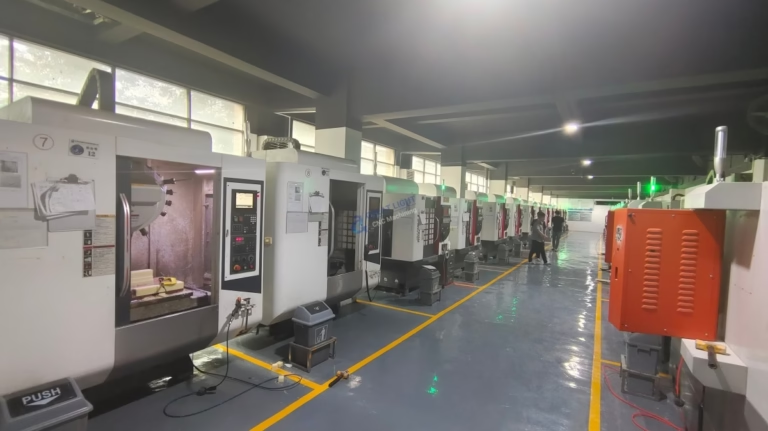
Machine choice matters too. A small brass fitting with cross-holes may run on a 3-axis mill with two setups, or on a mill-turn center in one. Fewer setups usually means a lower price, but only if the shop owns the right machine. We run 16 mill-turn centers and 16 simultaneous 5-axis machining centers, which is why we can quote single-setup work that other shops must split.
- 1Ask for the alloy by UNS number'Brass' on a quote is not enough. C36000, C27400, and C28000 behave differently at the spindle.
- 2Separate cutting from measuringA tight tolerance adds inspection cost more often than it adds cutting cost.
- 3Count the setupsEvery extra setup adds fixturing labor, and every refixture adds stack-up error.
Which brass parts suit CNC machining, and which do not
CNC machining wins on brass when the part has tight tolerances, complex internal features, or a low-to-medium volume that does not justify a die. Valve bodies, electrical contacts, RF connectors, bus bars, and instrument housings are typical. Wall thickness can go thin, threads hold up well, and the surface takes plating or laser marking cleanly.
CNC loses on brass when the part is simple and the volume is high. A plain cylindrical spacer at 100,000 pieces per year is a screw-machine or die-casting job, and a CNC quote will look expensive next to it. If your annual volume is above roughly 50,000 pieces and the geometry is mostly rotational, get a second quote from a different process before you sign.
There is a middle zone. At 500 to 10,000 parts, CNC machining often beats tooling-based processes because there is no mold cost to amortize and no waiting on a tool. We quote from one prototype to 10,000+ part runs with no minimum order quantity, so the same process carries from the first article to production.
One more boundary: very large brass parts. Our maximum processing size is 4,000 mm, with a large travel of 4,000 × 400 × 150 mm. Beyond that envelope, the part has to be split or the process has to change.
- 1Good fitTight tolerances, internal passages, low to medium volume, cosmetic surfaces.
- 2Poor fitSimple round parts above roughly 50,000 pieces per year, where screw machining or casting is cheaper.
The five quote inputs that decide your price
A brass quote is only as good as the file behind it. Send a 3D model plus a 2D drawing with tolerance callouts, and the shop can quote the real job. Send a sketch with no tolerances, and the shop has to guess. Guessing usually goes one of two ways: a padded number to protect the shop, or a low number that grows later. Both waste your time.
Alloy and temper come first. Name the UNS grade and the condition. Second is the tolerance map: mark which dimensions are critical and leave the rest general. Third is surface finish, both the Ra number and any cosmetic requirement on visible faces. Fourth is quantity, including whether you expect a prototype, a pilot lot, and a production ramp. Fifth is documentation, such as material certificates, first-article reports, or full dimensional reports.
We return a quotation and a free DFM analysis within 12 hours, and production can start within 24 hours after approval. The DFM pass often finds cost before the chips fly. A deep pocket that needs a long reach tool, a thread too close to a wall, or a tolerance that no process can hold at that feature size all show up in that review.
Uploads are secure and confidential, and we sign an NDA on request. If your drawings carry a customer name or a program logo, that matters more than the price difference between two shops.
- 1Model plus drawingSTEP for geometry, PDF for tolerances, datums, and notes.
- 2Mark the critical fewTighten only the features that function. A drawing where everything is ±0.005 mm costs more and buys nothing.
- 3State the rampPrototype, pilot, and production quantities let the shop price setup correctly.
- 4List the paperworkMaterial certs, FAI, and inspection reports are line items. Ask for them up front.
Certifications, capacity, and lead time as selection filters
Certifications tell you what kind of shop you are talking to. ISO 9001:2015 covers the quality system. IATF 16949:2016 matters if the brass part goes into a vehicle. ISO 13485:2016 matters for medical devices. ISO 27001:2022 covers information security, which is relevant when you send proprietary drawings across borders. We hold all four.
Capacity is the next filter. A shop with one 3-axis mill and a lathe will quote your part, then discover it needs a fourth setup. We run 127 high-precision CNC machines across 3 wholly-owned plants totaling 7,600 m², with 150 technicians. That footprint is why we can hold ±0.005 mm (±0.0002 in) on production brass parts and still ship in 3–5 days.
Lead time deserves a careful read. Ask whether the quoted date covers finishing and inspection, or just the machining. Anodizing, plating, and laser marking add days if they go outside. We keep finishing in-house for common brass work, which shortens the tail end of the schedule. Our historical late-delivery probability is below 2%.
Inspection scope closes the loop. We check raw material on arrival, monitor in-process, and inspect 100% before shipment, with reports on request. If your brass part is a sealing component or an electrical contact, that final gate is the one that protects your assembly line.
- 1Match the cert to the industryISO 9001:2015 for general work, IATF 16949:2016 for automotive, ISO 13485:2016 for medical.
- 2Ask where finishing happensOutsourced plating is a common source of hidden schedule slip.
- 3Confirm inspection levelSpot check and 100% inspection are different products at different prices.
Common traps in low brass CNC machining quotes
The cheapest quote is often a partial quote. It may assume general tolerances, no material certificate, no surface finish, and a single setup that the geometry does not actually allow. The part arrives, fails incoming inspection, and the rework or replacement erases the savings. Compare scope before you compare totals.
Another trap is alloy substitution. A shop quotes C36000 because it is easy to buy, then your drawing called for C27400 for corrosion resistance. The parts look the same and machine the same, so nothing flags it until the field fails. Put the UNS number on the purchase order, not just on the drawing.
Watch for tolerance creep on the shop floor. If the drawing says ±0.005 mm and the shop's inspection equipment cannot resolve that band, the parts may pass a bench check and fail your CMM. Ask what measurement equipment will be used on the critical features.
Finally, check the quotation validity and the currency. Brass prices move with the copper market. A quote that is six months old is not a quote. Ask how long the number holds and what triggers a requote.
- 1Compare scope, not totalsLine up alloy, tolerance, finish, inspection, and packaging before you compare price.
- 2Put the UNS grade on the PODrawings get simplified. Purchase orders get enforced.
- 3Ask about measurementA tolerance you cannot verify is not a tolerance you can ship.
How to get a brass quote you can compare
Follow these steps in order. Each one removes a variable that makes quotes hard to compare.
- 1Fix the alloy and temperWrite the UNS number and condition on the drawing and the RFQ. For free-cutting work, C36000 is the default. For higher strength or corrosion resistance, specify C27400 or C28000 and expect a longer cycle.
- 2Build a tolerance mapMark only functional features as critical. General dimensions can sit at ±0.05 mm or looser. Reserve ±0.005 mm for bores, sealing faces, and mating features that need it.
- 3Set the surface finish per faceRa 1.6–3.2 μm as machined is fine for hidden faces. Ra 0.8–1.6 μm suits most mating surfaces. Ra 0.2–0.8 μm is for sealing or optical interfaces and should be called out only where needed.
- 4State quantities and the rampGive prototype, pilot, and production numbers. Setup cost spread over 10,000 parts nearly disappears; spread over one prototype it does not.
- 5List documentation requirementsMaterial certificates, first-article inspection, and dimensional reports. If you need an NDA, ask for it before you upload the model.
- 6Send model and drawing togetherSTEP for geometry and a PDF drawing with datums and notes. A model alone leaves tolerance and finish undefined, which forces the shop to pad the quote.
- 7Review the DFM notes before releaseWe return a quotation and free DFM analysis within 12 hours. Read the notes. A small geometry change at this stage often removes a setup or a long-reach tool.
Brass CNC machining questions buyers ask
What is the minimum order quantity for brass CNC machining?
There is no minimum order quantity. We run from a single prototype to 10,000+ part runs on the same process, so the first article and the production lot come off comparable equipment.
For very small lots, the setup cost is the largest line in the quote. For large lots, material and cycle time dominate. Sending both numbers in one RFQ lets the shop price setup correctly.
Can you hold ±0.005 mm on brass parts?
Yes, on features where the geometry allows it. We hold ±0.005 mm (±0.0002 in) on production brass work, with surface finish down to Ra 0.2–0.8 μm when the drawing calls for it.
Tolerance is feature-dependent. A deep small-diameter bore is harder to hold than a flat face or an outside diameter, and we will say so in the DFM notes rather than quote a number we cannot verify.
How long does a brass CNC machining quote take?
We return a quotation and a free DFM analysis within 12 hours. Production can start within 24 hours after you approve the quote, and parts typically ship in 3–5 days.
The clock depends on the file. A complete model plus a tolerance drawing gets a firm number. An incomplete package gets a range and questions.
Which brass alloys do you machine?
We machine C101, C103, C110, C27400, C28000, and C36000, along with beryllium copper when the application needs it. Each grade has a different cutting behavior and a different price effect.
If your drawing names a grade we do not list, send it anyway. We will tell you whether we can source it or suggest a close substitute with the trade-offs written out.
Do you offer finishing and assembly with brass parts?
Yes. We do anodizing, electroless nickel, zinc, silver and gold plating, powder coating, black oxide, bead blasting, tumbling, brushing, polishing, and laser marking. Laser marking has a minimum character height of 1.5 mm.
Keeping finishing in-house shortens the schedule, because the parts do not wait in a second queue at an outside vendor.
How is confidentiality handled for brass parts with proprietary geometry?
Uploads are secure and confidential, and we sign an NDA on request. We hold ISO 27001:2022 for information security, which covers how drawings and models are stored and who can access them.
If your part carries a customer name or a program logo, tell us before you send the file so the NDA is in place first.
Send your brass part for a same-day quote review
Upload a STEP model and a tolerance drawing. You get a quotation and a free DFM analysis within 12 hours, with no minimum order quantity and no obligation.
12-hour quoteNo MOQ±0.005 mm100% inspection
More from GreatLight
We publish setup notes, tooling trials and inspection data from the factory floor.











