
How to Vet a 4 Axis CNC Machining Factory China
This guide is for design engineers and sourcing managers who need angled holes, wrapped contours or several faces cut in one setup. It lists the checks that separate a real 4 axis shop from a 3 axis shop with a rotary table bolted on, and the points where a 4 axis quote should still be declined.
Key takeaways
When a 4 Axis Shop Is the Right Call
Match the part to the process before you match it to a supplier.
| Part condition | Best process | Why |
|---|---|---|
| Angled holes off one face | 4 axis | Rotary indexing reaches the angle without a second fixture |
| Wrapped contour on a cylindrical boss | 4 axis | Continuous A-axis rotation keeps the cut smooth |
| Features on 3 or 4 sides | 4 axis | One setup beats three, and hole-to-hole position holds |
| Simple plate, one face only | 3 axis | Rotary setup adds time and no accuracy |
| Deep cavity with undercuts | 5 axis | Tool tilt clears the wall in one pass |
| Mirror-finish free-form surface | 5 axis | Short rigid tools, less hand polishing |
| Ø500 mm part on a Ø400 mm table | Re-quote | Part exceeds the table envelope; check workholding first |
| One-off bracket, ±0.1 mm | 3 axis | 4 axis tolerance is wasted on a loose drawing |
What a 4 Axis Machine Actually Adds
A 4 axis mill adds one rotary axis to the usual X, Y and Z. On most vertical machines it is the A-axis, turning around X, and it holds either the part or the tool. The machine can index that axis to a fixed angle and lock it, or rotate it continuously while cutting. Indexing is the common case. Continuous rotation is what lets you wrap a contour around a cylinder without a visible blend line.
The gain is not raw accuracy. A 3 axis machine can hit the same tolerance on a face it can reach. The gain is setup count. Every extra setup adds a fixture, a re-zero and a stack-up of position error. If a part has features on three sides, a 4 axis shop cuts them in one program from one datum, so hole-to-hole position stays tight across the whole part.
There is also a finish benefit. When the rotary axis feeds the work into the cutter, tool engagement stays more even. Chip load does not spike the way it does when a 3 axis tool changes direction on a corner. On aluminium and mild steel this shows up as Ra 0.8–1.6 μm out of the machine, which often removes a hand-polish step.
What it does not do is reach around the back of the part. One rotary axis tilts to any angle around one line, but the tool still comes from one general direction. Deep side walls, undercuts and true free-form surfaces stay out of range. That is 5 axis work, and paying 4 axis rates for a 5 axis part is how projects stall.
- 1Indexed rotaryAxis locks at a set angle. Best for flat faces and angled holes.
- 2Continuous rotaryAxis turns while cutting. Best for wrapped contours and cylinders.
- 3One datum, many facesPosition error does not stack across setups.
- 4Not a substitute for 5 axisUndercuts and deep cavities still need tool tilt.
How to Judge a 4 Axis CNC Machining Factory China
Start with the rotary table, because that number decides whether your part fits. A Ø400 mm rotary table is a common size in mid-range work, and it sets a practical envelope well under the machine table's own travel. Ask for the table diameter, the maximum swing and the part weight the chuck can hold. A shop that answers with a machine brand and nothing else has not thought about your part.
Then ask how tolerance is verified, not what tolerance is claimed. ±0.005 mm is achievable on a stable setup with light finishing passes, but it is a claim about selected features, not every surface on the print. A serious shop tells you which dimensions it can hold, which ones need a second operation, and which ones need a CMM report. We inspect 100% of parts before shipment and send reports on request.
Certifications are a gate, not a nice-to-have. ISO 9001:2015 is the baseline. Automotive and EV programs typically require IATF 16949:2016, medical device work requires ISO 13485:2016, and any customer handing over drawings and CAD wants ISO 27001:2022 for information security. If a program needs one of these and the shop does not hold it, the audit will stop the project later at more cost.
Finally, look at what the shop runs besides milling. A part that needs turning, heat treatment, anodizing and laser marking across four vendors collects four lead times and four sets of paperwork. In-house turning, finishing and assembly cuts the handoffs. Our Dongguan plants cover milling, turning, finishing and inspection under one quality system, with a Singapore factory for regional supply.
- 1Rotary table sizeØ400 mm table and swing limit decide the part envelope.
- 2Tolerance scopeAsk which features hold ±0.005 mm and how they are measured.
- 3Certification fitMatch ISO 9001, IATF 16949, ISO 13485 or ISO 27001 to your program.
- 4Process countFewer vendors means fewer handoffs and fewer re-zero risks.
What Makes a 4 Axis Supplier Unreliable
The first red flag is a 4 axis quote with no setup line. Rotary work needs a fixture, a datum check and usually a test cut. If the quote is priced like a 3 axis job with features on three sides, either the shop missed the drawing or it plans to re-cut the part in multiple setups and charge you later. Both outcomes cost you time.
The second is a tolerance promise with no measurement plan. If a supplier says it holds ±0.005 mm on everything but cannot say what instrument proves it, the number is marketing. First-article inspection, in-process checks and a final CMM report are the evidence. Ask for the report format before you place the order, not after.
The third is a material substitution habit. 6061-T6 is not 6061-T4, and 304 is not 303. On a bracket it may not matter; on a shaft running in a bearing it does. Ask the shop to state the temper and the mill certificate on the quote, and to flag any substitution before cutting. Material certificates should travel with the shipment.
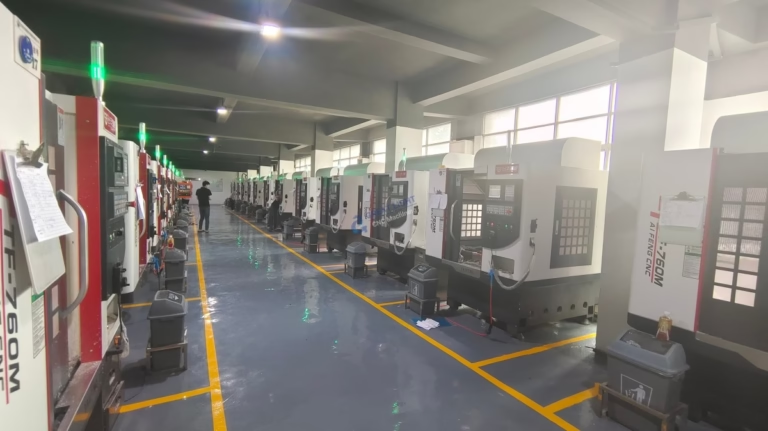
The fourth is silence on capacity. A factory with 12 four-axis mills, 16 five-axis centers and 27 three-axis machines can route work instead of queueing it. A factory that cannot say how many rotary machines it owns is usually brokering the job. Brokers are fine for simple parts, but on a 4 axis part with tight position tolerance you want the shop that owns the spindle.
- 1No setup linePriced like a 3 axis job, will be re-quoted later.
- 2No measurement planTolerance claim without an inspection method.
- 3Loose material controlTemper and mill certificate missing from the quote.
- 4Unknown capacityCannot name its own rotary machine count.
Quote Terms, MOQ and Lead Time to Compare
Compare quotes line by line, not by the bottom number. A usable 4 axis quote shows material grade and temper, stock size, setup and fixture cost, cycle time, finishing, inspection and shipping terms. When one quote is far below the others, it is usually missing a setup, a finish or an inspection step. Those reappear as change orders.
MOQ is where small programs get stuck. Tooling and fixture cost has to be spread over the order, so many shops set a minimum that a prototype run cannot reach. We do not set a minimum order quantity, so a single prototype and a 10,000 part run go through the same quote process. The fixture cost is stated separately, which makes the per-part price at volume easy to read.
Ask what happens between quote and first cut. A fast quote is worth little if it takes two weeks to start. At our plants a quotation with a free DFM analysis comes back within 12 hours, production can start within 24 hours of a released drawing, and parts ship in 3–5 days. Historical late-delivery probability is below 2%, which is a record, not a promise for your date.
Confidentiality belongs in the same conversation. Send drawings over a secure channel, and ask for an NDA before you release CAD if the design is not public. Uploads are held as secure and confidential, and an NDA is available on request. A shop that shrugs at this question is a shop you have not finished vetting.
- 1Line-item quoteMaterial, setup, fixture, cycle, finish, inspection, freight.
- 2No MOQOne prototype to 10,000+ parts on the same route.
- 3Start and ship dates12-hour quote, 24-hour start, 3–5 day shipment.
- 4NDA and secure uploadAgree confidentiality before CAD leaves your system.
7 Steps to Qualify a 4 Axis Shop
Run these in order. Stop at the first step the shop cannot answer in writing.
- 1Send a drawing with the hard features markedMark the angled holes, wrapped contours and the datum you care about. Ask for a DFM note, not just a price. A shop that returns comments on wall thickness and tool reach is reading the part.
- 2Ask for rotary table size and part envelopeGet the table diameter, maximum swing and weight limit. A Ø400 mm table with a 4,000 mm machine travel tells you the shop can take long parts, not just round ones.
- 3Confirm which dimensions hold ±0.005 mmAsk for the specific features and the inspection method. Expect a CMM report for position and a surface roughness check where Ra 0.8–1.6 μm is called out.
- 4Check certifications against your programISO 9001:2015 as the base, IATF 16949:2016 for automotive, ISO 13485:2016 for medical, ISO 27001:2022 for data handling. Request the certificate scope, not just the logo.
- 5Compare quote structure, not the totalDemand separate lines for material, setup, fixture, cycle time, finish and inspection. A missing fixture line on a 4 axis part is a warning.
- 6Pin down MOQ, first article and shippingAsk for the minimum quantity, when the first article arrives, and the shipping term. No minimum order quantity means prototype and production runs can share one quote.
- 7Run a small order before the big onePlace a low-volume order and check the first-article report, surface finish and packaging. If the 3–5 day shipment and the report both land clean, scale up.
Frequently Asked Questions
How many axes do I need for angled holes?
One rotary axis is usually enough. If the holes sit on flat faces around the part or at a fixed angle to the main face, a 4 axis machine can index to each position and drill from one setup.
You need 5 axis only when the hole axis is not reachable by tilting around one line, or when the tool has to enter a cavity at an angle to clear a wall.
Can a 4 axis shop hold ±0.005 mm on a long part?
It depends on the feature and the material. Short, well-supported features on aluminium or stainless can hold that band with light finishing passes and a stable fixture.
Long unsupported sections move with cutting heat and clamping force. Expect the shop to name which dimensions it can hold and which need a second operation or a stress-relief step.
What is the smallest order a factory will take?
It varies by shop. Many tie a minimum to fixture and setup recovery, which pushes prototype runs away.
We take no minimum order quantity. A single prototype and a 10,000+ part run use the same quote form, with fixture cost shown separately so you can see the volume effect.
Which certifications should I ask for?
Start from your own quality system. ISO 9001:2015 is the baseline for any supplier. Automotive and EV work normally needs IATF 16949:2016, medical device work needs ISO 13485:2016.
If you share CAD and drawings, add ISO 27001:2022 for information security, and ask for an NDA before releasing files.
How fast can a 4 axis job start and ship?
Ask for the quote turnaround, the production start and the shipping window as three separate numbers. A fast quote with a slow start does not help.
Our quotation and free DFM analysis come back within 12 hours, production can start within 24 hours, and parts ship in 3–5 days. Confirm both dates in writing before you release the order.
What materials are common for 4 axis parts?
Aluminium 6061-T6 and 7075 are the usual picks for housings and brackets, with 304 and 316L stainless for corrosion resistance and 17-4PH where strength matters.
Titanium TC4 and Inconel appear in aerospace and energy work but cut slowly. Plastics such as POM and PEEK are also machined on rotary setups for small precision parts.
Send the Drawing, Get a Real 4 Axis Quote
Send your CAD and we will return a line-item quote with a free DFM analysis within 12 hours, with fixture cost shown separately and no minimum order quantity.
12-hour quoteNo MOQ100% inspectionNDA on request
More from the shop floor
We publish setup notes, tooling trials and inspection data from the factory floor.











