
How to Qualify a Trusted Chinese 4 Axis CNC Machining Factory
This guide is for engineers and sourcing managers who need a trusted chinese 4 axis cnc machining factory and cannot afford a quality escape. Read it and you will know which documents to ask for, which machine details actually matter, and when a 4-axis shop is the wrong choice.
In this article
- 1
- 2
- 3
- 4
- 5
- 6
- 7
- 8
- 9
Key takeaways
What to compare before you send a PO
Each row is a check you can run without visiting the plant.
| Check | Strong signal | Weak signal |
|---|---|---|
| Machine list | Model, year and rotary table Ø per unit | Only a brand name and a photo |
| Tolerance claim | ±0.005 mm with inspection reports | 'High precision' with no number |
| Certification | ISO 9001, IATF 16949, ISO 13485 | One ISO 9001 copy, no scope page |
| DFM feedback | Written analysis within 12 hours | Quote returned with no comments |
| Lead time | 3–5 day ship window stated in writing | Vague 'as fast as possible' |
| Order size | One piece to 10,000+ pieces | Minimum order of 500 pieces |
| Confidentiality | NDA available on request | Refusal to sign anything |
| Finish work | Anodizing, plating, laser marking in house | Subcontractor, no process control |
Pick the shop that answers in numbers
A trusted chinese 4 axis cnc machining factory shows you machine models, a ±0.005 mm inspection report and a three-part lead time before you commit. If any of those is missing, keep looking.
What a 4 axis cnc machining factory actually does
A four-axis mill adds one rotary axis to the usual X, Y and Z travel. That axis is normally an A-axis that turns the workpiece around the X direction, or a B-axis that turns it around Y. The spindle still approaches from one side, but the part can be indexed to a new face without a human touching the fixture.
That single extra motion changes the economics of a job. A bracket with bores on two opposite faces and a slot on a third face might need three setups on a 3-axis machine. On a 4-axis machine it is one setup, one datum, one operator load. Position error between faces drops because the part never leaves the fixture.
It is not a 5-axis machine. The tool still cannot tilt to reach under a flange or machine a true compound surface in one continuous pass. If your part has deep undercuts, impeller blades or organic contours, you want simultaneous 5-axis work instead.
So the honest boundary is this: a 4 axis cnc machining factory is the right partner for prismatic parts with features on several faces, bores at odd angles indexed in steps, and round work that needs cross holes. It is the wrong partner for freeform surfaces and single-setup undercut geometry.
- 1Good fitHousings, manifolds, flanges, brackets, shafts with cross holes, valve bodies.
- 2Poor fitImpellers, turbine blades, deep undercuts, sculpted cosmetic surfaces.
- 3Typical gainTwo or three setups collapse into one, so datum stack-up shrinks.
Machine list, spindle condition and rotary table size
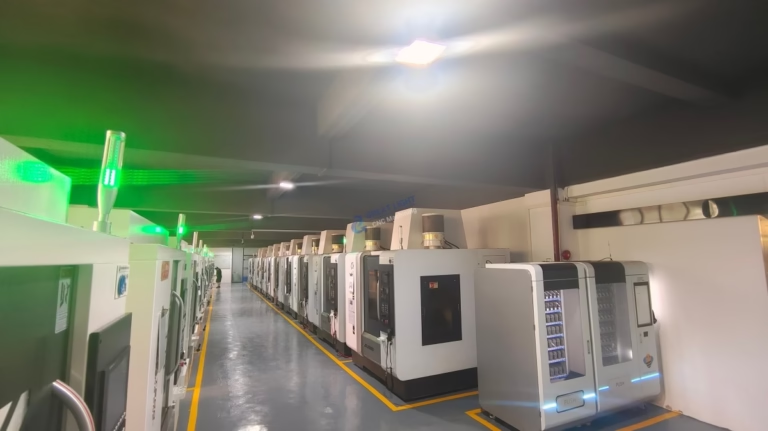
Every factory page says 'advanced equipment'. Ask for the asset register instead: make, model, year of purchase, spindle running hours and the diameter of each rotary table. A 12-machine 4-axis department with Ø400 mm tables tells you the size of part the shop handles every day.
Travel limits matter as much as axis count. A shop running 500 × 500 × 450 mm and 600 × 600 × 600 mm machines cannot take a 1,200 mm weldment no matter how good the quote looks. GreatLight runs 12 four-axis mills inside a 127-machine shop, with travel envelopes from 500 × 310 × 200 mm up to 4,000 × 400 × 150 mm.
Spindle hours are the quiet risk. A machine with 40,000 hours on the spindle will still cut aluminium, but thermal growth and bearing noise start to show in tight bores. Ask how often geometry is calibrated and whether the shop keeps a calibration log per machine.
Tool changer capacity also shapes your quote. A 24-pocket magazine handles a family of parts in one program. A 12-pocket magazine forces tool swaps mid-cycle, and that shows up as extra minutes on every part in the run.
- 1Ask forModel year, spindle hours, rotary table Ø, travel envelope, calibration log.
- 2Red flagMachine count quoted but no model names or table sizes.
Tolerance, inspection and what the report should contain
±0.005 mm is a claim you can test. Send a drawing with a tight bore, an angular position and a flatness callout, and ask for the inspection report from a similar past job. The report should show measured values, not just pass or fail stamps.
A serious shop inspects 100% of parts before shipment and splits the work into three stages: raw material check, in-process monitoring, and final inspection. That structure catches a drifting offset before the whole batch is finished, not after it is packed.
Surface finish is often where the argument starts. Ra 1.6–3.2 μm is a normal as-machined result. Ra 0.8–1.6 μm needs a controlled finishing pass and sharp tooling. Ra 0.2–0.8 μm needs a different process step, not just a slower feed.
When you write the PO, put the finish and tolerance numbers on the drawing and repeat them in the purchase order. If a supplier quotes a price without asking which surfaces are critical, they are pricing a shape, not a part.
- 1Inspection stagesIncoming material, in-process checks, final inspection before packing.
- 2ReportsAvailable on request, with measured values per critical dimension.
- 3Finish bandsAs-machined Ra 1.6–3.2 μm; fine Ra 0.2–0.8 μm.
Certifications, material traceability and finishing control
Certificates are only useful if the scope names the site that will run your job. ISO 9001:2015 covers general quality management. IATF 16949:2016 is what automotive and EV buyers look for. ISO 13485:2016 is the one that matters for medical device work. ISO 27001:2022 covers information security, which is worth checking when you send CAD files across borders.
Material traceability is the next question. Ask whether the shop buys from distributors with mill certificates and whether those certificates are filed against your job number. Aluminium 6061, 7075 and 6082 behave differently after anodizing, and stainless 316L and 17-4PH need different tooling and speeds. A shop that tracks heat numbers can explain a colour shift or a hardness problem later.
Finishing is where many suppliers quietly hand work to a third party. Anodizing, electroless nickel, zinc plating, powder coating, laser marking and bead blasting all change dimensions slightly or leave marks. If the finisher is a subcontractor, ask who inspects the parts after they return.
Laser marking has a hard limit worth noting: minimum character height is 1.5 mm. If your part number needs to be smaller than that, plan for a different marking method early in the design.
- 1Check the scope pageThe certificate must name the plant, not just the trading company.
- 2Ask for heat numbersTie mill certificates to your job so a material question can be answered.
- 3Finishing handoffKnow who inspects parts after plating or anodizing.
Quote format, MOQ and lead time in writing
A quote you can compare has line items: material grade, blank size, machining time, finish, inspection and packaging. When two suppliers return a single number with no breakdown, you cannot tell whether the difference sits in material, cycle time or margin.
Ask about MOQ directly. A prototype-friendly shop will quote one piece and a 10,000+ piece run from the same drawing. If the first answer is '500 pieces minimum', the shop is set up for volume and your prototype will be treated as an interruption.
Lead time claims should be split into three clocks: quotation and DFM analysis, production start, and shipping window. GreatLight returns a quote and free DFM analysis within 12 hours, can start production within 24 hours, and ships parts in 3–5 days. Historical late-delivery probability sits below 2%.
NDA terms belong in the same conversation. Uploads should be treated as confidential, and a signed NDA should be available on request before you send full CAD. If a supplier hesitates on an NDA for a production program, treat it as a signal about how they handle drawings in general.
- 1Quote anatomyMaterial, blank size, cycle time, finish, inspection, packaging, freight terms.
- 2Three clocksQuote and DFM, production start, ship window. Get all three in writing.
- 3ConfidentialityNDA on request; secure uploads for CAD and drawings.
When a Chinese 4-axis supplier is the wrong choice
There are jobs where geography is not the problem and the process is. If your part needs simultaneous 5-axis motion, a 4-axis quote will come back with a note about extra setups or a request to relax a callout. That is not a negotiation, it is a process limit.
Very large parts are another boundary. Many shops advertise 4-axis capability but their rotary tables and travels top out well below 1 m. Check the envelope against your blank size before you discuss price. A 4,000 mm machine and a 500 mm machine are not interchangeable.
Exotic materials change the risk profile. Inconel and titanium TA1, TA2 and TC4 cut slowly, work-harden quickly and wear tooling fast. Ask for a past job in the same alloy and the cycle time it took. If the shop cannot show one, budget for a learning curve on your dime.
Finally, a shop with no DFM feedback loop will machine exactly what you drew, including the mistake. The written analysis you get back before production is often the most valuable deliverable in the whole order.
- 1Wrong processFreeform surfaces, deep undercuts, single-setup compound geometry.
- 2Wrong sizeBlank larger than the stated travel and rotary table envelope.
- 3Wrong alloy fitNo reference job in Inconel, titanium or magnesium AZ31B / AZ91D.
7 steps to qualify a 4-axis supplier
Run these in order. Each step can end the conversation early and save you a bad batch.
- 1Send one drawing and ask for DFM commentsPick a real part with one tight bore and one angular callout. A useful reply arrives within 12 hours and names specific features, not generic praise.
- 2Request the machine list with model and yearAsk for rotary table diameter and travel envelope for each 4-axis unit. Cross-check the largest envelope against your blank size before going further.
- 3Ask for a sample inspection reportLook for measured values, the instrument used, and the date. A report with only pass or fail stamps is not a report.
- 4Confirm certificate scope and siteCheck that ISO 9001:2015, IATF 16949:2016 or ISO 13485:2016 names the plant that will run the job, not a parent company.
- 5Pin down lead time in three partsGet quote and DFM time, production start time, and ship window written into the PO or the email thread you will rely on.
- 6Agree the quote formatAsk for line items covering material grade, blank size, machining, finish, inspection and packaging so two suppliers can be compared fairly.
- 7Sign the NDA before releasing full CADSend a simplified model for the first quote, then release the full data set once confidentiality terms are signed.
Questions buyers ask before the first PO
How do I know a factory really has 4-axis capability and not just a 3-axis mill with a label?
Ask for the machine model and the rotary table diameter. A real 4-axis machine has a driven rotary table, a fourth-axis drive in the control, and post-processed CAM output for that axis.
Then send a part with features on three faces. A 3-axis shop will quote extra setups or ask you to relax an angular tolerance.
What tolerance should I expect from a four-axis mill?
On prismatic aluminium and stainless parts, ±0.005 mm is achievable on critical features when the machine is calibrated and the fixture is rigid.
Loose features should stay at standard tolerance so the shop spends its time where it matters. Put the tight callouts on the drawing and leave the rest open.
Is there a minimum order quantity for a prototype?
Not at every shop. GreatLight quotes from one prototype to 10,000+ part runs, so a single piece and a production batch go through the same engineering review.
If a supplier insists on a high minimum, that shop is optimized for volume and your prototype may sit in a queue.
Which certifications actually matter for my program?
ISO 9001:2015 for general quality management, IATF 16949:2016 for automotive and EV work, ISO 13485:2016 for medical devices, and ISO 27001:2022 for information security.
Check the scope page. A certificate held by a trading office does not cover the plant running your parts.
How fast can parts ship after the drawing is approved?
At GreatLight, quotation and free DFM analysis come back within 12 hours, production can start within 24 hours, and parts ship in 3–5 days.
Historical late-delivery probability is below 2%. Treat any 'same day' promise from an unaudited shop as unverified until you see the machine schedule.
Can you handle finishing and marking in the same order?
Yes. Anodizing, electroless nickel, zinc, silver and gold plating, powder coating, black oxide, bead blasting, tumbling, brushing, polishing, laser marking and engraving are all quoted as part of the job.
Note the marking limit: minimum character height is 1.5 mm. Plan smaller part numbers around that.
Send one drawing and test the response
We return a quotation and free DFM analysis within 12 hours, then start production within 24 hours once the drawing is locked.
12-hour quote100% inspectionNo MOQNDA on request
More machining notes from GreatLight
We publish setup notes, tooling trials and inspection data from the factory floor.











