
Trusted CNC Machined Part Factory China: What to Check Before You Order
This guide is for engineers and sourcing staff who need a trusted CNC machined part factory in China and cannot visit the floor. It lists the checks that separate a real partner from a trading desk: certificates tied to your industry, machine mix, tolerance and inspection data, quote completeness, and MOQ. Read it before you send an RFQ.
In this article
- 1
- 2
- 3
- 4
- 5
- 6
- 7
Five checks that decide the order
Checklist for a trusted CNC machined part factory China
Use this table to score two or three suppliers before you release a purchase order.
| Check | What to ask for | Weak signal |
|---|---|---|
| Certifications | Certificate numbers, scope, expiry date | One generic ISO 9001 PDF |
| Machine fleet | Count by axis type, travel sizes | Only photos, no model list |
| Tolerance | Capability statement plus sample report | 'We hold ±0.005 mm' with no data |
| Inspection | Raw, in-process, final, report on request | Final check only |
| Lead time | Quote in 12 h, ship in 3–5 days | Vague 'depends on quantity' |
| MOQ | Prototype to 10,000+ runs | Forced 1,000-piece opening order |
| Confidentiality | Secure upload, NDA on request | Email-only file transfer |
Pick the factory you can audit, not the one with the lowest quote
If certificates match your market, the machine envelope fits your part, and the inspection chain produces reports you can read, the supplier is worth a first batch. Price differences between two real factories are usually smaller than the cost of one failed launch.
Trusted CNC machined part factory China: what the certificates really cover
A certificate is a scope document, not a badge. ISO 9001:2015 tells you the factory has a documented quality system covering order review, material traceability, and corrective action. It does not tell you the shop can hold a 0.02 mm position on a 400 mm aluminum housing. That gap is where most first orders go wrong.
Match the certificate to your end market. Medical device parts need ISO 13485:2016 because the standard covers process validation and device history records. Automotive and EV parts need IATF 16949:2016, which adds APQP, PPAP, and traceability expectations. If your design files carry real IP value, ISO 27001:2022 shows the factory manages information security, not just metal.
Ask for the certificate number, the certification body, and the scope statement. Then ask one operational question: who signs the final inspection record? If the answer is a name and a role, the system is live. If the answer is 'the quality department', keep asking.
GreatLight holds ISO 9001:2015, IATF 16949:2016, ISO 13485:2016, and ISO 27001:2022 across its Dongguan and Singapore operations. That mix covers industrial, medical, automotive, and IP-sensitive programs from one supplier.
Machine fleet and travel sizes tell you what the factory can actually cut
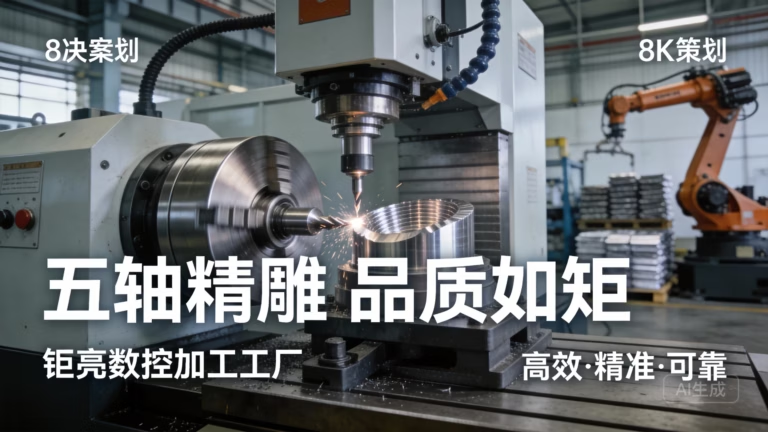
The equipment list is the fastest way to see whether a factory fits your part. A shop with only 3-axis mills will quote your part anyway, then fixture it three times and lose accuracy at every setup. A shop with simultaneous 5-axis centers can cut compound angles and deep pockets in one setup, which is where the tolerance holds.
Ask for machine count by type and the travel envelope. GreatLight runs 127 high-precision CNC machines: 16 simultaneous 5-axis machining centers, 12 four-axis mills, 27 three-axis machines, and 16 mill-turn centers. The largest travel is 4,000 × 400 × 150 mm, with a maximum processing size of 4,000 mm. Medium frames run 750 × 1,150 × 550 mm and 600 × 600 × 600 mm, and compact cells run 500 × 500 × 450 mm and 500 × 310 × 200 mm, plus a Ø400 mm rotary table.
Match the envelope to your part before you talk price. A 900 mm gearbox housing needs a machine that takes the whole part in one setup. A 40 mm medical fitting does not, and paying for a large-frame machine on a small part only adds cycle time.
Mill-turn matters more than buyers expect. Parts with a turned OD, a milled flat, and cross-drilled holes can finish on one mill-turn center instead of two operations. Fewer setups means fewer datum shifts and a shorter inspection queue.
- 1One setup beats three5-axis and mill-turn reduce datum stack-up on complex geometry.
- 2Check the envelopeConfirm travel covers your part plus fixture, not just the part.
- 3Small parts still need the right spindleHigh spindle speed matters more than table size below Ø50 mm.
Tolerance, finish, and the inspection chain behind them
Every factory advertises tight numbers. The useful question is which numbers apply to which feature. General tolerance across a 4,000 mm frame is not the same as a bored bearing seat. Ask the factory to state tolerance per critical feature, then ask how they measure it.
GreatLight quotes ±0.005 mm (±0.0002 in) for critical features, with surface finish options of Ra 0.2–0.8 μm for fine work, Ra 0.8–1.6 μm for high-finish mating surfaces, and Ra 1.6–3.2 μm as-machined. Those bands map to real processes: fine finish usually needs a finishing pass with light depth of cut, not just a slower feed on the roughing tool.
The inspection chain is the part buyers skip. A trustworthy factory checks raw material on arrival, monitors dimensions in process, and runs 100% inspection before shipment, with reports on request. A 99.99% qualification rate is only meaningful if that chain exists. Ask for a sample inspection report from a similar part and read the feature list.
One more question worth asking: what happens to a part that fails final inspection? A written rework and concession process is a sign the system is used, not written for the audit.
Quote speed, MOQ, and lead time as buying signals
A slow quote usually means a slow factory. GreatLight returns a quotation and free DFM analysis within 12 hours, and production can start within 24 hours after approval. That speed comes from engineers reviewing the model at quote stage, not sales staff forwarding a spreadsheet.
MOQ is where R&D programs get stuck. Many factories in China will not open a job below a few hundred pieces, which kills prototype iterations. No minimum order quantity, from one prototype to 10,000+ part runs, means you can validate the design at low volume and scale the same process later without requalifying a new supplier.
Lead time should come with a number, not a feeling. Parts ship in 3–5 days on standard jobs, and the historical late-delivery probability is below 2%. Ask how the factory tracks jobs against that number. A shop that can name its on-time metric is usually a shop that measures it.
Confidentiality is a commercial term too. Uploads should be secure and confidential, and an NDA should be available on request. If a factory hesitates on an NDA before you share drawings, treat that as a data point.
How to vet a supplier in six steps
- 1Screen on certificates firstAsk for certificate number, body, scope, and expiry. Reject suppliers whose certificates do not cover your end market: ISO 13485:2016 for medical, IATF 16949:2016 for automotive.
- 2Request the machine listGet counts by axis type and travel sizes. Confirm your part plus fixture fits the envelope, and check whether mill-turn can finish the part in one setup.
- 3Send one real part for a DFM readAttach a STEP file and a drawing with critical features marked. A useful DFM response names specific changes: wall thickness, tool reach, datum choice, or tolerance that cannot hold.
- 4Compare quotes line by lineCheck whether material grade, finish, inspection, and packaging are itemized. A quote missing the finish line is not cheaper, it is incomplete.
- 5Order a small first batchStart with one to ten pieces. Measure the features you flagged, request the inspection report, and compare against the drawing before you release volume.
- 6Score the response, not the pitchTrack quote turnaround, DFM quality, and answer speed. Suppliers who answer with data on the first pass usually hold that standard in production.
Questions buyers ask before the first order
How do I check a factory's certifications are valid?
Ask for the certificate number, the issuing body, and the scope statement, then verify the number on the body's public register. Check the expiry date and whether the scope covers the processes you need, such as machining rather than trading.
A current certificate with a narrow scope is more useful than an expired one with a broad claim. GreatLight holds ISO 9001:2015, IATF 16949:2016, ISO 13485:2016, and ISO 27001:2022.
What tolerance can a China CNC factory realistically hold?
On critical features with the right machine and a stable setup, ±0.005 mm (±0.0002 in) is achievable. The number depends on feature geometry, material, and how many setups the part needs.
General tolerances across a large part are looser. Ask the supplier to confirm tolerance per critical feature and to show an inspection report from a comparable part.
Is there a minimum order quantity for prototypes?
It depends on the factory. Some set an opening order in the hundreds of pieces, which blocks iteration. Others accept no minimum order quantity.
GreatLight machines from one prototype to 10,000+ part runs, so you can validate a design before committing to volume.
How fast can parts ship after I approve the quote?
GreatLight returns a quotation and free DFM analysis within 12 hours, and production can start within 24 hours. Standard jobs ship in 3–5 days.
Timing depends on material availability and finishing. Anodizing, plating, and powder coating add process steps, so confirm the finish route at quote stage rather than after machining.
What should I include in the RFQ to get a usable quote?
Send a STEP file, a 2D drawing with critical dimensions and tolerances marked, material grade, surface finish, quantity, and any inspection or documentation requirements.
Mark the datum scheme and the features that mate with other parts. Those are the features the supplier should quote and inspect closely.
How is my design protected if I share files?
Ask for a signed NDA before you upload drawings, and confirm the file transfer channel is secure. GreatLight works under NDA on request and treats uploads as confidential.
ISO 27001:2022 certification is a useful signal that information security is managed as a system rather than a promise.
Send one part and judge the response
Upload a STEP file and drawing for a quotation and free DFM analysis within 12 hours. Our engineers flag what will not hold before you pay for a setup.
12-hour quote100% inspectionNDA on request
More from the shop floor
We publish setup notes, tooling trials and inspection data from the factory floor.











