GreatLight CNC Machining Factory logo
CNC Machining
Rapid Prototyping
Materials
Industries
News
About GL

Get Instant Quote

Gearbox Fundamentals

What Are Planetary Gears?

A planetary gear set puts a sun gear, three or more planet gears and an internal ring gear on one axis. Load splits across the planets, so the same ratio fits in a much shorter housing. The carriers, pins and ring blanks that hold that stack together come off our machines.

±0.005 mm toleranceRa 0.8–1.6 μm gear faces3 plantsISO 9001:2015From one prototype up
CNC Lathe Technical Specifications Terminology
16Simultaneous 5-axis centers
127High-precision CNC machines
±0.005 mmAchievable tolerance
3–5 daysTypical part shipping
Failure Modes

Where Planetary Sets Go Wrong

Most planetary failures trace back to one of these four. Each one costs a rebuild.

01

Uneven load across the planets

If the carrier pin bores are not on a true pitch circle, one planet takes most of the torque. That planet wears first and the set starts to whine under load. Position error on the carrier, not gear tooth quality, is usually the root cause.

02

Planet pin fit drifts out of spec

A pin that is 0.01 mm undersized lets the planet tilt. Tilt cuts the contact area on the tooth flank and raises local stress. The flank pits, then spalls.

03

Ring gear bore is out of round

An out-of-round ring forces the planets into a moving mesh clearance. Backlash changes with rotation angle, so the gearbox sounds different at different speeds. Buying a ground ring blank does not fix a housing that clamps it oval.

04

Carrier flexes under peak torque

A thin carrier plate bends between the pins. Planet alignment shifts and the sun gear sees edge loading. This shows up in EV traction motors during hard launches, not on a bench at constant load.

Our Approach

How We Machine Planetary Gear Components

One setup strategy per part family, checked against the ratio it has to hold.

CNC Machining Services Online
Carriers

Carrier Pin Bores in One Setup

The carrier is the part that sets planet spacing. Bore position tolerance drives how evenly the planets share load, so we keep all pin bores in one 5-axis setup instead of repositioning between holes. Position error stays inside ±0.005 mm on a 200 mm carrier.

For high-ratio sets we check the pitch circle against a CMM report before the part leaves the floor. The report lists each bore's radial position, not just hole diameter. That is the number that matters when the set is assembled.

  • 1
    One setupAll pin bores machined without re-fixturing
  • 2
    CMM reportRadial position of each bore listed
  • 3
    Materials7075, 4140, 17-4PH, Ti-6Al-4V

Get Instant Quote

6011
Pins and Ring Blanks

Pins, Sun Shafts and Ring Blanks

Planet pins are turned and ground to a diameter tolerance that keeps the planet bearing preload steady. A pin held to ±0.005 mm on diameter and 0.005 mm on straightness keeps the planet from tilting under torque. Both ends get a chamfer so the bearing slides on without shaving material.

Internal ring gears start as a machined blank. We hold the bore round within 0.01 mm and keep wall thickness even, because an uneven wall distorts when the housing clamps it. Gear cutting and grinding are done after the blank is stress-relieved, so the roundness holds through heat treat.

  • 1
    Diameter control±0.005 mm on planet pin OD
  • 2
    Roundness0.01 mm on ring gear bores
  • 3
    FinishesRa 0.2–0.8 μm on bearing journals

Talk to an Engineer

Selection Guide

Which Layout Fits the Job

Ratio and duty cycle decide the layout before any drawing is cut.

LayoutTypical ratio per stageBest forWatch out for
Single stage, 3 planets3:1 to 8:1Compact servo reducersLower torque capacity per planet
Single stage, 4–5 planets3:1 to 6:1High-torque EV drivesCarrier must stay stiff between pins
Two stages compounded8:1 to 40:1Robot joints, winchesStack-up error adds across stages
Ring fixed, carrier output3:1 to 10:1Wheel hub drivesRing bore roundness is critical
Sun fixed, ring output2:1 to 6:1Backdriven actuatorsHigher bearing loads on carrier
Capabilities

What We Machine for Gearbox Builders

01

5-Axis CNC Machining

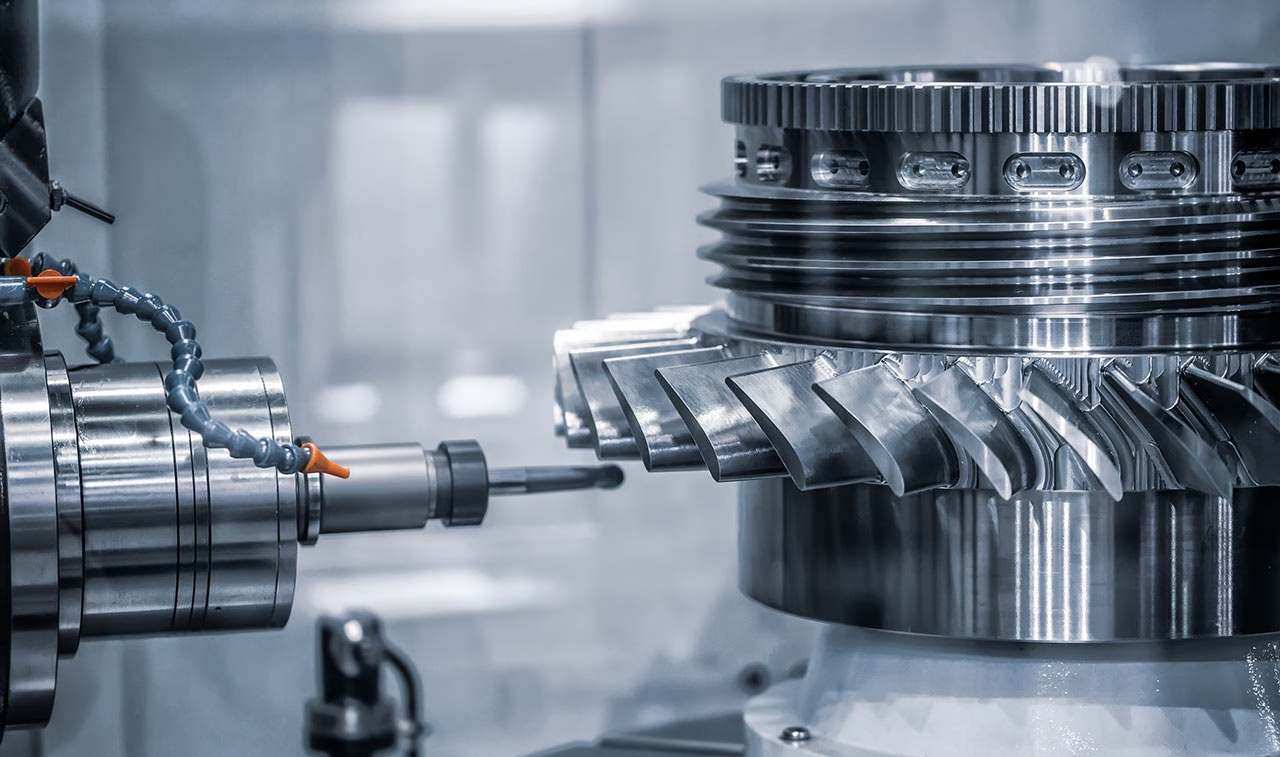
Carrier plates, housings and covers with angled bores cut in one setup. 16 simultaneous 5-axis centers, up to 4,000 mm travel.

02

CNC Turning

Sun shafts, planet pins and ring blanks turned to ±0.005 mm with Ra 0.2–0.8 μm on bearing surfaces.

03

CNC Milling

Flat carriers, mounting flanges and internal gear pockets. 27 three-axis machines handle the simpler profiles at volume.

04

Rapid Prototyping

One-off carriers and housings for fit checks before tooling. Quotation and DFM analysis inside 12 hours.

05

Surface Finishing

Hardcoat anodizing for aluminium carriers, electroless nickel for steel pins, bead blasting for cosmetic covers.

06

Die Casting and Vacuum Casting

Housings and covers where the load path does not need a machined billet. Machined interfaces stay on the CNC side.

Process Range

Machining Scope at a Glance

ItemRangeNotes
Maximum part size4,000 mmLarger carriers split into bolted assemblies
Achievable tolerance±0.005 mm±0.0002 in, verified on CMM
Gear face finishRa 0.8–1.6 μmRa 0.2–0.8 μm on journals
MaterialsAluminium, steel, stainless, titanium, copper, plastics6061, 4140, 17-4PH, Ti-6Al-4V, PEEK
Batch sizeOne prototype to 10,000+ partsNo minimum order quantity
Inspection100% before shipmentReports on request
Why GreatLight

Built for Gearbox Tolerances

15Y

15 Years in Precision Machining

Founded in 2011, operating three wholly-owned plants across 7,600 m² in Dongguan and Singapore.

127

127 High-Precision CNC Machines

16 simultaneous 5-axis centers, 12 four-axis mills, 27 three-axis machines and 16 mill-turn centers.

±0.005

Tolerance Held in Production

The same tolerance on the first part and the thousandth, checked with in-process monitoring.

99.99%

Qualification Rate

Raw material check, in-process monitoring and final inspection on every run.

12H

Quote and DFM in 12 Hours

A free design-for-manufacturing review comes back with the quotation. Production can start within 24 hours.

1–10K+

From One Part to Volume

Prototype carriers and full gearbox housing runs on the same process flow.

7,600 m²Manufacturing space
150Technicians
4Quality certifications
<2%Historical late-delivery rate
Industry Requirements

What Each Sector Demands, What We Deliver

Forge ahead with determination and create the future together.

Automotive and EV

Traction motor carriers need stiff pin plates that survive launch torque without flexing.

  • ±0.005 mm bores
  • IATF 16949:2016
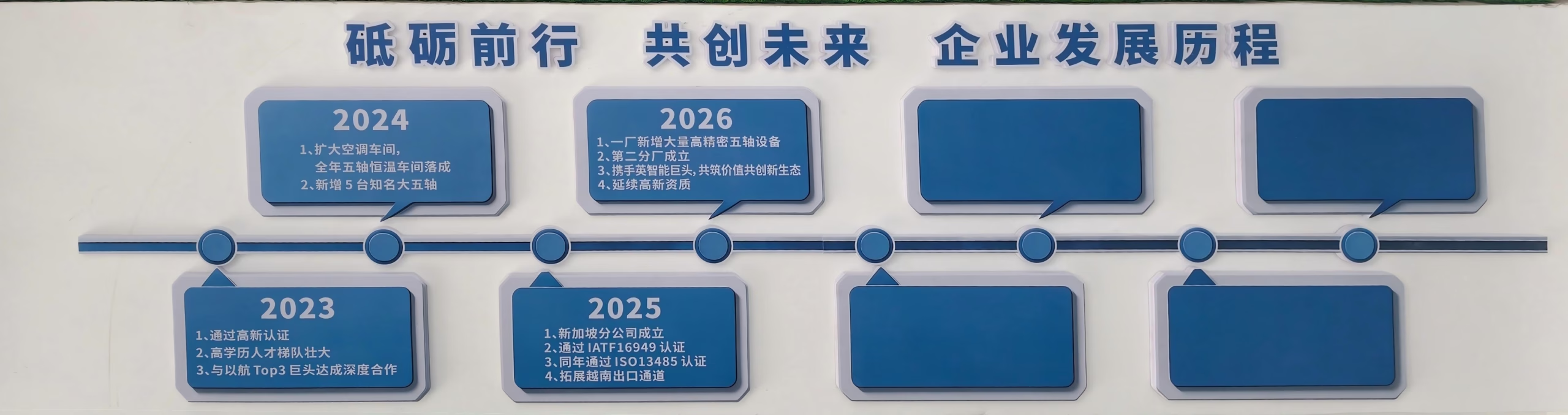
GreatLight Metal new factory building

Robotics and Automation

Two-stage reducers in robot joints live or die on backlash repeatability across a million cycles.

  • 0.01 mm ring roundness
  • Ra 0.2–0.8 μm
Leader in Cnc Machining Service China

Aerospace

Actuator gear sets trade weight for stiffness, so titanium and 7075 carriers get thin walls.

  • Ti-6Al-4V
  • 100% inspection
CNC Machining Services Comparison 2026 Fictiv vs Xometry vs GreatLight

Industrial Machinery

Winch and indexer gearboxes run hot and dirty, so housings must hold bore alignment after heat cycles.

  • 4,000 mm travel
  • ISO 9001:2015
FAQs

Planetary Gear Questions Engineers Ask

What is the difference between a planetary gear set and a standard gear train?

A standard train places gears on separate parallel shafts. A planetary set puts the sun, planets and ring on one axis, so input and output share a centerline and the housing gets shorter.

The tradeoff is the carrier. Every planet position depends on that one part, so carrier tolerance matters more than it does in a parallel-shaft box.

How is the gear ratio calculated for a planetary set?

With the ring held fixed, the ratio is 1 plus ring teeth divided by sun teeth. A 60-tooth ring with a 20-tooth sun gives 4:1.

Change which member is fixed and the same hardware gives a different ratio. That is why the fixed member is called out on the drawing, not just the tooth counts.

How many planets should a set use?

Three planets is the usual starting point. It balances load, leaves room for a stiff carrier and keeps the assembly simple.

Four planets share load further and suit high-torque EV drives, but the carrier has less material between pins. Five or more only pays off when the ring is large enough to keep pin spacing practical.

When should a carrier be machined instead of cast?

Choose machined when pin bore position has to hold inside 0.02 mm, when wall sections are thin, or when the run is under a few thousand parts.

A casting makes sense for larger housings where the load path is less sensitive and tooling cost spreads over volume. We machine both, so the recommendation follows the tolerance, not the process we prefer.

What surface finish do planet pins need?

Bearing journals want Ra 0.2–0.8 μm. Rougher surfaces wear the bearing race and change preload over time.

The pin body between the journals does not need that finish. Spending the cycle time only where the bearing sits keeps cost down.

Can you machine internal ring gears?

We machine the ring blank and hold the bore round within 0.01 mm. Gear cutting and grinding follow stress relief so roundness survives heat treat.

If the ring is a purchased, already-cut part, we machine the housing to match its actual bore, measured rather than nominal.

What do you need to quote a planetary gear component?

A 2D drawing with tolerances, the material, and the quantity. For carriers, mark which bore is the datum. For pins, state the bearing fit class.

If the drawing is incomplete, the DFM review flags it. Quotation and that review come back within 12 hours.

Do you sign NDAs for gearbox designs?

Yes. Uploads stay confidential and an NDA is available on request before you send drawings.

Gearbox geometry is the kind of IP that competitors would like to see, so we treat drawings and CAD files as confidential by default.

Send the Drawing, Get a Real Tolerance Answer

Carriers, pins, sun shafts and ring blanks quoted with a free DFM review inside 12 hours. One prototype or ten thousand parts, same process control.

12-hour quote100% inspectionNo minimum order quantity

Trusted by engineers and manufacturers worldwide

Tesla Ford Motor Company BYD Auto Denso Magna International Boeing Airbus Medtronic KUKA FANUC