
Application Fields of CNC Vertical Machining Center: What Fits and What Does Not
A vertical machining center cuts prismatic parts with a spindle that points down and a table that moves in X and Y. That geometry decides where the machine wins and where it fights you. This page walks through seven application fields of CNC vertical machining work, the part features that make each one a good fit, and the cases where a different machine is the cheaper answer.
In this article
- 1
- 2
- 3
- 4
- 5
- 6
Application Fields of CNC Vertical Work: Seven Areas
Why the Vertical Spindle Decides the Application Fields
A vertical machining center holds the tool in a spindle that rotates on a vertical axis. The table moves in X and Y, the spindle head moves in Z. The workpiece sits flat on the table, so gravity holds it against the fixture and an operator can see the cutting zone from above. That single arrangement is the reason the application fields of CNC vertical machining stay so wide.
Most machined parts in production today are prismatic. Housings, brackets, plates, manifolds, covers. Their critical features are pockets, slots, drilled holes and tapped threads that open toward one face. A vertical machine reaches those features with short, stiff tools. Short tools deflect less, so you can hold ±0.005 mm on a bore without a second operation.
The trade-off is depth. When a pocket is deeper than about three times the cutter diameter, the tool has to hang out of the holder and the cutting edge starts to sing. On a vertical machine there is no way to tilt the part away from the tool unless you add a fourth or fifth axis. That is the boundary where the application list narrows.
Part weight matters too. A vertical table carries the workpiece on top, and every kilogram on the table has to be accelerated in X and Y. Heavy castings slow the rapid moves and can force you to derate the feed. For parts above roughly 500 kg, a horizontal machine with a tombstone fixture usually pays back faster.
Field 1–3: Automotive, Aerospace and Medical Parts
Automotive and EV work is the largest single block on our floor. Engine brackets, motor housings, battery tray inserts, sensor bodies, transmission covers. These are aluminium and ductile iron parts with flat mounting faces and a handful of tight bores. A three-axis VMC with a Ø400 mm rotary table runs the first face, indexes 90 degrees, and finishes the side holes in one cycle. Typical volume is 500 to 10,000 pieces a year.
Aerospace parts are lower volume and harder to cut. Titanium TA1, TA2 and TC4 (Ti-6Al-4V) brackets, Inconel fittings, aluminium 7075 structural ribs. The material removes slowly, so tool life and heat control matter more than raw spindle speed. A vertical machine handles thin ribs well because the tool load stays axial, but you need sharp, coated carbide and a rigid holder. Our tolerance ceiling of ±0.005 mm is what these parts are quoted against.
Medical devices push surface finish and cleanliness. Surgical instrument bodies, implant housings, bone plate prototypes in 316L and 17-4PH stainless. A vertical machine can hold Ra 0.8–1.6 μm on a milled pocket, and Ra 0.2–0.8 μm with a finishing pass at low feed. Small features are the real constraint. A slot 0.8 mm wide needs a 0.6 mm cutter, which breaks if the setup has any runout.
All three fields share one habit: they buy from shops that hold ISO 9001:2015, IATF 16949:2016 or ISO 13485:2016. The certificate is not a marketing badge. It is a filter that says the shop tracks material lots and keeps inspection records you can hand to an auditor.
- 1AutomotiveFlat faces, bores and tapped holes; 500–10,000 pieces a year.
- 2AerospaceTitanium and 7075 ribs; slow speeds, tight tool life control.
- 3Medical316L and 17-4PH bodies; finish and small-feature accuracy dominate.
Field 4–5: Robotics, Automation and Electronics Hardware
Robotics and automation parts are usually one-offs or small batches, and they change often. End effector plates, gearbox housings, linear stage bases, gripper jaws. The value of a vertical machine here is setup speed. You clamp a 6061 plate on a vise, touch off the corner, and run. No tombstone, no pallet, no long changeover. When a design revision arrives on Tuesday, the new program runs on Wednesday.
Electronics hardware is smaller but equally flat in nature. Heat sinks, RF cavity blocks, connector shells, test fixture nests. Copper C101 and C110 cut easily and conduct heat away from the edge, so finish is good. Aluminium 6061 and 6082 dominate the chassis work. The tricky parts are thin walls. A 1.2 mm wall on a 100 mm long heat sink fin will deflect under tool pressure unless you take light radial passes and support the fin with the fixture.
Both fields lean on the same tolerance band. A gripper jaw that is 0.02 mm off will not repeat, and a heat sink that is not flat will not seat. On a well-set-up VMC, flatness of 0.01 mm over 100 mm is routine. That is achieved by roughing, letting the part cool, then finishing, not by a single aggressive pass.
We run these jobs on three-axis machines with quick-change vises and on four-axis mills when a part has features on four sides. Twenty-seven three-axis machines and twelve four-axis mills are dedicated to this class of work, which keeps small-batch queue times short.
Field 6–7: Industrial Machinery and New Energy
Industrial machinery covers the widest size range. Pump housings, valve bodies, machine frames, die plates, conveyor brackets. Some of these parts are 1,500 mm long and need a machine with 4,000 mm of X travel. Others are small manifolds with a dozen cross-drilled passages. The application fits a VMC because most of the cutting happens on one or two faces and the part can be relocated without losing datum.
New energy parts are a newer but fast-growing block. Battery module end plates, busbar supports, cooling plate manifolds, inverter housings. Aluminium 6061-T6 and ADC12 die castings are common. Castings bring their own problem: a skin of hard, abrasive material on the outside and porosity underneath. If the first pass cuts through the skin in one go, the insert chips. We take a 0.3 mm skinning pass, then a heavier cut underneath.
Many new energy parts are also large and thin. A 600 mm cooling plate that warps 0.5 mm after machining will leak at the seal. The fix is stress relief before the finish cut, plus symmetric material removal so the part does not bend toward the last cut. Both are process decisions, not machine decisions.
Across these fields the same question returns. Is the part mostly flat with features on one or two faces? If yes, a vertical machining center is the cheapest route to a finished part. If the features wrap around the part or the cavity is deep, the answer changes.
Which Work Goes on a Vertical Machining Center
Match the part to the machine before you request a quote.
| Part feature | Vertical VMC | Better alternative |
|---|---|---|
| Flat plates and housings | Ideal, one or two setups | — |
| Holes and pockets from one face | Ideal, short rigid tools | — |
| Deep cavity over 3× diameter | Chatter risk, slow feeds | 5-axis with tilted part |
| Features on five sides | Needs extra setups | 5-axis machining center |
| Turned shaft with milled flats | Two machines or a fixture | Mill-turn center |
| Part longer than 4,000 mm | Out of travel | Large gantry mill |
| Part heavier than about 500 kg | Table load and feed derate | Horizontal machining center |
| Thin-wall extrusion, 1.2 mm wall | Workable with light passes | — |
The Short Version
If most of your features open toward one face and the part fits inside the machine travel, a vertical machining center is the cheapest and fastest route. If the cavity is deeper than three times the cutter diameter, or the part needs work on five sides, book a 5-axis machine instead and skip the extra setups.
Questions Engineers Ask
What tolerance can a vertical machining center realistically hold?
On our machines we quote ±0.005 mm (±0.0002 in) on critical features. That figure assumes a rigid setup, a sharp tool and a finishing pass with light radial engagement.
If a part needs ±0.002 mm, that is a grinding or jig-boring operation, not milling. We will tell you that before you order.
Which materials are a poor fit for a vertical machine?
Nothing is off the list, but ductile materials with long chips slow the cycle. Inconel, titanium TC4 and 17-4PH in the hardened state cut at low surface speed and generate heat that goes into the tool.
Soft and gummy plastics such as PP and HDPE are harder than they look. They melt, smear and grab the cutter. Sharp, polished flutes and high feed rates are required.
Can a vertical machining center replace a lathe for round parts?
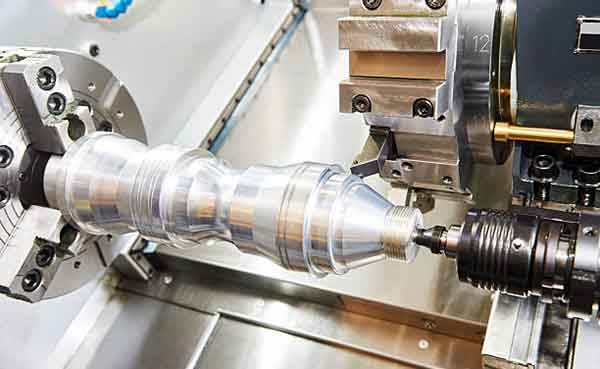
No. A vertical machine can mill flats on a turned shaft, but it cannot turn a diameter efficiently. The spindle holds the tool, not the part.
If a part is round with a few milled features, a mill-turn center does both in one setup. We run 16 mill-turn centers for exactly that case.
How do you hold a thin part flat during machining?
Rough machine, release the clamps, let the part cool, then finish with light passes. Vacuum fixtures and low-melt fixturing help on very thin plates.
Symmetric material removal matters as much as the fixture. If you cut 3 mm from one side and nothing from the other, the part will bow.
What is the largest part a vertical machining center can handle?
On our floor the maximum processing size is 4,000 mm, with travel of 4,000 × 400 × 150 mm on the largest machine.
Standard machines cover 750 × 1,150 × 550 mm and 600 × 600 × 600 mm. Compact models run 500 × 500 × 450 mm and 500 × 310 × 200 mm.
When should a part move to a 5-axis machine?
Three signals: features on five faces, an undercut the tool cannot reach vertically, or a deep cavity where a short tool needs the part tilted toward it.
A 5-axis machine removes setups and improves tool access. It does not automatically improve tolerance. The setup still has to be right.
Send Your Part, Get a Fit Check
Upload a STEP file and we will return a quotation plus a free DFM analysis within 12 hours, including a note on whether the part suits a vertical machining center or needs another route.
12-hour quote100% inspection±0.005 mm toleranceNo minimum order quantity
More Machining Notes
We publish setup notes, tooling trials and inspection data from the factory floor.











