
What CNC Machine Do I Need?
Machine choice follows geometry, not budget alone. This page explains how 3-axis, 4-axis, 5-axis and mill-turn centers cut differently, what each one can and cannot hold, and how to match a machine to your part before you request a quote.
In this article
- 1
- 2
- 3
- 4
- 5
- 6
- 7
- 8
- 9
Key takeaways
The real question behind what CNC machine do I need
Most engineers asking what CNC machine do I need are really asking whether a cheaper machine can hold the drawing. That question has a measurable answer. Three things set the machine class: how many faces need cutting, how tight the tolerance is, and how many parts you need. Get those three numbers and the machine type follows almost automatically.
A machining center removes metal with a rotating cutter while the part stays clamped. Every extra face you machine means an extra setup, and every setup adds re-fixturing error. A 3-axis machine moves the tool in X, Y and Z only. A 4-axis adds a rotary table that turns the part about one axis. A 5-axis machine tilts and rotates the tool or the table in two axes at once, so the cutter can reach angled features in one clamping.
That difference is geometric, not marketing. A 5-axis machine can hold the same tolerance as a good 3-axis machine on a single face. Its advantage is eliminating setups. On a part with features on five sides, three setups on a 3-axis machine may stack ±0.02 mm of positional error. One 5-axis setup keeps the same datums throughout.
So the first answer to what CNC machine do I need is rarely about the spindle. It is about how many times the part leaves the vise.
How to choose between 3-axis, 4-axis and 5-axis machining
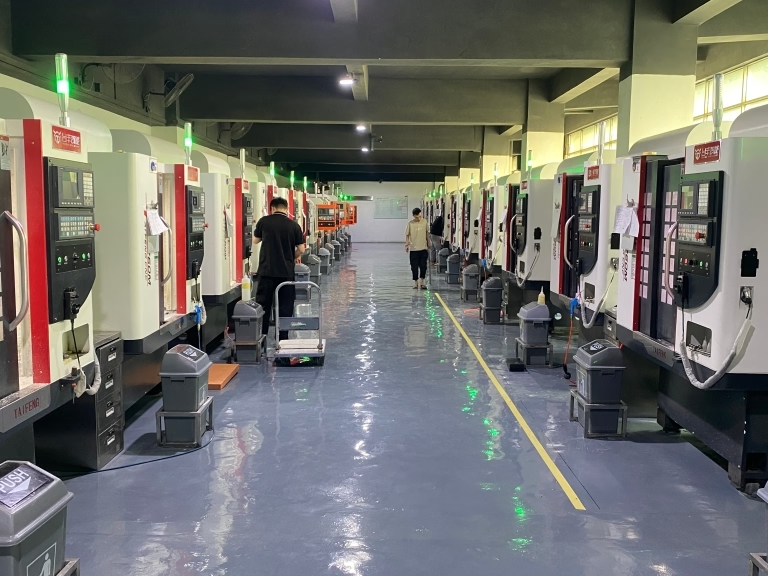
A 3-axis machine is the right call when all critical features sit on one face or on faces you can reach without re-chucking. It has the largest work envelope for the money and the simplest fixturing. At GreatLight, the 27 three-axis machines handle parts up to roughly 750 × 1,150 × 550 mm on the larger travel, and smaller 500 × 500 × 450 mm and 500 × 310 × 200 mm envelopes on the compact frames.
A 4-axis machine adds a rotary table, usually Ø400 mm on our mills. Use it when the part is prismatic but has features on a second or third face around a single axis: a manifold with ports on four sides, a bracket with holes around a cylinder, a shaft with milled flats. The rotary table indexes between faces and keeps the part clamped, so you remove one or two setups compared to 3-axis.
A 5-axis machine, specifically a simultaneous 5-axis center, is the choice when the part has compound angles, deep pockets with undercuts, or a surface that must be cut with the tool tilted to avoid chatter. Tilting the tool also lets you use a shorter, stiffer cutter, which matters on deep cavities. GreatLight runs 16 simultaneous 5-axis machining centers and 16 mill-turn centers.
Mill-turn is a different animal. It combines turning and milling in one machine, so a part that is mostly round with milled features, such as a hydraulic fitting or a motor shaft with a keyway, can be finished without moving it. If you are weighing a lathe against a mill, mill-turn often removes the handoff entirely.
- 13-axisFlat or single-side parts, large envelopes, lowest hourly cost, most setups.
- 24-axisPrismatic parts with features around one axis; one rotary table replaces multiple setups.
- 35-axis simultaneousCompound angles, undercuts, sculpted surfaces; one setup, shorter tools, higher hourly cost.
- 4Mill-turnMostly round parts with milled features; turning and milling in one clamping.
Tolerance and surface finish set the machine class, not the axis count
Two shops can both own a 5-axis machine and hold very different tolerances. The limit is the whole system: spindle thermal growth, ballscrew pitch error, fixture stiffness, coolant temperature and metrology. A ±0.005 mm tolerance is achievable, but it needs a temperature-stable room, sharp tooling and in-process checks. On a general-purpose machine in an uncontrolled shop, ±0.02 mm is a more honest number.
Surface finish follows the same logic. As-machined surfaces typically land at Ra 1.6–3.2 μm. A high-quality machined finish reaches Ra 0.8–1.6 μm with the right cutter and stepover. Fine finishes down to Ra 0.2–0.8 μm usually need a finishing pass, a smaller stepover or a secondary operation such as polishing. No machine delivers a mirror finish straight out of a roughing cut.
The engineering consequence: do not buy axis count for tolerance. Buy axis count for access, and buy machine condition and process control for tolerance. If a drawing calls for ±0.005 mm on two bores that are 300 mm apart, the problem is position accuracy across the part, not the number of axes.
For tight position work, the practical rules are simple. Rough and finish in separate passes. Let the part reach room temperature before the finish cut. Measure on the machine when the feature is still clamped.
Batch size decides whether you need automation or just a fast setup
A prototype and a production run want opposite things from a machine. For one part, setup time dominates. A 3-axis machine with soft jaws can be cutting within an hour. A 5-axis machine may need a custom fixture and a probing cycle, which only pays back across many parts. That is why prototypes often start on 3-axis or 4-axis machines even when the production part will run on 5-axis.
For medium batches, pallets and tombstone fixtures change the math. Loading four parts per cycle on a 4-axis tombstone can cut the per-part cycle time by more than half because the spindle never stops for a load. For high volume, bar feeders on mill-turn centers and tool-life monitoring keep the machine running unattended. None of this changes the geometry; it changes the cost per part.
GreatLight runs no minimum order quantity, from one prototype to 10,000+ part runs. That range matters when you are unsure of the final volume. The same drawing can start on a 3-axis machine for the first ten pieces and move to a 5-axis or mill-turn cell once the design freezes.
If your volume is genuinely unknown, optimize for the setup. A design that can be made in two setups on a 4-axis machine is usually cheaper to scale than one that requires a dedicated 5-axis fixture from day one.
Part geometry signals that point to one machine type
Long, thin parts are a stiffness problem. A 400 mm shaft with a 10 mm diameter will deflect under cutting force no matter how good the machine is. Mill-turn or a lathe with a steady rest is the fix, not a bigger mill. The travel on our large machines reaches 4,000 × 400 × 150 mm and 4,000 mm maximum processing size, but travel does not solve chatter.
Deep pockets with a depth-to-width ratio above about 4:1 usually need a 5-axis machine. Tilting the spindle lets you use a shorter tool, and a shorter tool is a stiffer tool. On a 3-axis machine the same pocket forces a long reach cutter, which chatters and leaves a poor floor finish.
Parts with undercuts or features on the back side of a flange are the classic 5-axis case. If you cannot reach a feature with a straight tool from the top, you either flip the part, which adds a setup and error, or you tilt the tool. The tilt is usually cheaper once you count the second fixture.
Sheet metal parts are not a machining-center job at all. A 2 mm aluminum bracket with bent tabs belongs in sheet metal fabrication. Cutting it from solid bar wastes material and time. Likewise, a simple round bushing is a lathe part, not a mill part.
Material and finishing change the machine and the tooling
Aluminum is the easy case. Grades such as 6061, 7075 and ADC12 cut fast, and a 3-axis machine handles most aluminum parts well. The machining risk is thin walls, not hardness. Aluminum also finishes cleanly with clear or colored anodizing, hardcoat and conductive anodizing.
Stainless and titanium raise cutting forces and heat. Grades like 304, 316L, 17-4PH, Ti-6Al-4V and Inconel demand rigid setups and slower parameters. On a light machine, the tool wears quickly and the surface tears. For these materials, a heavier 4-axis or 5-axis machine with high-pressure coolant is a better match, and the finishing plan should be set before the first cut.
Plastics behave differently again. POM, PEEK, PC and ABS cut with sharp tools and generous clearance, but they move with temperature. A part that measures correctly on a warm machine can shrink out of tolerance after cooling. If the drawing is tight on a plastic part, plan a stress-relief step and measure after stabilization.
Finishing is a separate routing decision, not a machine decision. Bead blasting, tumbling, brushing, polishing, black oxide, powder coating and laser marking are all post-machining steps. Laser marking needs a minimum character height of 1.5 mm, so plan the marking area early.
A five-step way to pick the machine before you ask for a quote
- 11. Mark every face that needs cuttingHighlight each machined face on the drawing. If three or more faces need work, plan for a 4-axis or 5-axis setup instead of multiple 3-axis setups.
- 22. Write down the tightest tolerance and its locationNote whether the tight tolerance is on one feature or between two features far apart. Position accuracy across the part points to a 5-axis or mill-turn setup in one clamping.
- 33. Check depth-to-width ratiosAbove roughly 4:1, plan for a 5-axis machine so you can tilt the tool and use a shorter cutter. Below that, a 3-axis machine is usually fine.
- 44. Match batch size to the setupOne to ten parts: minimize setup, accept a 3-axis or 4-axis machine. Hundreds to thousands: pallets and tombstones. High volume: mill-turn with bar feed.
- 55. Confirm the material and finish routeStainless, titanium and Inconel need rigid machines and slower parameters. Set finishing and marking requirements before quoting so they are not added as a second operation.
Machine type compared by geometry, tolerance and batch size
Use this as a first filter, then confirm with a DFM review.
| Machine type | Best for | Typical tolerance | Watch out for |
|---|---|---|---|
| 3-axis mill | One-face or reachable-feature parts | ±0.01 to ±0.02 mm | Setup stack-up on multi-face parts |
| 4-axis mill | Features around one axis, pallet work | ±0.01 mm | Rotary table runout and backlash |
| 5-axis simultaneous | Compound angles, undercuts, deep pockets | ±0.005 mm | Higher hourly rate, fixture cost |
| Mill-turn | Round parts with milled features | ±0.005 to ±0.01 mm | Bar size limits and tool clearance |
| CNC lathe only | Turned parts, no milling | ±0.01 mm | Cannot add cross features |
| Sheet metal | Bent and flat plate parts | ±0.1 mm typical | Not for solid 3D geometry |
| 3D printing | Concept shapes, internal channels | ±0.1 mm typical | Not a production metal process |
The short verdict
If your part is reachable in one or two setups and the tolerance is ±0.01 mm or looser, choose 3-axis or 4-axis and keep the cost down. If it has compound angles, undercuts or tight positional tolerance across several faces, go 5-axis. If it is mostly round with milled features, go mill-turn. Do not pay for axes you cannot use.
Questions engineers ask before choosing a machine
Can I just use a 5-axis machine for everything?
You can, but you will pay for it. A 5-axis machine has a higher hourly rate and often needs a custom fixture and a longer setup. On a simple one-face part, a 3-axis machine produces the same geometry at a lower cost.
Use 5-axis when it removes a setup or reaches a feature a straight tool cannot. Otherwise the extra axes add cost without adding value.
How do I know if my part is a mill or a lathe part?
If the part is mostly cylindrical and the critical features are turned diameters, it is a lathe or mill-turn part. If the critical features are flat faces, pockets and holes, it is a mill part.
Parts with both, such as a shaft with a keyway and cross holes, are the strongest mill-turn candidates because one machine finishes both sides.
What tolerance can a 3-axis machine actually hold?
A well-maintained 3-axis machine in a temperature-controlled shop can hold ±0.01 mm on a single setup, and ±0.005 mm on selected features with careful process control.
The limit on multi-face parts is not the machine but the re-fixturing error. Each new setup adds positional variation that no machine can remove.
Does the machine choice change if I need a polished or anodized finish?
Not the machine choice, but the process plan. Fine finishes down to Ra 0.2–0.8 μm may need a finishing pass with a smaller stepover or a secondary polishing step.
If you plan anodizing, tell us before machining so we can leave the right stock allowance and avoid marking areas that will be coated.
How fast can a prototype be produced once the machine is chosen?
Quotation and free DFM analysis come back within 12 hours. Production can start within 24 hours, and parts typically ship in 3–5 days.
Prototype complexity drives the schedule more than the machine type. A simple bracket on a 3-axis machine moves faster than a 5-axis part that needs a custom fixture.
Can a 3-axis machine handle a large part instead of a 5-axis machine?
Yes, when the features are reachable from one or two directions. Our larger 3-axis travels reach 750 × 1,150 × 550 mm, and the largest machines reach 4,000 mm maximum processing size.
The trade-off is setup count. A large part with features on five sides still needs multiple setups, and each one adds handling risk.
Send the drawing and we will tell you which machine fits
Upload your part and we will return a quotation with a free DFM analysis within 12 hours, including the machine class we recommend and why. All uploads are secure and confidential, and an NDA is available on request.
12-hour quoteFree DFM analysis100% inspectionNo minimum order quantity
More machining notes from the floor
We publish setup notes, tooling trials and inspection data from the factory floor.











