
What Does CNC Machine Do?
A CNC machine reads a program and moves a cutting tool through metal or plastic to make a shape that matches a CAD model. This page explains what that actually means on the shop floor: which operations happen, how tight the tolerances really get, and where the process stops working. Written for design engineers and buyers who need to judge whether a part belongs on a mill or somewhere else.
In this article
- 1
- 2
- 3
- 4
- 5
- 6
- 7
- 8
- 9
Key takeaways
What Does CNC Machine Do to a Block of Metal?
A CNC machine does one thing: it moves a cutting tool along a programmed path and removes material. The operator loads a blank, clamps it, sets a zero point, and starts the cycle. From there the machine follows G-code, a list of coordinates and feed commands generated by CAM software from your 3D model. The tool spins at a set RPM and travels along X, Y, and Z at a set feed rate. Every chip that comes off is material that will not be there in the finished part.
The cutting itself is a controlled fracture. The tool edge pushes into the material until the shear stress exceeds what the metal can hold, and a chip separates. Heat goes into the chip, the tool, and the workpiece in that order. Too much heat in the part means distortion, especially on thin walls. That is why feeds and speeds are matched to the material, not guessed. Aluminium 6061 runs fast and dry; 316 stainless runs slow with flood coolant.
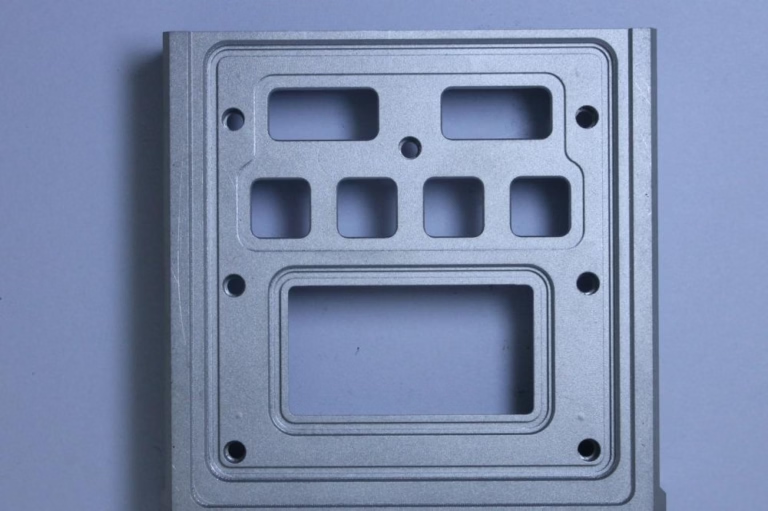
What comes out is a near-net shape with machined faces, drilled holes, tapped threads, and pockets. Dimensions are measured against the drawing, not the model. If the drawing says Ø25.00 ±0.05 mm, the machine has to hold that band on every part. The CAM path, the tool wear, and the fixture all feed into whether it does.
- 1Subtractive, not additiveMaterial leaves the block. There is no deposition step.
- 2Program-drivenAxis motion, spindle speed, and feed rate all come from code.
- 3Measured, not eyeballedCalipers, micrometers, and CMM reports confirm finished dimensions.
Milling, Turning, Drilling, and Tapping in One Setup
A CNC mill holds the part still and spins the tool. It handles flat faces, pockets, slots, profiles, and complex 3D surfaces. A CNC lathe does the opposite: the part spins and a stationary tool peels material off the outside diameter. Turning is the fast way to make shafts, bushings, and fittings that are round. Most shops run both, and mill-turn centers combine them so a part can be turned and milled without a second setup.
Drilling and tapping usually happen on the same machine as the milling. A drill plunges to depth, then a tap cuts threads at a synchronized feed so the pitch matches. On a 5-axis machine, these operations can reach faces that would be hidden on a 3-axis setup. That means fewer fixtures and less chance of a setup error stacking up.
The choice between 3-axis, 4-axis, and 5-axis is not about prestige. It is about how many faces need work and how the tool can reach them. A bracket with holes on two sides is a 3-axis job with two setups. A turbine blade with a twisted aerofoil needs simultaneous 5-axis motion because the tool has to stay normal to a surface that curves in two directions.
- 13-axisFlat plates, pockets, and parts with accessible faces.
- 24-axisCylindrical parts with features along the rotation axis.
- 35-axisContoured surfaces, undercuts, and angled holes in one setup.
How Tight Can a CNC Machine Hold?
Tolerance is the band a dimension is allowed to fall in. A shop that quotes ±0.005 mm is saying its machines, tooling, and inspection can hold that band under normal conditions. That is about ±0.0002 in, tight enough for most mating features in medical and aerospace parts. It is not a promise on every feature. A 4,000 mm long beam will not hold ±0.005 mm over its full length because thermal expansion alone moves it more than that.
Surface finish follows a similar rule. As-machined surfaces typically land around Ra 1.6–3.2 μm. A fine finish of Ra 0.2–0.8 μm needs a finishing pass with a sharp tool, light depth of cut, and a rigid setup. The part has to allow it. A deep pocket with a long tool will chatter before it polishes.
The practical limit is often the setup, not the machine. Every time a part is unclamped and reclamped, a small error creeps in. Five setups multiply that error. One 5-axis setup keeps it to a single datum. When a drawing has tight true position between features on different faces, reducing setups matters more than adding a better machine.
- 1±0.005 mmAchievable on well-supported features with a stable setup.
- 2Ra 1.6–3.2 μmStandard as-machined finish for most metals.
- 3Ra 0.2–0.8 μmFine finish, needs a dedicated finishing pass.
Why Repeatability Matters More Than a Single Good Part
A skilled machinist can hand-cut a one-off part to a tight tolerance. A CNC machine does it on part 1 and part 10,000 without a change in the result. That is the real answer to what does a CNC machine do for production. It converts a good setup into a repeatable process. The program is the recipe, and the machine follows it exactly until a tool wears or a chip packs wrong.
Repeatability is what makes CNC suitable for automotive and medical work. A batch of 5,000 brackets has to assemble the same way every time. If one hole drifts 0.03 mm, the line stops. Process control, in-process checks, and tool-life tracking keep the drift inside the band. A shop that only inspects the last part is not controlling the process.
It also changes how you design. Features that are hard to measure are risky on a production run because you cannot prove they are in tolerance. Round holes, flat faces, and standard thread forms are easy to verify. A complex freeform surface needs a CMM and a nominal model. If the drawing does not define the datum scheme, the shop has to guess, and guessing is where variation enters.
- 1One proven programRuns the same path on every part until a change is made.
- 2Process controlIn-process checks catch drift before the part leaves the machine.
- 3Measurable featuresDesign for features that can be inspected, not just cut.
What CNC Machines Can and Cannot Cut
CNC machining covers a wide material range. Aluminium grades like 6061, 7075, and 6082 cut fast and hold a good finish. Stainless 303 and 304 machine well; 316 and 17-4PH are tougher and slower. Titanium Ti-6Al-4V and Inconel are machinable but eat tool life and demand rigid setups. Plastics like POM, PEEK, and ABS machine cleanly if you manage heat and chip evacuation.
The limit is rarely the material itself. It is the geometry that comes with it. Deep holes smaller than 3× the drill diameter need peck cycles and often a smaller tool that deflects. Undercuts cannot be reached by a straight tool from above. Sharp internal corners cannot be cut because every tool has a radius. If a drawing calls for a sharp internal corner, the shop has to either leave a radius or use EDM.
Hardened steel above 45 HRC is a different problem. Cutting it in the hardened state needs carbide or ceramic tooling and light passes. Many shops prefer to machine soft, then heat treat, then finish grind. If your part needs a hard surface and tight tolerance, the sequence matters as much as the machine.
- 1Easy to cutAluminium, brass, mild steel, and most plastics.
- 2Harder to cutStainless 316, titanium, Inconel, and hardened tool steel.
- 3Not machinableSharp internal corners, true undercuts, and very deep small holes.
When a CNC Machine Is the Wrong Choice
CNC is a subtractive process with a fixed cost per part. For a one-off prototype, that cost is fine because the setup is small and the part is quick. For a high-volume part with a simple shape, casting or injection moulding will beat it on unit cost once the tooling is paid for. The crossover is usually in the thousands of parts, and it depends on geometry.
Thin sheet parts are usually better on a laser or press brake. A 1 mm steel bracket with a few bends does not need a mill. It needs a flat pattern and a brake. Similarly, a part with a hollow internal cavity that you cannot reach with a tool is a candidate for casting or 3D printing, not milling.
The process also struggles with parts that are floppy before they are finished. A long thin rib that is rigid in the final assembly may vibrate during machining. That means light passes, slow feeds, and sometimes a temporary support that has to be cut away. If the design allows a thicker section during machining, the part gets cheaper and more accurate.
- 1High volume, simple shapeCasting or moulding wins on unit cost.
- 2Thin sheet with bendsLaser cutting and press brake are faster.
- 3Internal cavitiesAdditive or casting reaches where a tool cannot.
How a CNC Job Runs, Step by Step
The sequence a shop follows from your file to a shipped part.
- 1DFM reviewWe check wall thickness, tool access, and tolerances against the material. Feedback within 12 hours.
- 2CAM programmingThe model is converted to toolpaths. Feeds and speeds are set per material and tool.
- 3Fixture and setupThe blank is clamped on a datum. Zero point is set and verified with a probe.
- 4RoughingLarge cuts remove bulk material, leaving 0.3–0.5 mm for finishing.
- 5FinishingLight passes bring the part to final dimension and surface finish.
- 6InspectionDimensions are checked against the drawing. Reports on request.
- 7Finishing and shippingAnodizing, plating, or blasting as specified, then packed and shipped.
Which Machine Setup Fits Your Part?
Match the geometry to the machine, not the other way around.
| Part feature | Typical setup | Why |
|---|---|---|
| Flat plate with through holes | 3-axis | One face, simple access |
| Shaft with keyway and threads | Turning or mill-turn | Round features turn fast |
| Angled hole on two faces | 4-axis or 5-axis | Fewer refixtures, less stack-up |
| Curved aerofoil surface | Simultaneous 5-axis | Tool stays normal to surface |
| Deep pocket, 5× diameter | 3-axis with long reach tool | Chatter risk, slow feeds |
| Thin wall under 1 mm | 5-axis with light passes | Support the wall, avoid deflection |
The verdict on what a CNC machine does
If your part needs tight tolerances, repeatable geometry, and a material that cuts, CNC is the right call. If it is a thin sheet part, a high-volume simple shape, or a hollow cavity, another process will be cheaper and faster. Send us the drawing and we will tell you which one it is.
Frequently asked questions
How accurate is a CNC machine compared to manual machining?
A CNC machine holds ±0.005 mm on well-supported features because the motion is driven by screws and servos, not by hand. Manual machining depends on the operator's feel and can match that on a good day, but not on every part in a run.
The bigger difference is repeatability. A CNC program produces the same result from part 1 to part 10,000. Manual work drifts with fatigue and setup changes.
What materials can a CNC machine process?
Aluminium 6061, 7075, and 6082; stainless 303, 304, 316, and 17-4PH; steel 1018, 1045, and 4140; brass and copper; titanium Ti-6Al-4V and Inconel; and plastics including POM, PEEK, ABS, and PC.
The limit is usually geometry, not material. Deep small holes, sharp internal corners, and undercuts are hard regardless of what the part is made from.
How long does it take to get custom CNC machined parts?
We return a quotation and free DFM analysis within 12 hours. Production can start within 24 hours of approval, and parts typically ship in 3–5 days.
Complex parts with multiple setups or special finishes take longer. The quote will state the lead time for your specific job.
Does GreatLight offer post-processing for CNC parts?
Yes. Anodizing in clear, colour, hardcoat, and conductive types; electroless nickel, zinc, silver, and gold plating; powder coating and black oxide; bead blasting, tumbling, brushing, and polishing; and laser marking with a minimum character height of 1.5 mm.
Finishing is quoted with the machining so the tolerance stack includes any coating thickness.
What certifications does GreatLight hold?
ISO 9001:2015, IATF 16949:2016, ISO 13485:2016, and ISO 27001:2022. These cover quality management, automotive, medical devices, and information security.
Inspection is 100% before shipment, with raw material checks, in-process monitoring, and final inspection. Reports are available on request.
Can GreatLight handle both prototyping and mass production?
Yes. There is no minimum order quantity. We run from a single prototype to 10,000+ part runs on the same floor, using 127 high-precision CNC machines including 16 simultaneous 5-axis centers.
The same program and fixture carry from prototype to production, which keeps the first article and the production parts aligned.
Send us your drawing and we will tell you how to make it
Free DFM analysis and quotation within 12 hours. No minimum order quantity, from one prototype to 10,000+ parts.
12-hour quote100% inspectionNo MOQNDA on request
More from GreatLight
We publish setup notes, tooling trials and inspection data from the factory floor.











