
What Does a CNC Bending Machine Do?
A cnc bending machine forms flat sheet metal into angled, flanged and boxed shapes by driving a punch into a die under programmed control. This page explains the mechanism, the tooling, where the process holds tolerance and where it does not.
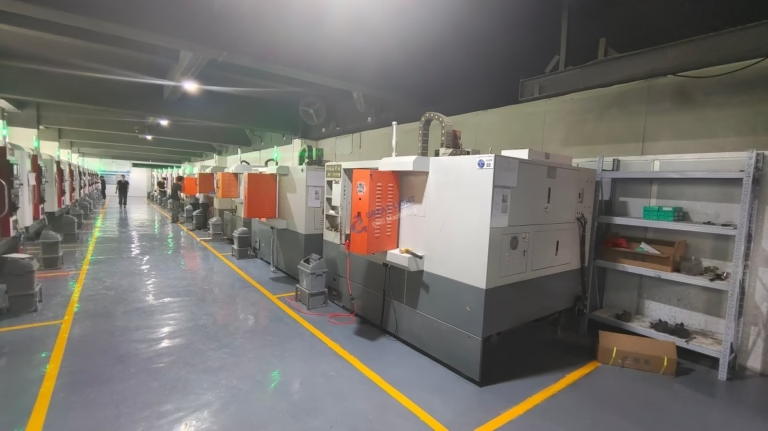
What a cnc bending machine actually does
A press brake holds a punch in an upper ram and a die in a lower bed. Sheet metal sits between them. The ram descends, the punch pushes the sheet into the die opening, and the material yields along a straight line. That line becomes the bend. Everything else on the machine exists to control where that line lands and how deep the punch travels.
On a manual brake the operator sets the depth by hand and watches the part. A cnc bending machine stores the bend sequence, the ram depth, the backgauge position and the tonnage in a program. You load a drawing or a G-code file, the controller simulates the sequence in 3D, and the machine repeats it part after part.
The output is a formed part, not a cut part. Bending does not remove material. The blank is cut first, usually by laser or punch, then bent. If the flat pattern is wrong, no amount of machine accuracy saves the part. That is why the flat layout matters as much as the brake itself.
The ram can stop within a few microns of a commanded depth, but the sheet springs back when the load releases. Controllers compensate by overbending slightly. The correction depends on material grade, thickness and grain direction, so the first article still gets checked on the bench.
The parts that decide bend accuracy
The controller is the brain. It holds the bend program, runs the 3D simulation and drives the axes. Most shop-floor errors trace back to a wrong program, not a worn machine. Good controllers warn you when the punch would collide with a previously formed flange, which is the most common crash on multi-bend parts.
The backgauge sets the bend line position. It is a set of stops the operator pushes the sheet against before each hit. On a cnc bending machine the backgauge moves to a new position for every step in the sequence, so the operator never measures. Repeatability here sits in the ±0.05 mm range on a well-maintained machine.
The tooling shapes the result. A punch with a small tip radius gives a tighter inside radius but concentrates stress. A wide die opening needs less tonnage and produces a softer bend. Standard air bends use a die opening roughly 6 to 8 times the sheet thickness. Go narrower and you risk marking the surface.
Crowning and ram deflection matter on long parts. When you bend a 2,000 mm flange, the ram flexes in the middle and the bend angle drifts. Mechanical or hydraulic crowning pushes the bed up to cancel that deflection. Without it, a long part can vary several degrees from end to end.
How a programmed bend sequence runs
Programming starts from the flat pattern. The engineer enters material, thickness, bend angles, inside radii and tooling. The controller calculates the bend deduction for each corner and produces the flat length. Get the deduction wrong and the finished part comes out short or long by a predictable amount on every flange.
The operator then selects the tooling, mounts the punch and die, and lets the machine reference the axes. The backgauge moves to the first stop. The sheet goes in, the operator holds it against the stops, and the ram descends to the programmed depth.
After the first bend the part is turned or flipped and the next stop engages. A part with six bends might run through six positions on the same tooling. The controller tracks the order so the operator cannot skip a step without a warning.
First-article inspection closes the loop. The operator checks angle with a protractor or a laser angle gauge and checks flange length with calipers. If the angle is off, the correction is entered as a depth offset and the program updates. Production then runs against that corrected program.
Which materials bend well and which fight back
Mild steel is the easy case. A36 and 1018 bend predictably, spring back modestly, and tolerate a die opening of 6 to 8 times thickness. Stainless 304 and 316 need more tonnage because they work-harden as they deform. Expect more spring back and a larger minimum inside radius.
Aluminium splits if you push it too far. 5052 and 6061 bend reasonably in the annealed or T6 state depending on thickness, but 7075 is a poor candidate for tight radii. The usual rule is to keep the inside radius at or above the sheet thickness for 6061-T6.
Titanium and Inconel bend but demand respect. They need higher tonnage, sharper spring-back compensation and often a hot or warm setup for thick sections. For thin brackets in Ti-6Al-4V we would rather machine the feature than form it, unless the quantity justifies the tooling.
Thickness sets the practical ceiling. A typical shop brake handles 0.5 mm to 6 mm sheet without special tooling. Heavier plate moves to a different class of press brake with much larger tonnage, and the tooling cost jumps with it.
Where bending loses to machining
Bending is fast and cheap per part once tooling is set. It is not the right answer for every geometry. A part with odd angles in three planes, deep pockets or a closed box shape is usually easier to mill from solid than to form and weld from flat sheet.
The bend line is straight by definition. Curved flanges need a different process, such as roll forming or a die with a curved punch. If your design shows a sweep along the flange, ask before assuming a brake can make it.
Minimum flange length depends on the die opening. A common rule is that the flange should be at least 60 percent of the die V width plus the inside radius. Shorter flanges fall into the die opening and the bend collapses.
Holes near a bend deform. Keep hole edges at least 2.5 times the sheet thickness away from the bend line, or the hole will stretch into an oval. If the design does not allow that distance, plan to drill or punch the hole after forming.
Choosing between bending and machining
Use this when the drawing could go either way.
| Factor | Sheet metal bending | CNC milling from solid |
|---|---|---|
| Best geometry | Flat blanks with straight bend lines | 3D pockets, curved walls, complex angles |
| Tooling cost | Punch and die set, shared across jobs | Fixtures only, no form tooling |
| Unit cost at volume | Low after setup | Higher, more cycle time per part |
| Wall thickness | Limited by sheet gauge available | Any thickness the stock allows |
| Weight | Lighter, hollow sections possible | Heavier unless pockets are cut |
| Lead time | Fast for simple brackets | Fast for one-off prototypes |
| Surface finish | Mill finish, then coat or plate | Machined finish from Ra 0.8–1.6 μm |
Pick the process by geometry, not habit
If the part is a flat blank with straight flanges and you need many of them, bend it. If the geometry twists in three planes or carries deep pockets, machine it from solid and skip the welding.
Common questions
What tolerance can a cnc bending machine hold?
Bend angle typically holds within ±0.5° on a maintained machine with crowning, and flange length within ±0.1 mm. Those numbers depend on material, thickness and how close the bend sits to the sheet edge.
At GreatLight we machine formed parts to ±0.005 mm on the machined features, while the formed geometry follows the bend tolerances above. The two are quoted separately so nobody assumes a formed flange carries a machined tolerance.
Can one machine handle many different bend angles?
Yes. The program stores a depth for every bend, so a part can mix 30°, 90° and 135° corners in one run. The limit is tooling interference, not the angle count.
Deep return flanges or a bend next to an already-formed wall can block the punch. Simulation in the controller catches most of these before the first hit.
Does bending work for small batches?
It does, but the setup dominates the cost. A single prototype bracket may spend more time in programming and tooling selection than in the press.
There is no minimum order quantity at our shop, so a one-piece bracket is fine. Just expect the per-part price to reflect the setup rather than the cycle time.
What surface finishes survive bending?
Mill finish is the safe default. Pre-coated, anodized or powder-coated sheet can crack at the outside of a tight bend because the coating has less elongation than the base metal.
When the finish matters, form first and coat after. That keeps anodizing, electroless nickel or powder coat intact across the bend radius.
How do you check a bent part before shipping?
First article gets a full check: angle, flange length, hole position and flatness. Production parts then get sampled across the run.
Every order ships after 100% inspection, with dimensional reports available on request. We also keep the material certificates on file for traceability.
Can bending be combined with machining in one order?
Yes, and it usually saves handling. A bracket might be laser cut, bent, then milled to bring two mounting faces flat and parallel.
We run bending alongside 5-axis, 4-axis and 3-axis machining, so mixed-process parts stay under one quality system and one shipment.
Send your sheet metal drawing for a bend review
Upload a DXF or STEP file and we will return a quotation plus a free DFM analysis within 12 hours.
12-hour quote100% inspectionNo minimum order quantity
More from the shop floor
We publish setup notes, tooling trials and inspection data from the factory floor.











