
What Does CNC Stand For Machining? 5 Basics Explained
What does CNC stand for machining? Computer Numerical Control: a computer reads a toolpath file, drives servo motors, and moves a cutting tool along a programmed path through solid stock. This page breaks the acronym into its parts, follows one part through a real control loop, and shows where the process is a good fit and where it is not.
In this article
- 1
- 2
- 3
- 4
- 5
- 6
What does CNC stand for machining, word by word
CNC stands for Computer Numerical Control. The words matter in that order. Computer means the path is stored as code, not held in an operator's hands. Numerical means the code is coordinates and feed rates, not prose. Control means a closed loop runs in real time, comparing where the tool should be against where it actually is, then correcting.
Before CNC, a machinist turned handwheels and read dials or a digital readout. Skill decided whether two parts matched. A CNC machine stores the same numbers for part one and part ten thousand, so the second part repeats the first unless a tool wears out or thermal drift creeps in. That repeatability is the reason the acronym shows up in every precision sourcing conversation.
The acronym describes the control method, not the cutting method. A CNC machine can mill, turn, drill, grind, or cut with wire, laser, or plasma. All of them share the same loop: a program, a controller, motors, and a feedback device. When a supplier says CNC machining, they usually mean a rotating cutting tool removing material from a workpiece on a milling or turning center.
- 1ComputerThe CAM file and controller hold the geometry.
- 2NumericalCoordinates, feeds, and speeds in numbers.
- 3ControlServo feedback corrects position in real time.
From CAM file to chips: how the control loop actually moves
A part starts as a 3D model. A CAM programmer picks tools, sets stepover, feed per tooth, and spindle speed, then posts G-code. The controller reads that code block by block. For each block it computes an interpolation path, usually a line or an arc, and sends position commands to the servo drives at a fixed cycle time, often 1 to 4 milliseconds.
Each servo motor carries an encoder. The drive compares commanded position to encoder feedback and adjusts current to close the gap. This is the loop that makes a milling machine hold ±0.005 mm ( ±0.0002 in ) on a good day, provided the machine is thermally stable and the tool is not deflecting. The loop corrects axis position. It cannot correct a tool that bends under cutting force, which is why toolpath strategy and tool stickout still matter.
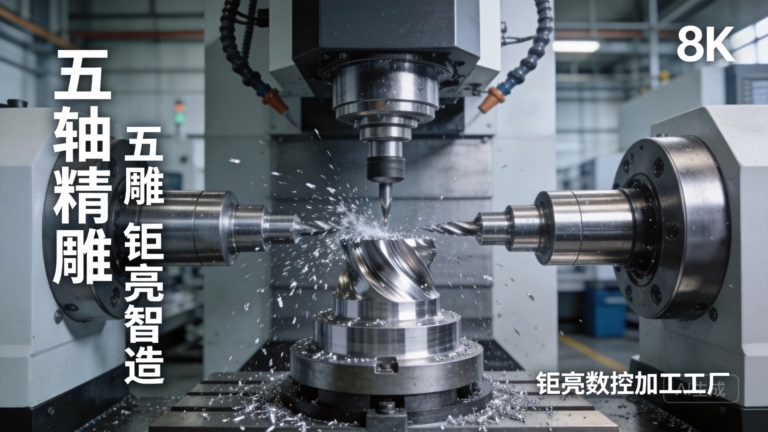
On a basic 3-axis mill, X, Y, and Z move the tool while the part stays still. A 4-axis machine adds a rotary table, usually Ø400 mm, so the part can index to a new face without a second setup. A 5-axis machine adds two rotary axes that move at the same time as the linear axes. Simultaneous motion lets a ball nose cutter stay normal to a curved surface, which is how impellers and turbine blades get machined in one setup.
- 13-axisFlat faces, pockets, holes, simple profiles.
- 24-axisCylindrical parts, cross holes, multiple faces.
- 35-axisContoured surfaces, undercuts, one-setup parts.
Why axis count changes the part, not just the machine price
Every setup adds a chance to lose position. Clamp a part, cut three faces, unclamp, rotate it, clamp again, and you introduce two sources of error: fixture repeatability and operator judgement. A 5-axis machine reaches the back of a part while the part stays in one fixture, so datum relationships stay tight. On a bracket with six drilled faces and a true position callout, that single setup is often the difference between passing and reworking.
Axis count also changes the cut itself. A 3-axis machine can only approach a surface from the Z direction. Steep walls and deep pockets need long tools, and long tools chatter. A 5-axis machine tilts the tool, uses a shorter cutter, and reaches the same surface with better rigidity. The result is a cleaner wall finish, sometimes Ra 0.8–1.6 μm straight off the machine.
The trade-off is programming time and setup cost. A 5-axis toolpath needs collision checking and a post-processor matched to the machine. For a simple plate with a few holes, 3-axis is faster to program, faster to prove out, and cheaper. Match the axis count to the geometry, not to the spec sheet.
When CNC machining fits a part, and when it is the wrong process
CNC machining is subtractive, so it fits parts that start from a billet, bar, or plate and get material removed. It suits tight tolerances, hard materials, and geometries with pockets, threads, bores, and faces. It also suits low to mid volumes, because there is no tooling to amortize. One prototype and a 10,000-part run use the same program on the same machine.
It is the wrong choice when the part is a thin-walled shell with uniform wall thickness, when the annual volume is high enough to justify a die, or when the geometry is hollow and organic with internal channels that no cutter can reach. In those cases die casting, sheet metal fabrication, or 3D printing usually wins on cost per part.
Material choice drives the decision too. Aluminium 6061 and 7075 cut fast and hold tolerance well. Stainless 316L and 17-4PH work-harden, so feeds and speeds need care to avoid rubbing. Titanium TC4 ( Ti-6Al-4V ) and Inconel generate heat at the cutting edge, so they run slower with more coolant and shorter tool life. The process still works. It just costs more per cubic centimeter removed.
- 1Good fitTight tolerance, hard material, low to mid volume.
- 2Poor fitThin uniform walls, very high volume, hollow internals.
Reading a tolerance callout like a machinist
A general tolerance block on a drawing is not the same as a specified tolerance on a critical feature. If the title block says ±0.1 mm and one bore says Ø20 ±0.005 mm, only that bore is held to ±0.005 mm. Everything else is held to the looser block. Engineers who know this save money, because tightening the whole drawing buys nothing on features that do not need it.
Finish works the same way. Ra 1.6–3.2 μm is a normal as-machined finish from a sharp end mill. Ra 0.8–1.6 μm takes a finishing pass with a lighter stepover. Ra 0.2–0.8 μm usually needs a finishing strategy plus a fine tool or a secondary operation. Calling out Ra 0.2 across a large face adds cycle time, so reserve it for sealing surfaces and bearing fits.
Geometric callouts are where most quotes change. Position, flatness, perpendicularity, and concentricity all need to be measured, and some need fixtures or CMM time. A drawing with a dozen GD&T frames is not harder to machine than a drawing with two. It is harder to prove, and proof is what the inspection report documents.
CNC machining compared with other processes
Use this as a first filter before requesting a quote.
| Process | Best for | Watch out for | Typical volume |
|---|---|---|---|
| 3-axis CNC milling | Plates, brackets, pockets, holes | Deep pockets need long tools | 1 to 10,000+ |
| 5-axis CNC milling | Contoured surfaces, one-setup parts | Programming and setup cost | 1 to 10,000+ |
| CNC turning | Shafts, bushings, threaded parts | Off-axis features need a second op | 1 to 10,000+ |
| Die casting | High-volume complex housings | Tooling cost and lead time | Thousands to millions |
| Sheet metal fabrication | Enclosures, brackets, panels | Thickness and bend radius limits | Tens to thousands |
| 3D printing | Organic shapes, internal channels | Surface finish and anisotropy | 1 to hundreds |
The short answer for sourcing
If your part needs tight tolerance, a hard material, or a low to mid volume, CNC machining is the right process. If it is a thin uniform shell or a high-volume housing, pick die casting or sheet metal instead. Send the drawing and we will tell you which one, with a DFM note inside 12 hours.
Questions engineers ask after the acronym
Is CNC the same as automation?
Not exactly. CNC is a control method. Automation is what you build on top of it. A CNC machine can run unattended for a while, but someone still loads stock, changes tools, and checks the first part.
The practical gain is consistency across a run, not the absence of people.
Does 5-axis always give a better part?
No. It gives access and rigidity on contoured or multi-face parts. On a flat plate with six holes, a 3-axis machine is faster and cheaper.
Choose axis count from the geometry, not from the machine list.
What materials can be machined?
Aluminium 6061 and 7075, stainless 303 and 316L, steel 1045 and 4140, copper and brass, titanium TC4, Inconel, magnesium, and plastics such as POM, PEEK, and PC.
Harder and gummier materials raise cycle time and tool wear, so expect a different price.
How tight can the tolerance be?
We hold ±0.005 mm ( ±0.0002 in ) on critical features when the machine, tool, and setup support it.
Tolerance is feature-specific. A ±0.005 mm bore does not mean the whole part is held that tight.
Can I get parts without a minimum order?
Yes. There is no minimum order quantity. One prototype and a 10,000-part run go through the same process.
Uploads stay confidential, and an NDA is available on request.
What files do you need for a quote?
A STEP or IGES model plus a PDF drawing with tolerance, finish, and material callouts.
If the drawing is not ready, send the model and note the critical features. We return a DFM analysis with the quote.
Put the acronym to work on your part
Send a STEP file and a drawing. You get a quote, a DFM note, and a process recommendation within 12 hours.
12-hour quote100% inspectionNDA on request
More machining notes
We publish setup notes, tooling trials and inspection data from the factory floor.











