
What Drill to Use for CNC Machine?
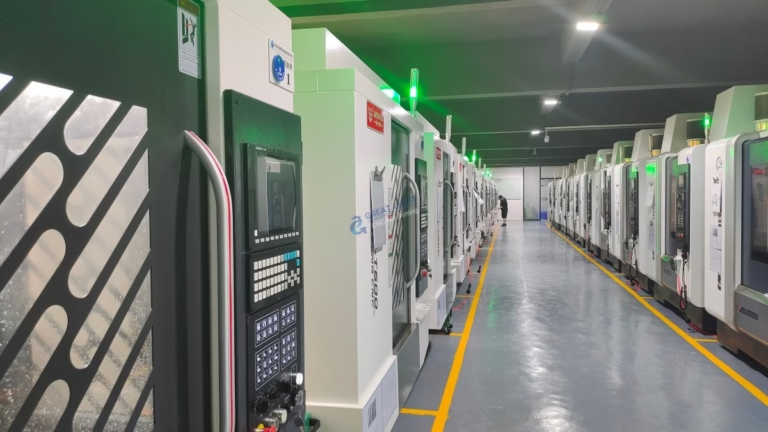
The drill decides hole size, roundness, finish and tool cost more than the spindle does. This page covers six drill families, the depth-to-diameter limits that break them, and the feeds and speeds we run on 127 CNC machines in Dongguan.
Which drill to use for CNC machine work: six families compared
Most shops keep one drawer of twist drills and reach for it every time. That works until the hole is 12 mm deep and 3 mm wide, or the material is 17-4PH. The drill body, point geometry and coolant path decide whether a hole comes out round and on size, or comes out oversize with a bell mouth and a burned tip.
A twist drill is the general-purpose answer to which drill to use for CNC machine work. HSS cobalt grades (M35, M42) survive interrupted cuts and manual setups. Solid carbide holds size better at high rpm, but it chips if the setup is not rigid. For aluminium and brass, 118° to 130° points with wide flutes clear chips fast. For stainless and steel, 135° to 140° split points stop the tool from walking on entry.
Indexable insert drills cut holes from Ø12 mm up to about Ø80 mm. Two carbide inserts do the cutting, so you replace an insert instead of the whole body. They run high feed rates on stable machines, which suits production runs. The trade-off is cost per body, plus a minimum hole size that rules out small work.
Step drills combine several diameters on one shank. A single plunge produces a pilot hole, a clearance hole and a countersink at the same depth. Use them on sheet metal and thin plates where a second setup costs more than the tool. They are a poor fit for deep holes because the step shoulders rub the wall.
Center drills locate a hole before a longer tool enters. The 60° tip matches a lathe center, so the same tool works for tailstock support. Deep hole drills, usually gundrills with through-coolant, handle depth-to-diameter ratios above 10:1. Micro drills from Ø0.05 mm to Ø1 mm need high spindle speed and low runout, often under 3 μm.
Five factors that decide the drill you pick
Material comes first. Aluminium 6061 and 7075 cut freely with uncoated or ZrN-coated carbide. Stainless 304 and 316 work-harden, so a sharp edge and steady feed matter more than coating. Titanium TC4 and Inconel 718 need through-coolant and low surface speed, often 20–40 m/min, or the cutting edge dies in seconds.
Hole requirements set the geometry. If the tolerance is ±0.05 mm, drill undersize and ream. If the depth-to-diameter ratio passes 5:1, chip evacuation becomes the limit, not the tool material. Above 10:1, use a gundrill with high-pressure coolant. Hole finish follows the same logic: a standard twist drill leaves Ra 3.2–6.3 μm, a reamer reaches Ra 0.8–1.6 μm.
Machine compatibility matters as much as the drill. A 20,000 rpm spindle can run micro tools; a 6,000 rpm spindle cannot. Through-spindle coolant needs a rotary union rated for the pressure. Tool holders add runout, and every 10 μm of runout roughly adds 0.02 mm to the hole diameter. Hydraulic and shrink-fit holders keep runout low; a worn ER collet does not.
Feeds and speeds follow a simple rule. Surface speed is set by material, and feed per revolution by drill diameter. A Ø10 mm carbide drill in 6061 runs near 120 m/min and 0.15 mm/rev. The same drill in 316 stainless drops to 40 m/min and 0.08 mm/rev. Start conservative, listen to the cut, then raise feed until the chip breaks cleanly.
- 1MaterialSets coating, point angle and surface speed.
- 2Depth ratioAbove 10:1, move to a gundrill with coolant.
- 3ToleranceUnder ±0.05 mm, drill undersize and ream.
- 4Spindle and holderRunout and rpm cap the smallest usable drill.
Four mistakes that ruin CNC drilled holes
The first mistake is using the wrong drill material for the workpiece. A general-purpose HSS drill in Inconel 718 dulls before the first hole is done. Coatings help, but they do not fix the wrong substrate. Match the grade to the material group first, then pick the coating.
The second is ignoring the depth-to-diameter ratio. A Ø3 mm drill at 30 mm deep is 10:1. Chips pack the flutes, torque spikes, and the drill snaps. Peck drilling helps to about 8:1. Past that, switch to a gundrill or drill from both ends.
The third is neglecting the coating. TiN is a general-purpose coating. TiAlN and AlTiN resist heat, so they suit stainless and titanium. ZrN and DLC reduce built-up edge on aluminium. A coated drill run at the wrong speed still fails, so treat coating as one variable, not a fix.
The fourth is overlooking spindle power and coolant pressure. A Ø50 mm insert drill in steel needs real spindle torque and steady coolant. If the machine cannot hold the load, the hole bell-mouths on entry. Check spindle power and coolant pressure before buying a large drill body.
Drill type by hole size, depth and material
Ratios are depth-to-diameter. Speeds are starting points for rigid setups.
| Drill type | Typical size | Best depth ratio | Materials |
|---|---|---|---|
| Twist drill (HSS cobalt) | Ø1–20 mm | Up to 5:1 | Steel, stainless, plastics |
| Twist drill (solid carbide) | Ø0.5–16 mm | Up to 8:1 | Aluminium, brass, cast iron |
| Indexable insert drill | Ø12–80 mm | Up to 4:1 | Steel, cast iron, aluminium |
| Step drill | Ø4–40 mm | Up to 2:1 | Sheet metal, thin plate |
| Center drill | Ø0.5–6 mm | Up to 2:1 | All metals, spotting only |
| Gundrill | Ø1–40 mm | Up to 30:1 | Steel, titanium, Inconel |
| Micro drill (carbide) | Ø0.05–1 mm | Up to 6:1 | Aluminium, copper, plastics |
When to choose which drill
For one-off holes, prototypes and mixed materials, use a solid carbide twist drill. For production holes above Ø12 mm on a stable machine, use an indexable insert drill. When the depth-to-diameter ratio passes 10:1, switch to a gundrill with through-coolant, no exceptions.
Frequently asked questions
What drill bit is best for CNC machining aluminium?
Solid carbide twist drills with polished flutes and a 118° or 130° point cut aluminium cleanly. Uncoated or ZrN-coated tools reduce built-up edge.
Run high surface speed, near 120 m/min for 6061, and use a feed per revolution around 0.1–0.2 mm for a Ø10 mm tool. Clear chips with air or mist.
What is the best drill for deep hole CNC machining?
Past a 10:1 depth-to-diameter ratio, a gundrill with through-coolant is the standard choice. It holds straightness and clears chips from the cutting zone.
For ratios between 5:1 and 8:1, a carbide twist drill with peck cycles and high-pressure coolant can still work, but watch torque and chip color.
Can I use regular hand drill bits in a CNC machine?
You can hold them, but they are ground for low speed and manual feed. At CNC speeds, runout and imbalance show up fast, and hole size drifts.
Use them only for rough, non-critical holes. For anything held to ±0.05 mm, use a CNC-ground drill with a proper holder.
How often should CNC drill bits be replaced?
Replace when hole size drifts past tolerance, the chip color turns blue in steel, or the drill starts to squeal. In aluminium, a dull edge leaves a rough wall and built-up edge.
Track holes per tool by material and diameter. A carbide drill in 6061 often runs thousands of holes; the same tool in 316 stainless may only last hundreds.
Does drill coating matter for CNC machining?
Yes, but it is not a substitute for the right substrate or the right speed. TiAlN and AlTiN resist heat in stainless and titanium. ZrN and DLC reduce sticking in aluminium.
Match the coating to the material group, then set surface speed from the workpiece, not from the coating label.
What drill is best for micro hole CNC machining?
Solid carbide micro drills from Ø0.05 mm to Ø1 mm, run in a high-speed spindle with runout under 3 μm. Use a sensitive holder and low feed per revolution.
Spot with a center drill or a stub drill first. Peck often, and keep coolant aimed at the tip, because micro drills break from chip packing, not from heat.
Send us your hole dimensions
Upload your drawing and we return a quotation with free DFM analysis within 12 hours, covering tolerance, drill selection and finish.
12-hour quote100% inspectionNo minimum order quantity
More from GreatLight
We publish setup notes, tooling trials and inspection data from the factory floor.











